In a few months, Mitsubishi will introduce its new electric car for the U.S., reentering a segment which it exited when it stopped selling the i-MiEV in 2017. Expected to go on sale in mid-to-late 2026, the brand confirmed last year that its vehicle is based on the 2026 Nissan Leaf.
Later in 2026, MMNA (Mitsubishi Motors North America) will introduce two significant additions to its SUV portfolio: the brand’s first battery‑electric vehicle and a rugged, off‑road‑focused Outlander variant.
From MMNA’s first quarter 2026 sales release issued on April 1, 2026
Here’s everything we know and expect from the Mitsubishi electric car.
Design
 We expect minor front and rear styling changes, wheel designs, and brand-specific trim details, but the overall proportions will be identical to the Leaf.
Mitsubishi’s electric vehicle for the U.S. will take the shape of a crossover SUV, following the basic layout of the 2026 Nissan Leaf on which it is based.
Adopting a subcompact crossover form factor, it should feature a sleeker roofline, flush front door handles, hidden rear door handles, and a drag coefficient of around 0.26.
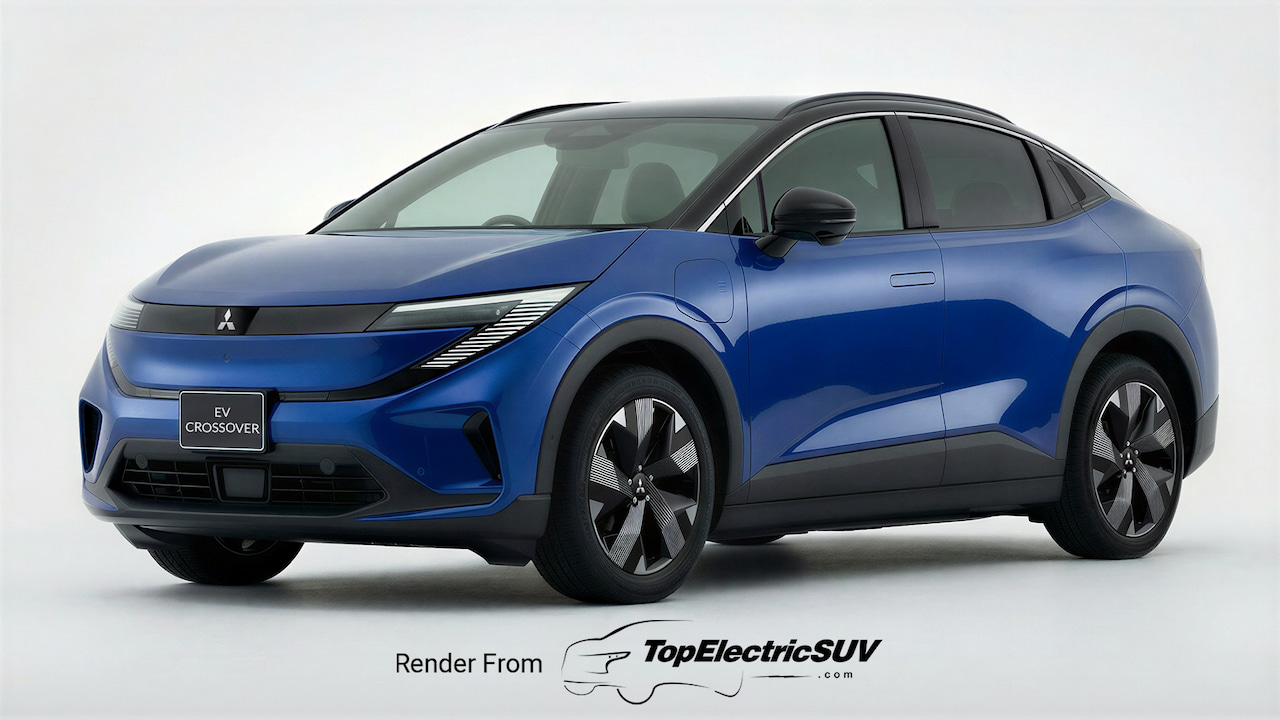
As shown in our exclusive renderings in this story, we expect differentiation at the front with unique details including a sportier bumper. The teaser has confirmed that the 7-shaped DRL will continue on the Mitsubishi product, but we don’t see a light bar that connects both ends.
 Mitsubishi’s official teaser released in October 2025 reveals the same DRL structure as the Nissan Leaf S and SV variants. Image: Mitsubishi
A sharply raked rear window with an integrated spoiler should define the back, complete with Mitsubishi logos and badges.
Interior
The cabin should follow the Leaf’s basic package and layout, which means a roomy two-row interior with seating for five, a flat floor area ahead of the front seats, and a slimmer center console with dashboard-mounted shift controls.
During our time with the new Leaf, we found front-seat ingress easy, with a snug and supportive driver’s seat, good back support, about four inches of headroom, and clear forward and side visibility.
While not as comfortable as the Outlander/Rogue PHEV, rear-seat access was also easier than expected, though the sloping roofline reduces headroom to about three inches, and while knee room felt acceptable, legroom and under-thigh support were limited. We expect a similar experience in the Mitsubishi electric SUV.


Besides color and badge changes, we don’t expect the Mitsubishi SUV’s interior to be any different from the Leaf’s cabin (pictured).
Up to 55.5 cubic feet of cargo space with the rear seats folded, dual 14.3-inch displays, Google built-in, wireless Apple CarPlay and Android Auto, front and rear USB-C ports, a wireless phone charger, and a dimming panoramic roof are the expected features in the top-end variant.
Specifications
The Mitsubishi electric crossover SUV should use a 75 kWh lithium-ion battery pack and a single electric motor producing 214 hp and 261 lb-ft of torque. The setup should deliver up to 303 miles of range (combined), depending on grade.
DC fast charging at up to 150 kW and a 10-80% charge time of 35 minutes should also carry over. The Leaf uses both a J1772 port and a NACS port and supports Plug & Charge and 1,500-watt vehicle-to-load capability.
It is safe to expect these to carry forward to the Mitsubishi electric car, allowing buyers to quickly use the Tesla Supercharging network which has 1,000s of stations in the U.S. and Canada.
Price, Release Date & Competitors
 There’s market speculation that the all-electric subcompact SUV (rendered) could come bearing the ‘Lancer’ or ‘Lancer Sportback’ nameplate.
In calendar-year 2026, MMNA will introduce a refreshed Outlander Plug-in Hybrid in late spring, an all-new electric crossover SUV in late summer, and a rugged, off-road performance variant of the Outlander toward the end of the year.
From MMNA’s fourth quarter 2025 sales bulletin issued on January 5, 2026
On May 6, 2025, MMNA said the Leaf-based EV would be available in the United States and Canada starting in summer 2026. On January 5, 2026, the company referred to it as an “all-new electric crossover SUV” due in late summer 2026.
We expect prices to begin at around USD 30,000, and top out at under USD 40,000 for the fully-equipped trim in the U.S. As for Canada, prices should range between CAD 46,000 and CAD 58,000. It will compete with variants of the 2027 Chevrolet Bolt, Chevrolet Equinox EV, 2027 Kia EV3, and the Subaru Uncharted.
Featured image: TopElectricSUV’s illustration of the Mitsubishi electric SUV for the U.S. and Canada

An automobile engineer by training, I’ve analyzed the global car market since 2005, with a keen focus on EVs since 2008. My journey in online automotive publishing spans 17 years, during which I have reviewed cutting-edge automotive technologies and interviewed leading global CEOs and vehicle developers.