Key Points
Tesla’s automotive revenue declined 10% year over year.
BYD exported over 120,000 vehicles in March alone.
Tesla’s stock has declined more than 20% in 2026.
Tesla (NASDAQ: TSLA) wants to be known for more than just electric cars. BYD (OTC: BYDDY) aims to dominate the global electric vehicle (EV) market. Both companies are industry leaders and globally recognized brands. So which company should investors choose over the next five years?
Tesla’s core EV business is slowing. In 2025, the Elon Musk-run business saw automotive revenue decline 10% year over year. Total deliveries were down 9%. In 2025, BYD dethroned Tesla as the world’s top EV seller.
Will AI create the world’s first trillionaire? Our team just released a report on the one little-known company, called an “Indispensable Monopoly” providing the critical technology Nvidia and Intel both need. Continue »
BYD sold more than 2.25 million electric vehicles worldwide last year. Tesla is fighting back in early 2026, however, and reclaimed the top spot through the first quarter of 2026. The competition between the two is hotter than ever.
Tesla is pivoting into artificial intelligence and autonomous robotaxis. The broadening of Tesla’s mission is compelling, but how this multi-pronged approach plays out for investors is yet to be determined and likely several years away.

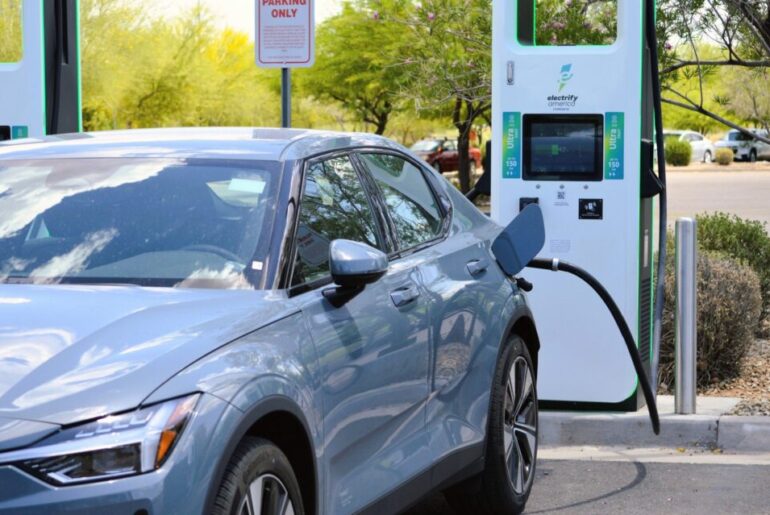
A person is charging their electric vehicle. In the background, there are two EVs, one red and one blue.
Image source: Getty Images.
Tesla’s stock is also expensive. The trillion-dollar company has a trailing price-to-earnings (P/E) ratio of 333 as of April 7. Its price/earnings-to-growth (PEG) ratio is a lofty 4.3. The stock has also fallen 23% in 2026.
BYD’s global growth is impressive, even as the company faces fierce competition at home in China. Where it’s struggling in its home country, BYD makes up for it by expanding into other countries. In March 2026, BYD exported 120,083 cars internationally, a 65% year-over-year increase and 19% more than in February.
BYD’s stock is much more attractively priced than Tesla’s. BYD has a forward P/E ratio of 18 and a PEG of 0.71 as of April 7. These metrics show that BYD is fairly priced or perhaps even undervalued.
For investors with a five-year time horizon, BYD is a less speculative stock than Tesla. Although BYD is struggling to maintain its market share in China, its growth prospects outside of China are most appealing. Tesla’s path forward seems less open than BYD’s, and the stock is arguably overvalued.
For investors who need to choose between Tesla and BYD for the next five years, BYD is the clear winner. After all, its rock-bottom PEG ratio leaves room for strong returns.
Should you buy stock in BYD Company right now?
Before you buy stock in BYD Company, consider this:
The Motley Fool Stock Advisor analyst team just identified what they believe are the 10 best stocks for investors to buy now… and BYD Company wasn’t one of them. The 10 stocks that made the cut could produce monster returns in the coming years.
Consider when Netflix made this list on December 17, 2004… if you invested $1,000 at the time of our recommendation, you’d have $536,003!* Or when Nvidia made this list on April 15, 2005… if you invested $1,000 at the time of our recommendation, you’d have $1,116,248!*
Now, it’s worth noting Stock Advisor’s total average return is 946% — a market-crushing outperformance compared to 190% for the S&P 500. Don’t miss the latest top 10 list, available with Stock Advisor, and join an investing community built by individual investors for individual investors.
*Stock Advisor returns as of April 9, 2026.
Catie Hogan has no position in any of the stocks mentioned. The Motley Fool has positions in and recommends Tesla. The Motley Fool recommends BYD Company. The Motley Fool has a disclosure policy.