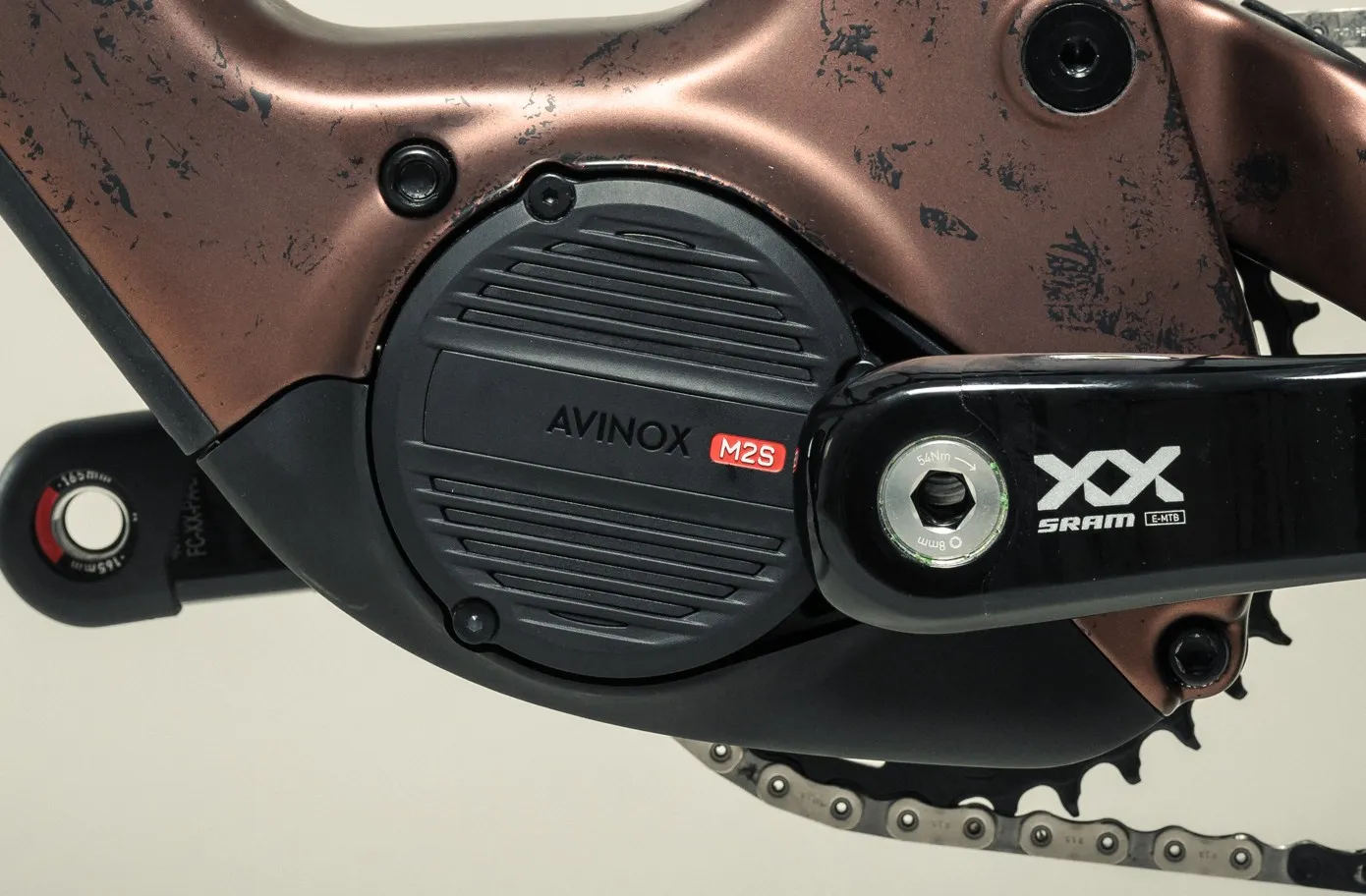
Avinox has again successfully built up plenty of hype around its next-generation e-MTB motors, housed under the M2 banner and today the embargo lifts, meaning we can reveal both the specs and a long list of brand new e-bikes housing the updated drive system.
Though there is much more to electric bike motors than just power and torque, we know that some people are eagerly awaiting a better understanding of what the second-generation motor delivers and, versus the first-gen motor, the difference in M2S spec peak power and torque at the top end in Boost mode is about 50% and 25% more, respectively.
Within both motors, new temperature sensors paired with a new heat-dissipating gearing design apparently reduce the powerful unit’s tendency to get hot. With this improvement comes a small efficiency gain on the prior generations 82%, now up at 84.5% and 83% for the M2S and M2, respectively.
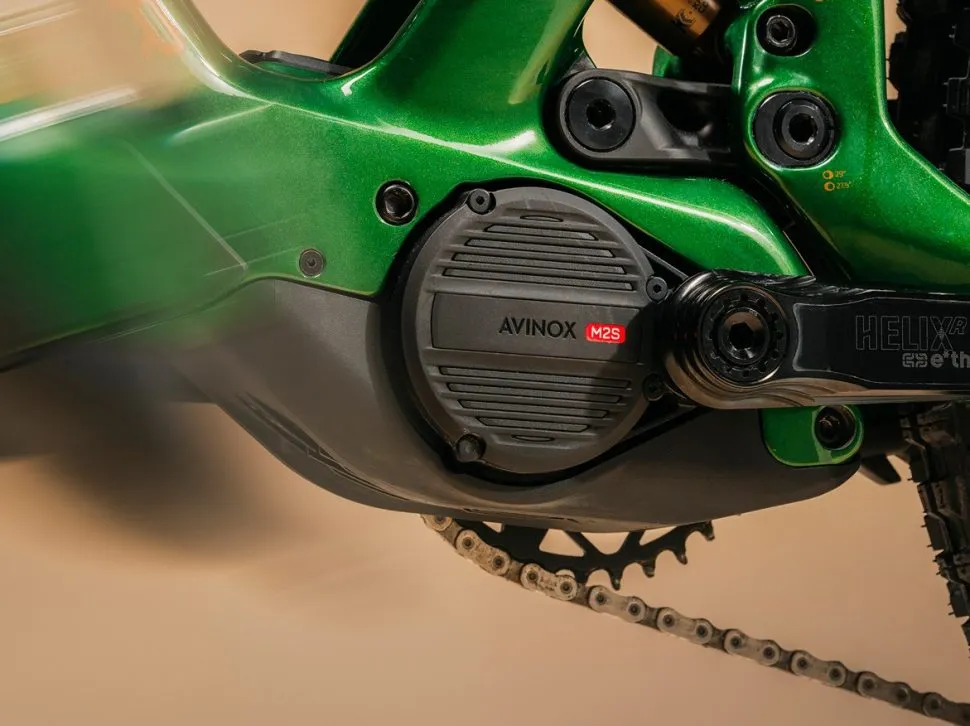
Avinox M2S e-MTB motor
The Avinox M2S drive unit will, at its peak, be capable of an unprecedented 150Nm torque in its boost mode and with a 1,300 peak power output to boot. Many models will unlock even faster charging and, at its base level, the system will pair to an IP56 waterproofing rated 800Wh battery weighing 3.74kg.
So, over the M1 drive that put the cat amongst the pigeons in prior years, the performance metrics have been driven upward from what was a 1,000W and 120Nm Boost mode limit. To be precise, Avinox bike offshoot Amflow says that the power density is improved by 45.9% compared to the M1 Drive Unit, while the torque density increases by 21.6%.
With those headline details out of the way, Avinox has worked on an issue with its first-generation motor where users complained of a rattle, now said to be ‘significantly reduced’ and, with that it has apparently also reduced the pedal resistance and thus improved the efficiency of its power transfer.
Weighing in at 2.6kg, there’s not anything to shout about in terms of weight improvement (it’s actually a touch heavier), but your power-to-weight ratio has certainly shifted north. It now has an insane up to 800% pedal assist ratio, markedly up from the generation one product, which was already a robust hill climber, albeit with great power sometimes came loose terrain wheelspins, so we will be interested to see how this generation manages traction control.
Perhaps most interesting of all is that these motors continue to appear on e-bikes that you might typically expect to cost more money; that’s not to say they come cheap, just prices do appear to be competitive when these systems are specced. An example is the new Whyte Karve EVO RS and RSX builds, which settle between £5,650 and £7,299. Hefty price tags, but we’ve seen worse.
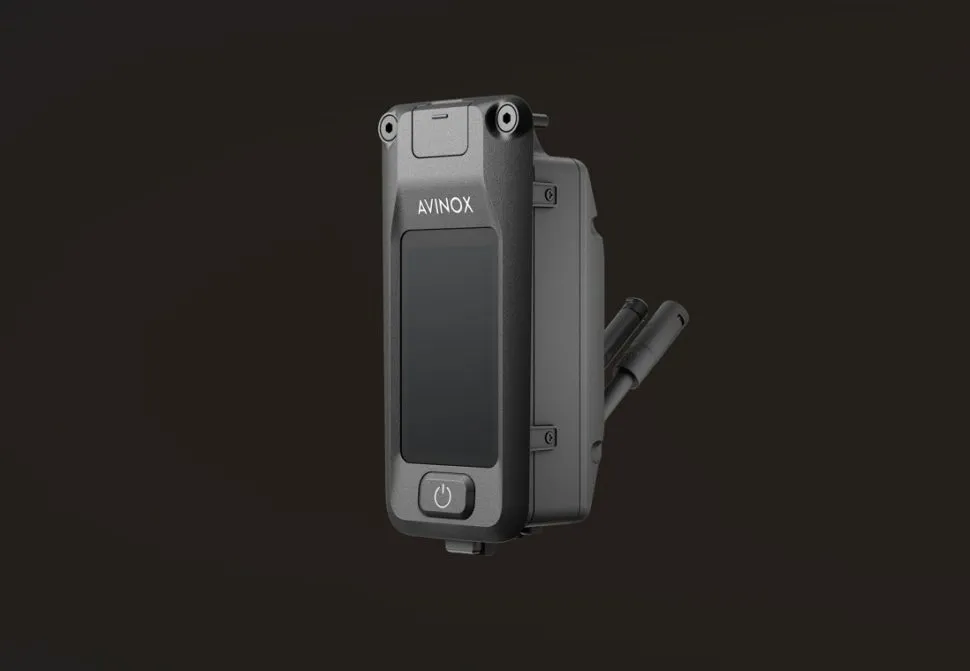
Avinox M2
The secondary edition Avinox M2, more likely to be found on marginally cheaper builds, instead has the topline metrics of a 1,100W peak power and a Boost mode torque of up to 125Nm, though the regular limit is 110Nm.
Again, this is a 2.65kg drive unit with five modes – Eco, Trail, Auto, Turbo and Boost – also paired to a 2″ OLED touchscreen display with 4G/BLE connectivity. The very same 800Wh, 3.74kg battery is supplied.
According to a snippet from an Amflow press spec sheet for its incoming PX and PR e-MTBs, the power density is improved by 4.6% compared to the M1 Drive Unit.
Both motors are said to have achieved a noise reduction and now measure at under 45 decibels. Some gearing gaps have been eliminated through new meshed surfaces, apparently removing a pedal kickback sound previously heard.
Other shared improvements include the replacement of the high-resistance oil seal with a low-resistance sealed bearing. This reduces unassisted riding resistance (drag) by 41% while maintaining the same level of protection.
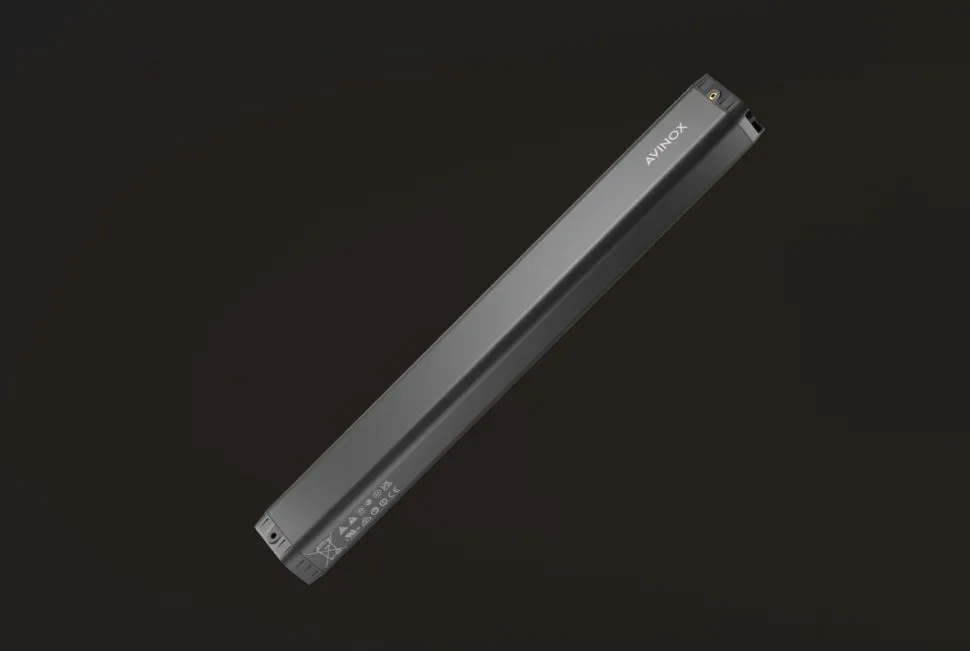
Looking very closely at the battery specs, it does seem that there are actually two versions – a standard and an RS spec – with the latter a little heavier at 4kg and standard weighing 3.74kg. This means that the weight to Wh ratios differ and run at 200Wh/Kg for the RS spec and 214Wh/kg for the standard.
Software highlights
Since its inception, Avinox has been tinkering in the background, steadily updating its software to improve performance and the feature list on the fly. Things like the ability to drop power during gear shifting have been answers to concerns about chain stress, for example.
Among the upgrades on the AVinox M2 series motors the feature list contains, but is not limited to:
Apple Find My integration – users can see the bike’s location, battery status and trigger a buzzer via the app.
Display navigation – Users can now create routes and import from third-party apps like Komoot in a GPX, FIT or TCX format. These will then show on the Control Display. Historic ride records are also accessible this way. Directional guidance can then be offered via the display in real time as you move.
Front light control – You will be able to control the front light via Wireless Controllers or Control Display, including turning it on or off and switching between low and high beam, while viewing the front light status information on the display.
Heart rate control – Riders can set a pre-determined heart rate range to assist with their medical requirements; the output increases from the motor if your heart rate climbs too high and decreases again when your heart rate normalises, encouraging exercise.
Custom assist modes – as ever, you can fine tune your assist modes, inclusive of start assistance, motor overrun and maximum power or torque metrics. Boost can be set to run at 10 to 60 seconds.
To understand more about electric bike motors, check in with our guide to the electric bike motor market, inclusive of Avinox and many of its competitors.