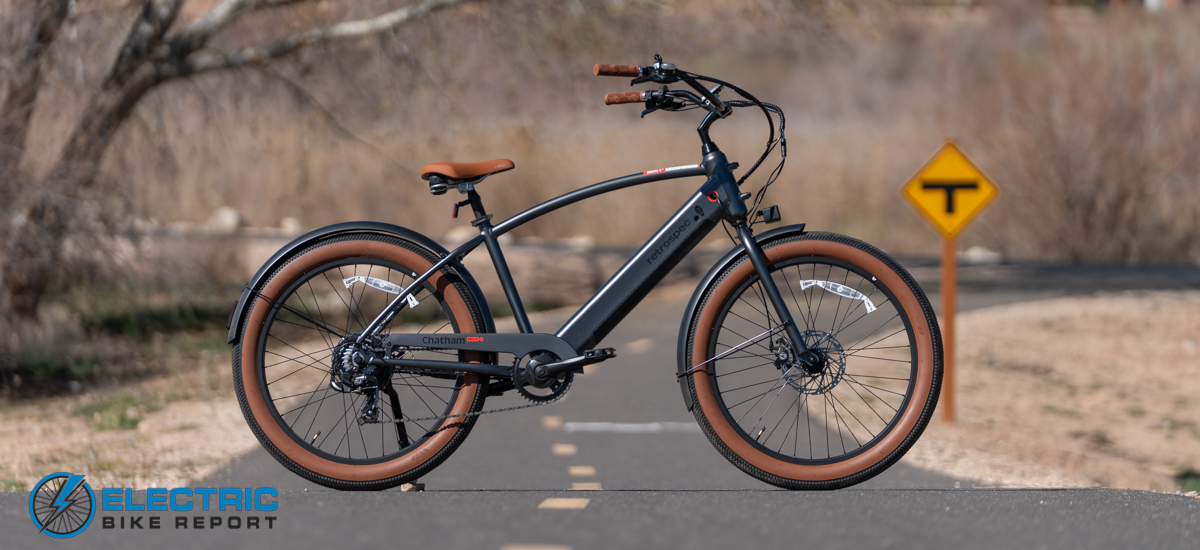
Walking in (or, I suppose, riding) to the Chatham Rev+ 2, I expected the bike to be relaxed, comfortable, stable, and user-friendly. The bike met and exceeded those expectations, though it is not without some room for improvement. Let’s explore the many factors that influence how the bike feels and functions below.
As I mentioned in the introduction to this review, the Chatham is available in both high-step (HS) and step-thru (ST) frame styles. Both have a single size; the ST fits riders from 5’2” to 6’1”, while the HS—the version we tested—accommodates taller riders between 5’7” and 6’4”.
My height of 5’11” places me firmly within the recommended height range for the HS frame, and I found it generally comfortable. I enjoyed the bike’s upright riding position, and while its handlebars felt somewhat low, this is not unexpected or unusual for the cruiser style. Additionally, the wide, swept-back handlebars and textured rubber grips felt ergonomic and easy to hold on to.
The bike offers multiple adjustment points that allow riders to personalize their fit. The saddle height and forward/backward placement can be adjusted via the seatpost and rails, respectively. The quill-style stem can be raised or lowered to alter handlebar height, and the angle of the bars can also be changed.
The Chatham Rev+ 2’s handling was very characteristic of a cruiser. Steering was predictable, though not too sharp or aggressive. The handlebars and hand placement encouraged relaxed maneuvering that complemented the bike’s overall feel and comfort level.
While there are no suspension elements like a fork or seatpost, the bike’s saddle and tires serve as a sufficient substitute. The gel saddle felt supportive and soft without impeding pedaling, and the 26×3” tires ensured a stable ride while adding an appreciated layer of softness and shock absorption (especially considering the bike’s rigid fork).
I noticed that the Chatham’s motor was quick to engage, supplying pedal assist after only a quarter-turn of the cranks. With four power levels to choose from, it could feel gradual, forceful, or something in between; these settings ranged from matching my expectations for a cruiser to being somewhat livelier than I anticipated. The result was a bike that could feel calm or energized depending on how I wanted to ride.
Retrospec equipped the bike with some useful accessories, including integrated lighting, fenders and a chain guard. Commuters looking to carry a storage bag or a paper sack full of groceries can add either a rear rack or front basket, and the company offers a range of other accessories to outfit the bike further.
The bike is generally specced relatively simply and functionally, but considering the Chatham Rev+ 2’s price point of around $1,500, I challenge Retrospec to include a handful of higher-tier components. Hydraulic brakes and an 8-speed drivetrain would add value—especially since these are common among most e-bikes in this price range.
That critique aside, I believe the Chatham’s simplicity will make it approachable for new riders and those who have not been on a bike in years. I enjoyed the straightforward nature of its user interface; the clean color display is operated by a small control pad, its four assist levels are intuitive. All other controls are relatively common among electric and analog bikes, making the Chatham familiar and easy to grasp.
There’s also the matter of the bike’s appearance. Looks are subjective, but we appreciate the classic-meets-contemporary style of both Chatham Rev+ 2 frame styles. The HS model’s three color options match its slightly edgier styling, while the mostly lighter tones of the ST version feel more vibrant and fun.
All in all, the Chatham Rev+ 2 offers great ride quality—especially for those who value comfort, approachability, and simplicity.