Electric vehicles (EVs) continue to grow in popularity globally, including within the RV industry. It’s no surprise that many consumers who spend so much time in nature would be environmentally conscious. In fact, in Go RVing’s 2025 RV Owner Demographic Profile, 78% of young family RVers who responded said that RVing was an environmentally friendly form of travel, and 44% said their decision to purchase an RV was to visit locations with natural beauty.
To get some insight into EV RVs, RV PRO asked some of the biggest names in the industry what they have in store for electric RVs. Here’s what 5 companies had to say.
“Forest River is currently in a prototyping and exploration phase, evaluating multiple EV chassis platforms,” said Royer Allman, vice president – chassis administration, Forest River Inc. “While we previously introduced the all-electric concept RV, the RVEX, we are not yet in full production on an EV platform. Our focus today is exploring viable chassis partnerships and continuing internal development work to prepare for the future of EV RVs.”
“Over the past number of years, we’ve seen the automotive market slowly moving toward electrification and other alternative fuel sources,” said Cory Weatherton, senior director of product development, Jayco Family of Companies. “It does seem as though alternative fuel sources to fossil fuels will become more and more mainstream in the coming years. As a company, it’s our desire to be innovative and remain relevant in regard to consumer demand. We have seen diesel pushers decline in popularity, and also certain states not allowing their residents to buy these products.”
Sam Shapiro, founder and CEO of Grounded, said, “The biggest challenge is that you’re building on platforms that were not designed for this. Electric cargo vans are optimized for last-mile delivery, not living, so we’re working around separated cab compartments, limited rear access and packaging constraints that traditional RV builders don’t have to deal with. Every generation we’ve had to engineer creative solutions around those limitations.”
“Evotrex is resonating with modern, tech-forward adventurers who want to go off-grid without sacrificing comfort, design or reliable power. The core buyer is typically tech-forward families and couples who value independence, performance and access to remote destinations over traditional campground RVing, space for serious adventure gear and the ability to stay self-sufficient while remaining connected and comfortable. At its core, Evotrex is for people who want unlimited range, unlimited destinations and true energy independence,” said Ivan Wang, chief marketing officer at Evotrex.
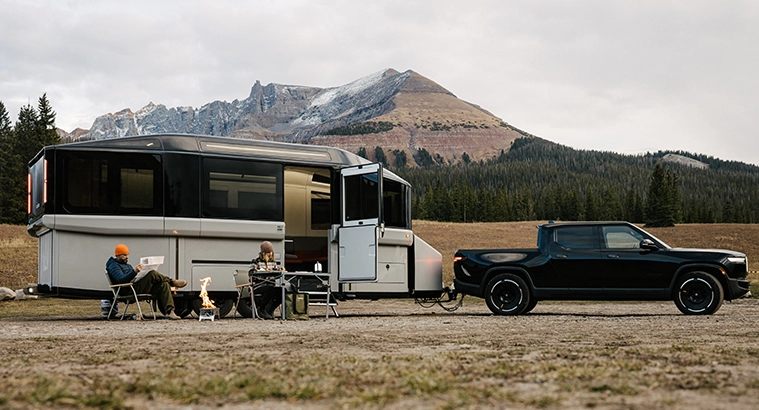
“Towable/travel trailer. Towing is where electrification can have the greatest impact,” said Toby Kraus, co-founder and CEO, Lightship. “Conventional trailers can reduce EV range by 50% or more due to aerodynamic drag and weight. By integrating self-propulsion and aerodynamic optimization, we meaningfully mitigate that range penalty. This approach solves a core industry pain point while preserving flexibility; customers can detach the trailer and use their tow vehicle independently.”
Some of the benefits of an EV RV, Royer Allman of Forest River Inc. explained, include, “Increased ability to operate off-grid, greater self-sufficiency and energy independence, reduced carbon footprint and quieter operation.”
“The end user will be able to charge the RV chassis while at home, at campgrounds or any EV charging station,” said Cory Weatherton, Jayco Family of Companies. “Because of the flexibility of the charging options, weather through the gasoline range extender, or one of the previously mentioned electric options, we believe it will not be difficult for the end user to be able to power the electric chassis.”