Even if you love your job, you’ve probably come across a business idea and thought: That’s for me.
“Marketplace Morning Report” host David Brancaccio has been collecting those moments. And in the lead-up to his final day hosting the program, he’s talking with entrepreneurs behind some of the most envy-inducing business models — in a new series called “Business Envy.”
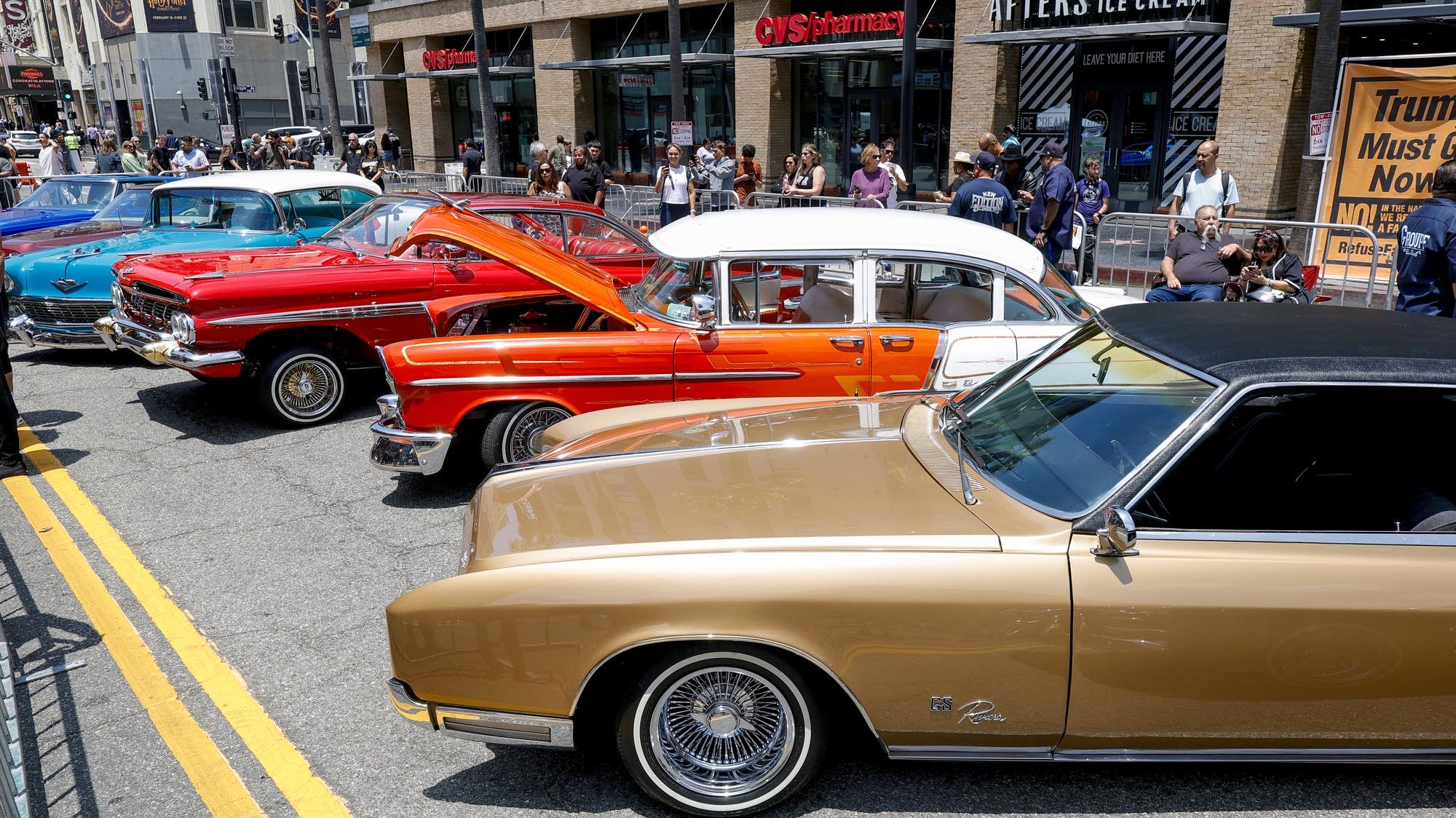
One of them is based in Austin, Texas, where a company is taking classic cars and giving them a modern, electric upgrade. To learn more, Brancaccio spoke with Mark Davis, founder of Moment Motors, where for a price, your vintage ride can go electric. The following is an edited transcript of their conversation.
David Brancaccio: All right, so I got to find a classic car that I love, or maybe owned already. I don’t own a classic car, but I’ll have to find one. I could bring it to you, and you could do what with it?
Mark Davis: You want to start with a classic car that you love, and we take them in, and we strip out their internal combustion engine drive trains and we replace it with a brand new electric drive train.
Brancaccio: And you’re not starting from scratch on the electric motor, right? Is it like a modular system that could be used in different cars?
Davis: We’re a small company, so we’re not inventing our own motors or our own battery cells or anything like that. What we’re doing is we’re piecing together automotive technology from the most modern suppliers we can work with, and we are creating a drive train that fits into these classic cars. And as we’re approaching these different vehicles, you know, everyone is different, and so we have to have a modular solution that we can adapt to each one of those different platforms.
Brancaccio: Right, now, this statistic I’m mentioning for a reason, the average cost of private four year college per year in America is $45,000. OK, so to do this, if I bring you a classic car, is it two years, three years, four years worth of college, it would cost?
Davis: That’s funny that you would use that metric, as I am paying for one of those kids right now.
Brancaccio: Oh, I see.
Davis: Yeah, we kind of say on our website it’s anywhere from $75,000 to $175,000, a lot of it depends on the size of the vehicle, the power requirements and and the condition of the vehicle, and so it does vary. But yeah, it is expensive. You do this because you want the end result. You want this amazing experience of flying down the highway silently with so much modern electric torque and power, but still be sitting in a 1960s Mercedes, or, you know, any car that you dream of.
Brancaccio: I have a list of five that I’d like you to do for me. Let me bounce each of them off of you to see if one would be better than another. I don’t own any of them, but you know, you gotta dream.
Davis: Exactly.
Brancaccio: Okay, numero uno for me is Roger Moore’s car from “The Saint.” I would go with a 19 — in my case, 1969 Volvo P1800. Is that too small to do?
Davis: No, absolutely. We’ve had lots of inquiries about the P1800s. They’re really interesting cars. We haven’t done one, but they’re absolutely convertible.
Brancaccio: All right. Now, my mom, if she were still with us, would ask you to convert a 1972 Mercedes SL, two-seater convertible. That would work, right?
Davis: Big enough. You know, there is a lot of heartache about what we do from some aficionados who are concerned that we’re taking the soul out of the car by taking the gas engine out of it. And I can guarantee you that if you went back into the ‘60s and found some Mercedes engineers and said, “Hey, we’ve got this amazing electric power plant, you know, 370 foot-pounds of torque and 300 horsepower, do you want to use it?” Every single one of them would have raised their hand and said, “absolutely,” and put it in those cars.
Brancaccio: Some of it’s about preservation, right?
Davis: People do this for a variety of different reasons, but it is fundamentally about preservation. These cars, you know, if they are not taken care of, end up in people’s garages and then barns and then sitting rotting away. This allows them to be driven and experienced, you know, anytime and anywhere. And I think that that’s part of preservation.
Related Topics