Support CleanTechnica’s work through a Substack subscription or on Stripe.
VinFast sold 3,520 electric vehicles in a single day in Vietnam — an operational benchmark that matters less for its volume than for what it reveals. This was not a sales spike. It was a systems test. Production, logistics, and delivery aligned at scale, without visible friction. For a relatively young automaker, that is the real milestone.
One might say: “but that’s home turf, so sales can be expected.”
However, Dr. Lê Hoàng Nam, a transportation planning expert in Vietnam, notes that there is more to it. He said that VinFast’s continued record-breaking performance is expected, alongside its proven product quality, as more Vietnamese consumers prioritize electric vehicles as their primary choice.
“When the entire ecosystem, from products to charging infrastructure and service workshops, is systematically developed as VinFast is doing, consumers will feel more confident about making the switch to electric vehicles. The green transition
not only benefits individual households and users, but also helps accelerate transport electrification, reduce emissions, and importantly lessen dependence on fossil fuels,” the expert explained.
Le is right. V-Green, VinFast’s global charging infrastructure partner, has 150,000 charging ports across Vietnam’s. Before the year ends, it will deploy a total of 99 ultrafast charging hubs equipped with 150 kW chargers, further strengthening its charging network advantage. At the same time, the VF service network will add more than 400 service workshops, ensuring a seamless and well supported ownership experience for customers.
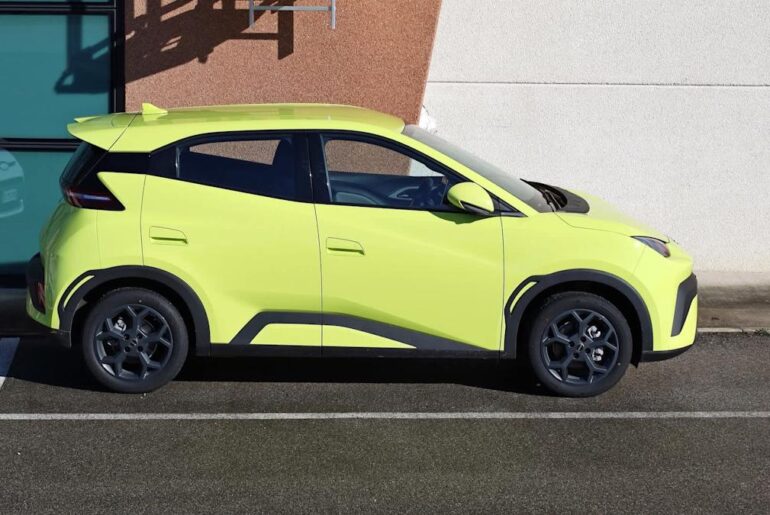
The company delivered a mix of its VF 3 and VF 5 models, compressing what would typically be spread across weeks into a single 24-hour window. That kind of throughput suggests something more important than demand: coordination. Many EV startups can build cars. Fewer can move them efficiently, in bulk, and on schedule. VinFast is signaling that it may be crossing that threshold.
This matters because the company is no longer operating as a regional experiment. It is preparing to export that execution speed into two of the most complex automotive markets in the world — India and Indonesia. For this op-ed, let’s focus on India first.
Speed as strategy, not byproduct
VinFast’s next move is not subtle. In Thoothukudi, Tamil Nadu, the company has broken ground on an integrated EV manufacturing facility backed by an initial $500 million investment. The planned capacity — up to 150,000 vehicles annually — positions the site not just as a domestic plant, but as a regional export hub for right-hand-drive markets.
On paper, this follows a familiar playbook: local production to avoid import duties, proximity to a large consumer base, and alignment with government incentives. But VinFast’s differentiator is not location — it is tempo.
The 3,000-unit delivery day in Vietnam is a preview of how the company intends to operate: high volume, tightly coordinated, and fast. The question is whether that tempo can survive outside its home market.
India is not an easy next step
India’s appeal is obvious. It is the third-largest automotive market globally, with strong policy support for electrification through programs such as the FAME (Faster Adoption and Manufacturing of (Hybrid &) Electric Vehicles) incentives. But it is also one of the most price-sensitive and operationally complex markets in the world.
Domestic players like Tata Motors and Mahindra have already adapted to these constraints, compressing costs and tailoring vehicles to local conditions. Margins are thin. Infrastructure is uneven. Consumer expectations vary sharply across regions.
VinFast is entering this environment not as a low-cost disruptor, but as a fast-moving outsider with a premium-leaning portfolio. That creates immediate tension.
Local manufacturing will help the company sidestep punitive import tariffs, but it does not solve the deeper challenge: aligning product, pricing, and after-sales support with a market that has little tolerance for missteps. Speed, in this context, is both an advantage and a risk.
Building for conditions, not just markets
The company has indicated that it is adapting its vehicles for Indian conditions — heat, road quality, and usage patterns. This is not optional. It is foundational.
At the same time, VinFast is building out a dealership and service network ahead of its first product launch. This sequencing is deliberate. Delivering vehicles at scale is only one part of the equation; maintaining them in a fragmented and infrastructure-constrained environment is another.
If the Vietnam delivery milestone proved anything, it is that VinFast can synchronize internal systems. India will test whether it can extend that synchronization outward — to suppliers, dealers, regulators, and customers.
Execution over innovation
The broader implication is strategic. The EV race is often framed around battery chemistry, software, or autonomous capabilities. VinFast is making a different bet: that execution speed — getting vehicles built, moved, and delivered efficiently — can be just as decisive.
This is not a trivial shift. Legacy automakers often struggle with speed due to organizational inertia. Startups, meanwhile, struggle with consistency at scale. VinFast is attempting to position itself between those extremes: fast, but increasingly coordinated.
The 3,000-car delivery day is not proof of dominance. It is proof of capability. Replicating that capability in Vietnam is one thing; sustaining it in India is another.
A test of scalability
If VinFast can translate even a portion of its domestic execution into the Indian market, it will not just gain share — it will force competitors to respond. Speed compresses reaction time. It reshapes pricing dynamics. It exposes inefficiencies.
But if that speed collides with the realities of India — cost pressures, infrastructure gaps, regulatory complexity — it could just as quickly become a liability.
VinFast is not trying to out-innovate the EV leaders. It is trying to outpace them. The transition from Hanoi’s controlled delivery surge to India’s unpredictable scale will determine whether that strategy holds.
Sign up for CleanTechnica’s Weekly Substack for Zach and Scott’s in-depth analyses and high level summaries, sign up for our daily newsletter, and follow us on Google News!
Advertisement
Have a tip for CleanTechnica? Want to advertise? Want to suggest a guest for our CleanTech Talk podcast? Contact us here.
Sign up for our daily newsletter for 15 new cleantech stories a day. Or sign up for our weekly one on top stories of the week if daily is too frequent.
CleanTechnica uses affiliate links. See our policy here.
CleanTechnica’s Comment Policy