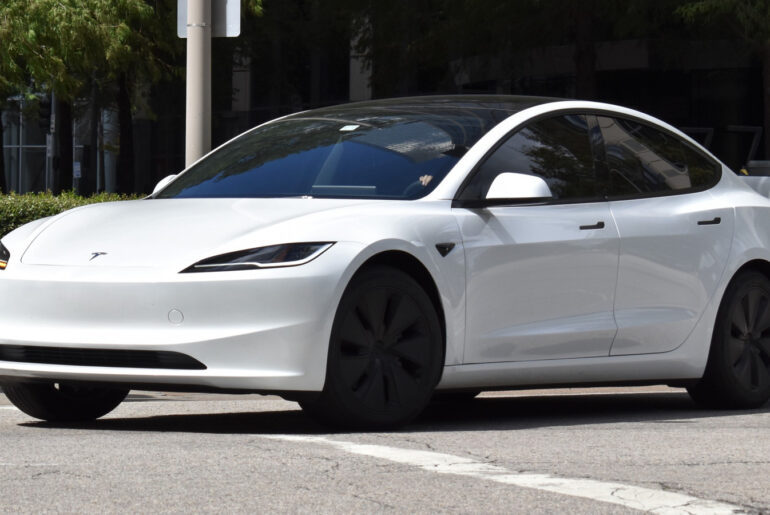
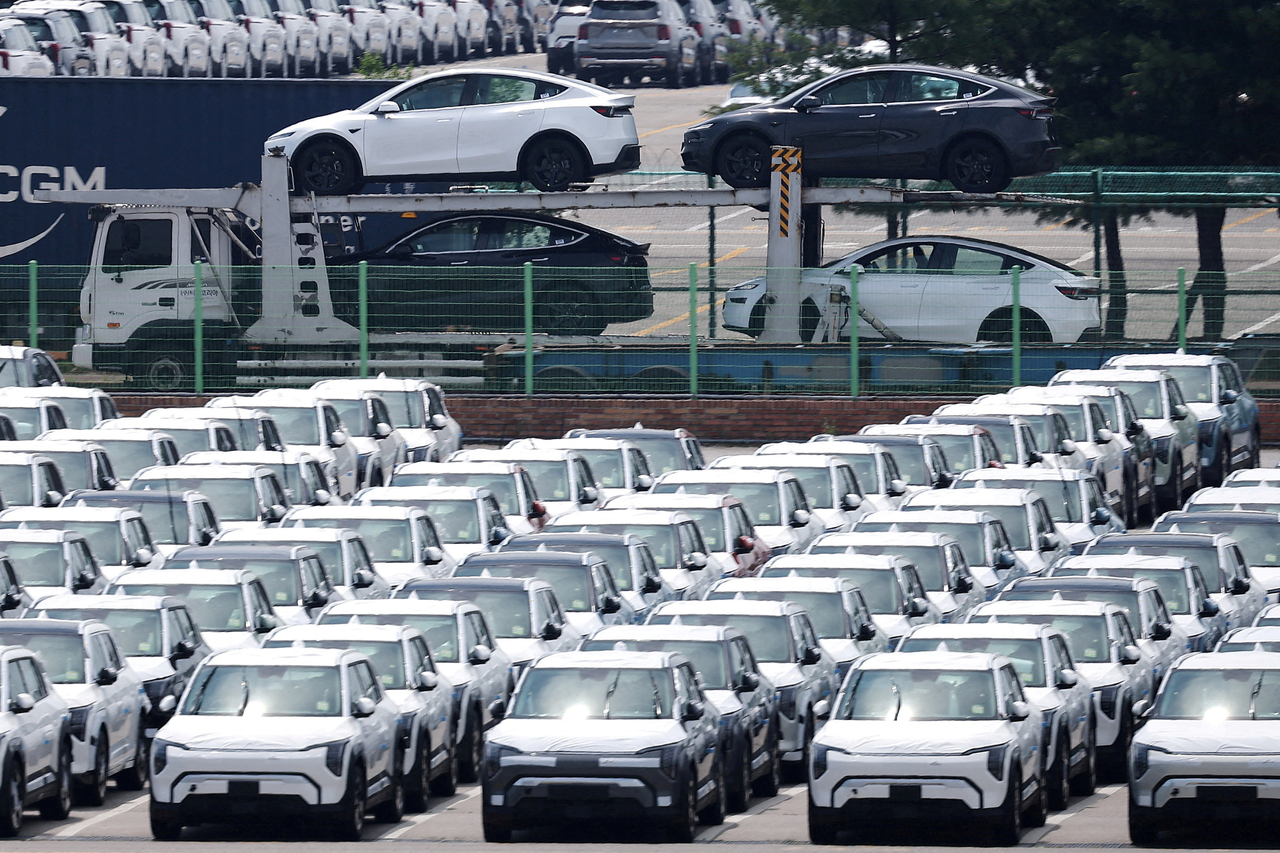
 A car carrier transporting Tesla vehicles passes by Kia cars parked at a port in Pyeongtaek, Gyeonggi Province. (Yonhap)
Tesla ranked No. 1 in Korea’s imported car market in the first quarter, marking its first time taking the quarterly top spot.
According to the Korea Automobile Importers and Distributors Association on Sunday, Tesla sold 20,964 vehicles in the January–March period, up 335.1 percent from a year earlier.
The result signals a shift in a market long dominated by BMW, Mercedes-Benz, Audi and Volkswagen. Tesla was followed by BMW with 19,368 units and Mercedes-Benz with 15,862 units, forming a new three-way competition at the top.
A significant gap remains between the leading trio and the rest, including BYD, Volvo Cars and Audi.
Tesla’s surge was driven by stronger demand for electric vehicles, supported by the early rollout of government subsidies. Unlike previous years, when subsidies were typically confirmed around March, this year’s program was finalized in January, boosting early-year purchases.
Rising oil prices amid geopolitical tensions also added momentum, accelerating the shift toward EVs. In March, national EV sales reached 16,249 units, accounting for 47.8 percent of imported car sales and surpassing hybrids at 14,585 units, or 42.9 percent, for the first time.
However, questions remain over the sustainability of Tesla’s momentum.
The company’s global deliveries fell 14 percent quarter-on-quarter to 358,000 units in the first quarter, missing market expectations of 365,000 units.
Tesla’s strong Korean sales have also been linked to aggressive pricing, including conditional discounts applied to first-quarter deliveries, possibly aimed at clearing inventory of China-made Model Y vehicles.
jwjeon7625@heraldcorp.com