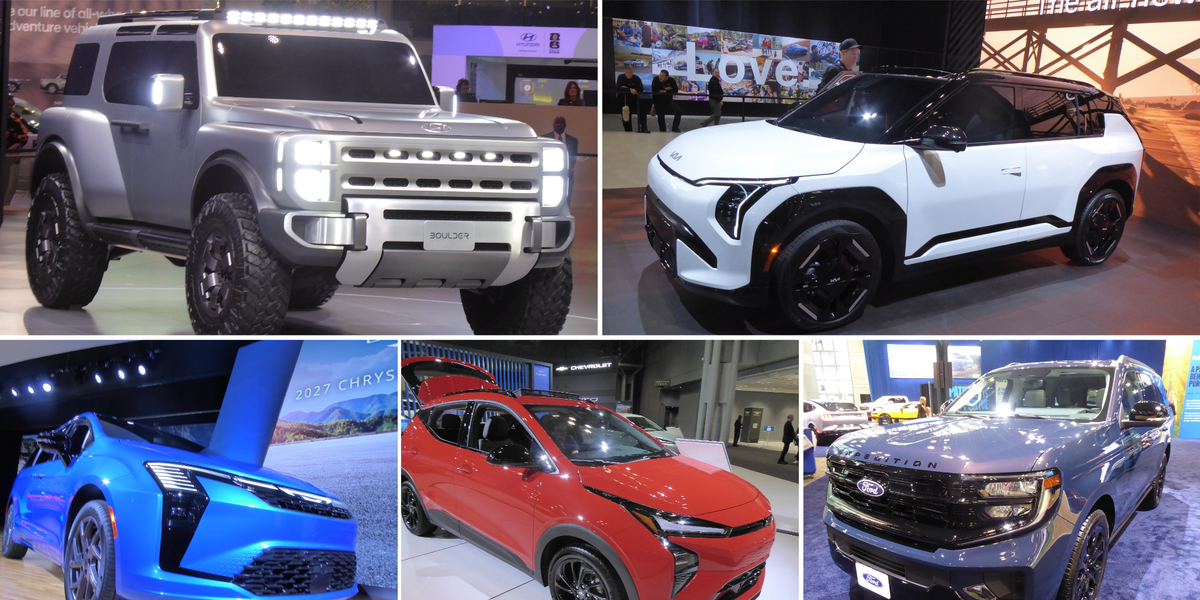
It was not a big year for model introductions at the New York International Auto Show, with automakers trying desperately to align their product lineups with consumer taste that keeps getting see-sawed by public events. Will the Straits of Hormuz blockaded and gasoline rising over $4 a gallon, will the renewed interest in EVs prove lasting? It hasn’t in the past.
Still, what’s new on the stands was a combination of EVs, hybrids (which are surging in popularity) and some badge-engineered special editions celebrating such milestones as the 250th birthday of America.
Related Story
Kia and Hyundai had the most going on. Kia’s Eric Watson, vice president of sales operations, touted six straight years of growth in North America. “We had the best January and February in our history, and March is shaping up well,” he said. “Hybrids are up 70 percent year over year.”
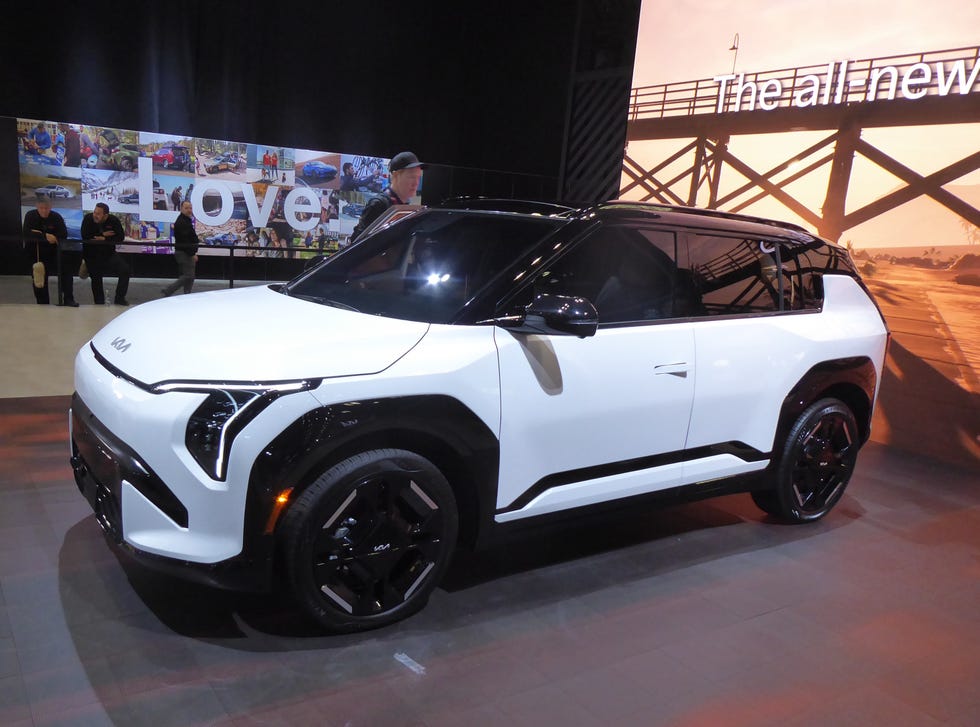
The new “EV for everyone” is the compact and distinctly blocky EV3 (basically, a scaled-down EV9), going on sale later this year in the U.S. but already doing well abroad. According to Russell Wager, vice president of marketing, the EV3, with a 400-volt architecture, will have a choice of three powertrains and either 220 or 320 miles of range. The starting price will be between $30,000 and $35,000—addressing the paucity of affordable EVs on the market now.
 Jim Motavalli
Kia’s affordable EV3.
All-wheel drive is available, as is up to 288 horsepower in the U.S.-exclusive GT model, and the two battery options are 58.3 and 81.4 kilowatt-hours. The charging time of 10 to 80 percent in 31 minutes seems slower than others on the market now. The EV3 can be equipped for bi-directional charging, and you can use your phone as the key. There’s 16.2 cubic feet of storage behind the second row, and a small frunk.
The 2027 EV3 has five USB ports and a near-30-inch display. What’s not to like? “It’s easy to live with,” Wager said. Cars like this makes you wonder why Chevrolet brought back the Bolt for only 18 months. The 2027 model was sitting forlornly in a corner of the company’s stand.
Related Story
Also new for 2027 and going on sale in the second quarter is a second-generation subcompact Kia Seltos that Kurt Kahl of Kia’s North American design studio said will be “stronger, with a more planted stance, and a more capable and premium feel.” The squared-off steering wheel won’t be to everyone’s tastes.
Two and a half inches were added to the wheelbase, which increases rear legroom, and as the rugged looks suggest it’s designed to go off road with 8.1 inches of ground clearance. For more frequent supermarket trips, there’s up to 64 cubic feet of storage with the rear row folded.
The Seltos will be available with a two-liter four, a turbocharged 1.6-liter turbo four, and a forthcoming hybrid (in the fourth quarter) that also uses a turbo four paired with a six-speed dual-clutch automatic. The Seltos should also be affordable, starting under $30,000 for the base model.
Options include a panoramic sunroof, a premium stereo, and a Relaxation Seat (in the up-market X-Line) that like a La-Z-Boy pops out a platform for your legs.
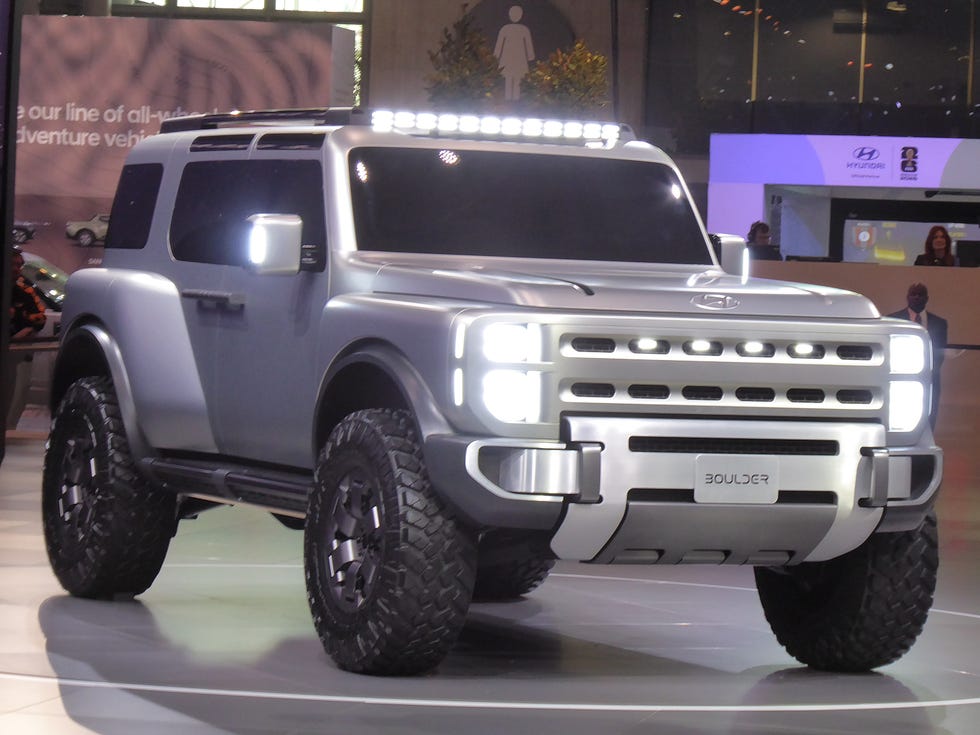
 Jim Motavalli
Hyundai Boulder Concept.
Hyundai leapt from its global sales triumphs to its new body-on-frame technology that appeared in the metal as the Boulder Concept—chasing the Bronco. The concept was designed in California for the American market, and it’s likely Hyundai will produce something along its lines. “It’s an accessory-ready platform,” said Randy Parker, president and COO of Hyundai North America. The available doo-dads presumably included the row of lights mounted above the windshield that made the Boulder look badass. “No two Boulders will be the same,” Parker said.
Subaru has two new models, introduced by Yoichi Hori, chairman and CEO of Subaru of America. The big gun is the Getaway, a three-row electric SUV on the Toyota Highlander EV platform to compete with the Hyundai Ioniq 9, the Kia EV9, the Lucid Gravity (winner of the World Luxury Car award this year), the Volvo EX90 and the Cadillac Vistiq.
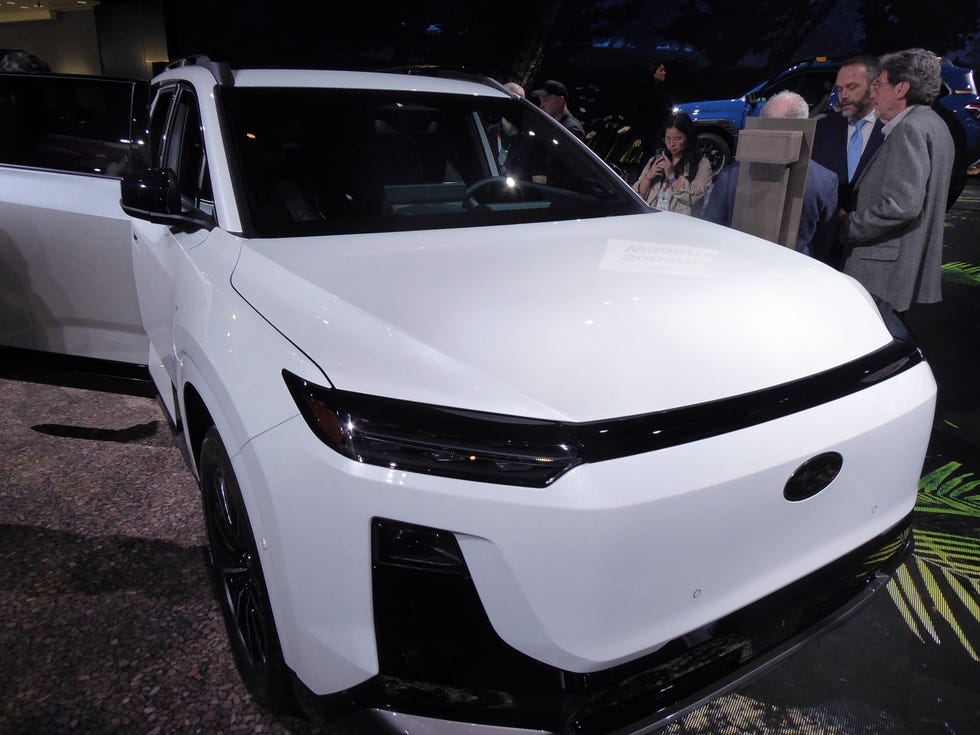
 Jim Motavalli
Subaru’s Getaway is a three-row electric SUV based on the Toyota Highlander EV platform.
The mid-sized Getaway has up to 300 miles of range from the standard 96-kilowatt-hour battery. There’s 420 horsepower on tap from a dual-motor AWD powertrain, permitting five-second zero-to-60 times. Oddly, the base model is called Premium, succeeded by Limited and Touring. Photos show it getting down and dirty in the mud—it has 8.3 inches of ground clearance.
Prices should start around $50,000 for the Getaway, which will arrive in late 2026. Subaru was late to the EV game, but it now has four of them available. Subaru said the Getaway will be built in the U.S. with an American-sourced battery pack.
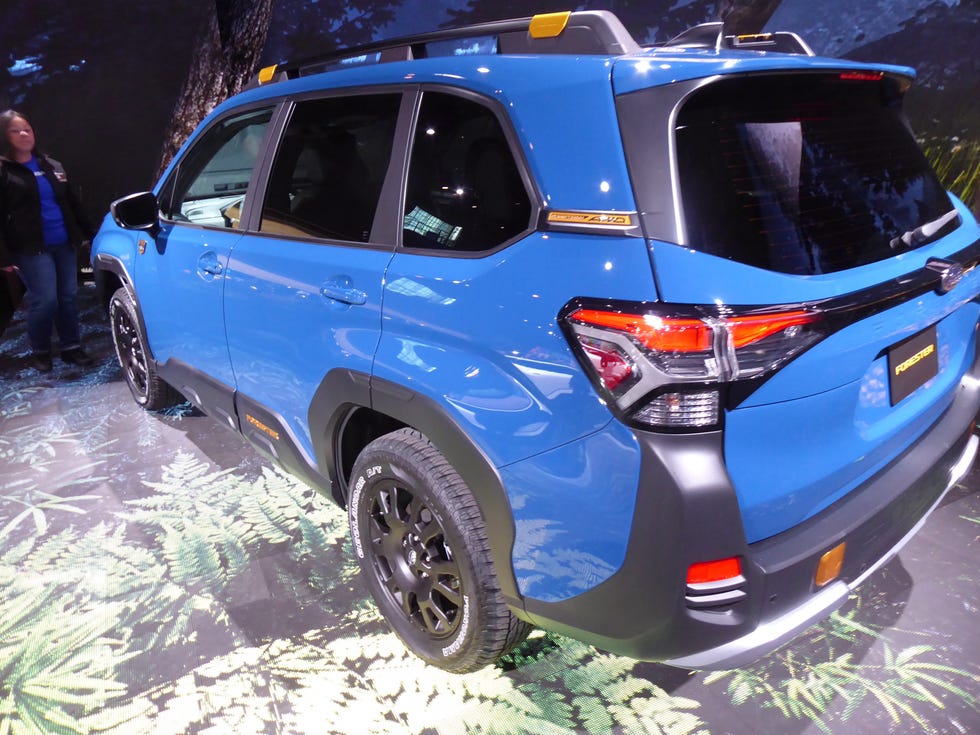
 Jim Motavalli
Subaru added hybrid power to the Forester Wilderness.
The other new Subaru is a hybrid version of the Forester Wilderness, promising 25 percent better fuel economy (maybe 32 mpg) and 194 combined horsepower. People don’t usually think of hybrids going off road—“Let’s take the Prius!”—but this one is headed there, with an impressive 9.3 inches of clearance. The hybrid comes loaded with big blacked-out 17-inch wheels, a Harmon Kardon stereo, and a power liftgate.
VW brought out the 2027 Atlas, which continues a trend evident in New York of existing models going bigger, more powerful and more premium (cue the Kia Seltos). With car prices averaging $50,000, and gas expensive, this might not be the best strategy. Still, VW said it was offering more power in the two-liter turbo, but increasing fuel efficiency.
Related Story
VW of America President and CEO Kjell Gruner touted “more of what matters: a stronger design, smarter technology, increased power, and a premium feel where it matters most.” Expect pricing to start around $40,000.
Ford and Stellantis went small(ish), and the latter wrapped themselves in the flag as America veers towards its 250th birthday. The Dodge Durango America 250 comes with red, white and blue stitching and an American flag, evoking “apple pie, 2X4s and V-8s,” said Matt McAlear, chief executive officer at both Dodge and Chrysler. He acknowledged that Chrysler is “a minivan brand for now,” but tried to inject some excitement into the new 2027 Pacifica with kid “influencers.” Limited and Pinnacle models were shown, with the model’s pricing starting at $41,495 (for the LX).
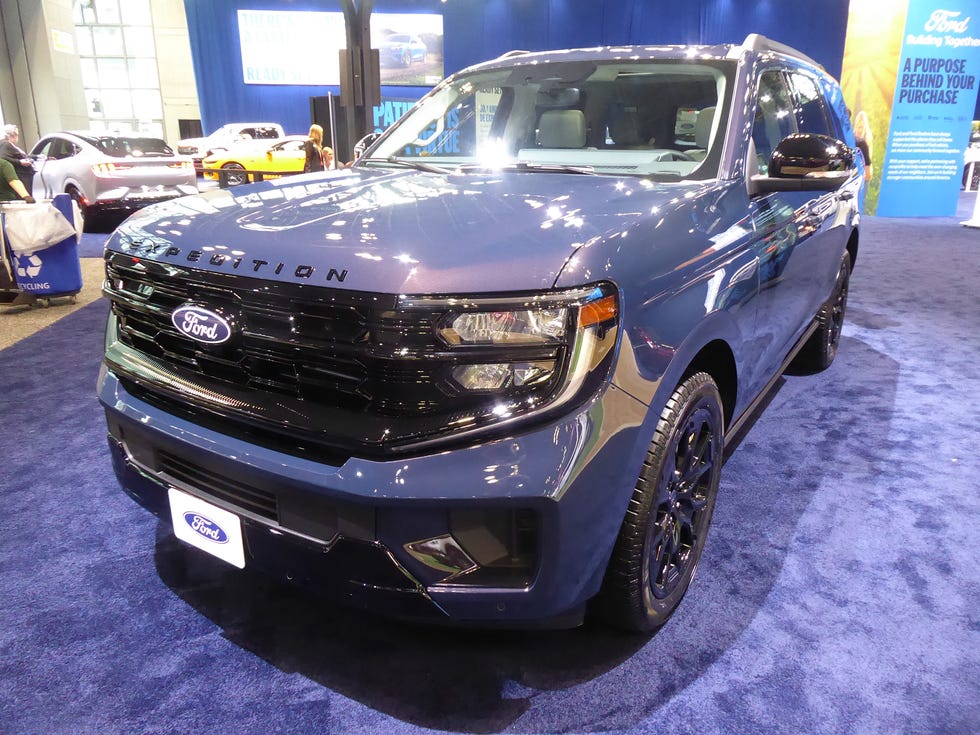
 Jim Motavalli
The Expedition celebrating 30 years.
Ford was crowing about selling 2.2 million cars and trucks to Americans in 2025, something no other domestic automaker did. Ford spokesman Mike Levine, a longtime truck guy, also had anniversaries on the mind, and presented an Expedition celebrating 30 years of the model. A new collaboration with OnX will give off-roaders access to trail maps, and the first year is free for owners of 2017 and newer vehicles. Ford’s stand also included the Bronco RT done up as a search-and-rescue vehicle, and its hit Maverick small truck—available as a hybrid.

Jim Motavalli is an auto writer and author (nine books) who contributes to Autoweek and Barron’s Mansion Global. He has written two books on electric cars, Forward Drive (2000) and High Voltage (2010), and hosts the Plugging In podcast.
Motavalli’s writing has appeared in the New York Times, CBS Moneywatch, Car Talk at NPR, Forbes, US News and World Report, Sierra Magazine, Audubon, and many more. In his spare time, he reviews books and jazz.