The growth of EVs at all levels has accelerated in recent years to reduce CO2 emissions, and while passenger cars are a core piece of this, electrifying heavy-duty vehicles stands to hugely reduce emissions.
However, the needs of electric trucks that carry freight over long distances is different to passenger EVs, as the drivers are often on strict timelines that doesn’t allow for long charging periods when the battery is on a low state of charge (SOC).
That’s where the megawatt charging system (MCS) can make a difference. MCS is a relatively new, high-power system that has been specifically designed to deliver rapid charging capabilities for trucks, and other large EVs such as buses, much faster than Combined Charging Systems (CCS). While there is interest in switching to electric trucks, their presence in Europe is going to be more common in the coming years, regardless of logistic fleet owner’s thoughts on EV vs ICE (internal combustion engine).
The EU has legislated that manufacturers need to cut CO2 emissions by 45% by 2030 to avoid heavy fines, so meeting these targets is going to hinge on electrifying long-haul logistics. Therefore, megawatt charging systems are going to be critical for ensuring a smooth transition towards electrified trucking operations.
What is a megawatt charging system?
MCS chargers are a new international standard that contain 7 pins and will be rated for a maximum charging rate up 3.75MW, 3000A and 1250 volts direct current (VDC). The MCS charging standard was first developed by CharIn in 2018 and has been developed over the years to improve battery electric vehicles (BEVs) that have large battery packs and can accept a charge rate above 1MW.
MCS is going to be critical for electronic trucking because most trucks using an MCS charger will be able to go from a 20% SOC to 80% SOC in 30-40 minutes. For trucks, this is about 10 times the speed of using CCS chargers. While there is going to be some variation, it’s a much more practical solution for electrifying trucking operations as this charging stop could add up to an extra four and half hours driving. This is the maximum amount of time that drivers are allowed to drive in one go under EU law before needing a break. So, the charging time, and charge added, line up almost perfectly for European trucking operations, allowing electrification to become possible without disrupting trucking schedules.
The MCS stations being developed today are for Class 6-8 commercial trucks and plan to deliver between 1MW and 1.68MW of power, depending on the specific MCS installation. MCS are also being integrated with robust communications to reduce failed charging events, as too much downtime in this type of charging station would have a significant impact on the ability for trucks to meet their deadlines. The high amperage of these chargers means that they require liquid-cooled cables and connectors to work without causing safety issues.
To make MCS chargers ubiquitous across regions and manufacturers, CharIN published IEC TS 63379 in February 2026 to establish global interoperability standards. This standard ensures that MCS chargers contain a standardised pin and contact design alongside specific safety requirements, interlocks, thermal management systems and temperature monitoring capabilities. The standard also ensures that any charger that is designed and manufactured is mechanically and electrically robust for extreme operating conditions, i.e. up to 1500VDC and 3000A.
How MCS differs from CCS charging for electric trucks
CCS charging stations are well established in public places for cars, but they are not suited to trucks that need a quick recharge. This is because the battery packs in electric trucks are significantly larger than EV batteries, so they take a lot longer to charge with CCS stations.
CCS charging stations typically deliver between 50-400kW of DC power, and the majority of commercial charging stations provide 200-920VDC (although they could theoretically go higher). This is considered rapid charging for cars, but for trucks, MCS being developed today will deliver between 1-1.6MW of power, with the potential to increase to 3.75MW in the future. MCS chargers will deliver up to 1250 VDC and will support a total operating range of 400-1250VDC, which will support a wider range of vehicles. Overall, MCS chargers will deliver at least 6 times the current and 10 times the power of CCS chargers, leading to much faster charging times.
Because they are much more powerful, MCS needs a distinct connector that differs from the CCS connector, but many of the latest truck models being developed today are equipped with both connectors. This means that CCS charging will still be useful for overnight charging of fleets when time isn’t a critical factor compared to when a truck is mid-journey.
The fact electric trucks are being fitted with both suggests that MCS chargers are not going to replace CCS chargers in public settings, as both will be available to trucks depending on charging needs and cost. Public charging stations will likely have a mixture of MCS and CCS chargers in the coming years. However, MCS chargers will enable many more logistics companies to go electric, as slower charging limitations have been a technical barrier for long-distance haulage companies.
MCS charging infrastructure rollout: Europe and US deployment status
While not yet as popular as CCS charging stations, there is currently a large MCS charging infrastructure rollout happening where 1MW+ charging stations are being deployed across both Europe and the US. There are also many companies developing and installing these electric truck charging solutions, and 2026 is set to be the year of MCS.
In Europe, Iberdrola is launching its first 1MW MCS chargers in Murcia, Spain, while BP Pulse plans to install its first 1MW charger at its new Ashford International Truckstop in 2026, with the capacity to install up to 20 of these MCS chargers. There has also been a lot of projects in the Nordics via Kempower. This includes the first MW charging stations in Norrköpingin, Järna, Vädermotet in Sweden, Odense (Denmark), and at the depots of ASKO in Norway.
One of the biggest MCS charging infrastructure rollouts in Europe has come from Milence via the Mobility Infrastructure for Logistics – Electric & Sustainable (MILES) project to fund 284 MCS charging stations across 71 locations. The rollout will be completed by 2027 and will cover 10 EU member states: Austria, Belgium, Denmark, France, Germany, Italy, Netherlands, Poland Spain, and Sweden.
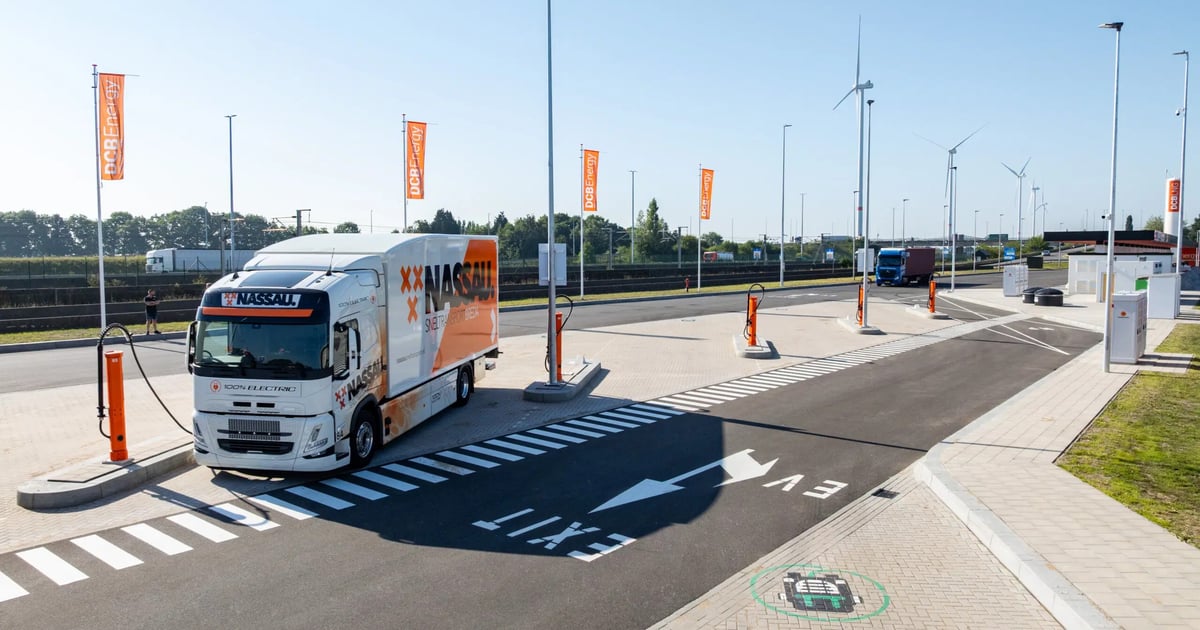
Milence has already opened its first public MCS charger in the Port of Antwerp-Bruges, and each MCS charger has a charging capacity of 1440 kw. There are currently 2 installed, providing 2.8MW charging capacity alongside 4MW CCS.
Milence is also involved with many automotive companies that are manufacturing electric trucks, including Daimler Truck and Volvo Group, and is actively working to create Europe’s first MCS charging corridors along the Trans-European Transport Network (TEN-T). Scania, Volvo FH Aero Electric, and the Daimler eActros 600 trucks are all being developed with MCS charging capabilities to operate along these corridors, with Volvo stating it will take 40 minutes to charge from 20 to 80% SOC, while Daimler have stated it will only take their trucks 30 minutes.
There is also a significant MCS charging infrastructure rollout happening across the US. Kempower is involved in US infrastructure rollout, set to deliver over 1.2MW of charging capacity to EV Realty’s truck fleet hub in San Bernardino, California. The power unit will be connected to two Kempower Mega Satellite MCS charging dispensers.
Tesla is also rapidly increasing its MCS charging infrastructure across the US to charge up its Tesla Semi trucks. Tesla recently added 64 locations across the US, bringing the total to 66 in the major freight corridors from the West Coast to the East Coast. Texas has the most planned sites at 19, with California close behind with 17.
The two that are currently operational with Tesla’s 1.2MW MCS charging stations are in Sparks, Nevada, and Carson, California. The planned sites suggest that Tesla is targeting the busiest freight corridors in the US (I-5 and I-10), as well as the I-95 and I-75 in the East and the I-65 and I-94 corridors around Chicago. Tesla has said that the chargers can add 60% of charge (300 miles of range) to a Semi truck in 30 minutes.
Leading megawatt charging system providers: Kempower, ABB, Tesla, and more
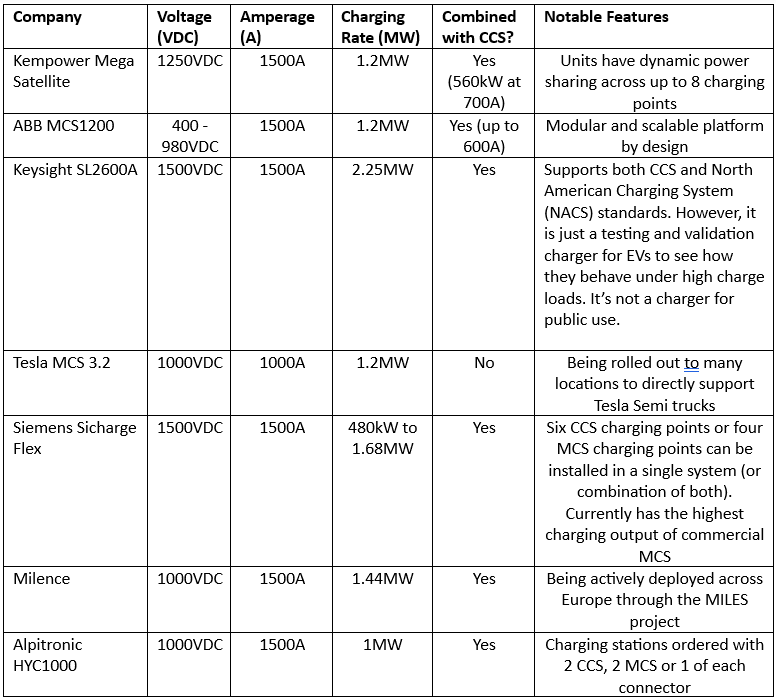
For a large MCS charging infrastructure rollout to happen, there needs to be a lot of charging units available for installation. A number of companies are actively involved with creating MCS charging infrastructure. Companies such as ABB, Kempower and Tesla have all developed megawatt charging systems, and while more geared towards cars instead of trucks, BYD has also developed their own megawatt charging system called “flash charging”.
The following table compares the main MCS charging units being developed by companies today:
While it is not been designed for charging trucks, BYD’s MCS flash charging is also noteworthy. Designed to rapidly charge EV cars in less than 10 minutes, it’s a technology that will complement trucking infrastructure along major transit routes in the future. The BYD system is not directly comparable to trucking MCS because the batteries of EV cars are much smaller, but it delivers a 1.5 MW charging rate, 1000V and 1500A. This translates to a 10-70% SOC charging rate of 5 minutes, a 10-97% SOC charging rate of 9 minutes, and 10-97% SOC charging rate of 12 minutes at -30 °C for BYD’s second generation blade batteries.
The future of electric truck charging solutions
The shift to using electric trucks has been slow because the batteries don’t have the range to cover the full distance of long-haul logistics. While a tank of fuel doesn’t either, it has been much easier for trucks to fill up fuel using conventional fuelling infrastructure than it would be to charge the EV battery due to slow charging rates.
But that’s about to change, and MCS will open electric trucks to more long-haul logistics operations, especially in Europe, as the charging can be done during mandatory breaks and will provide enough charge to last until the next mandatory break—meaning that trucks will not need to alter their schedules.
There will be a big shift in Europe, not only because it lines up logistically with the breaks and existing schedules, but also because the European Union is aiming for around 400-600,000 electric trucks to be on the road by 2030. It’s not necessarily a matter of if, but when, and MCS charging infrastructure will not only speed up adoption, but it will also help to make the transition smoother.