 For the first time in the 21-year history of the World Car Awards, every trophy in every category went to a battery-electric vehicle. The sweep — announced Wednesday at the New York International Auto Show before a crowd of journalists and automakers — offered a vivid illustration of how completely the industry has shifted in just a few years.
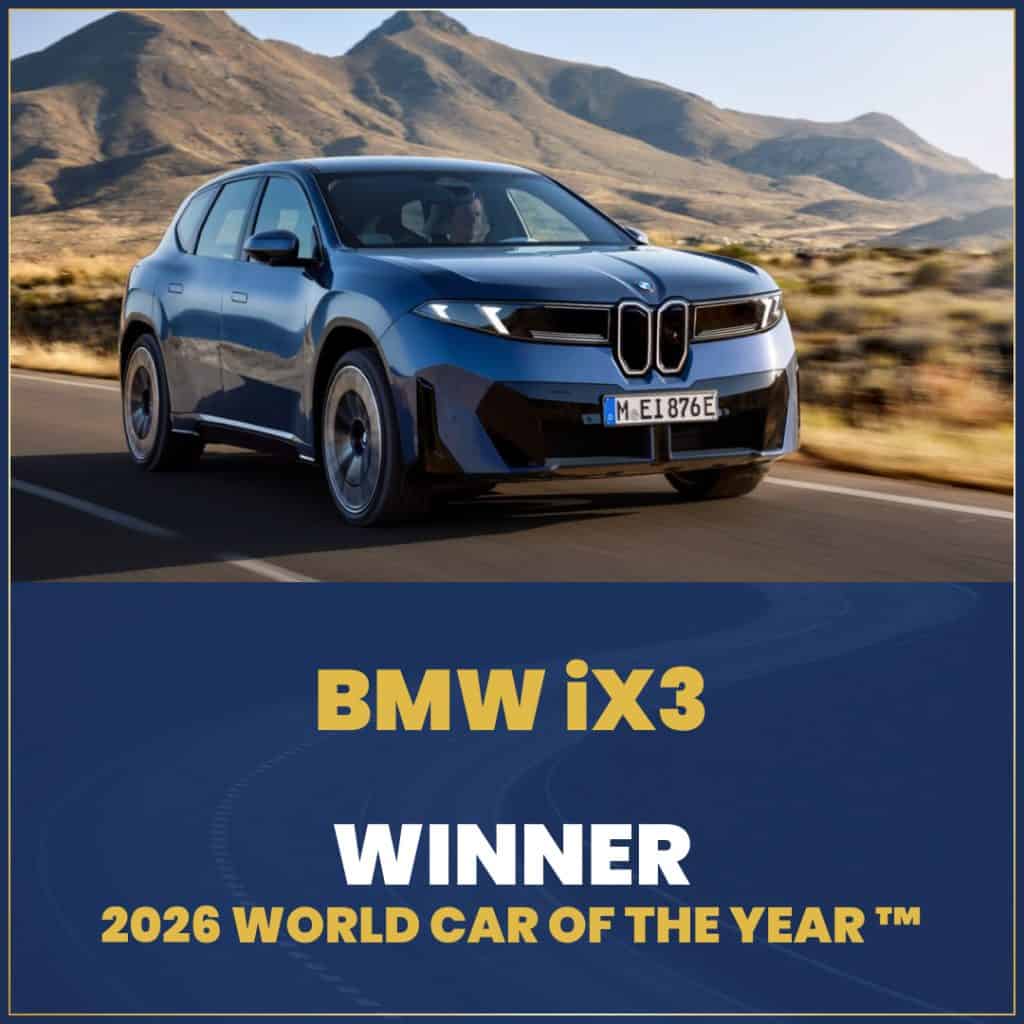
Leading the honors was the BMW iX3, which claimed both the overall World Car of the Year title and the World Electric Vehicle award — a double victory earned by besting 57 contenders and judged by 98 automotive journalists from 33 countries. It was BMW’s first win in the top category since the 3 Series took the prize 20 years ago.
“The BMW iX3 marks the beginning of a new era at BMW — in terms of design language, range, charging capacity as well as driver assistance,” said Mike Reichelt, the automaker’s head of the Neue Klasse program, collecting the trophies in New York. “Above all, the BMW iX3 represents the next generation of Sheer Driving Pleasure.”
The wins bring BMW’s cumulative World Car Awards tally to 11 — tying Audi as the program’s most decorated manufacturer. The last gasoline-powered car to win the top prize was the Kia Telluride in 2020.
BMW iX3: A New Platform Makes Its Debut
The iX3 is the inaugural production model from BMW’s Neue Klasse architecture — a ground-up reinvention of the company’s electric vehicle engineering that the automaker has been developing for years. The platform made its public debut at the IAA Mobility show in Munich in September 2025, and the iX3 has quickly piled up accolades: Car of the Year recognition in several markets, Germany’s Golden Steering Wheel award for best innovation, and now the world’s most globally watched automotive prize.
Technically, the vehicle impresses with an EPA-estimated range of approximately 400 miles, peak charging capacity of 400 kilowatts — one of the highest available on any passenger vehicle — and an energy consumption rating of between 15.1 and 17.9 kWh per 100 kilometers under WLTP standards. The interior is defined by the new BMW Panoramic iDrive system, which projects a wide-field display across the lower portion of the windshield from A-pillar to A-pillar, complementing a 17.9-inch center touchscreen built on BMW’s new Operating System X.
The iX3 had secured 50,000 customer orders within months of its debut, suggesting that whatever elegance the jury recognized is resonating with buyers as well. The finalists it beat in the overall category were the Hyundai Palisade and the all-new Nissan Leaf; in the electric vehicle category, it edged out the Mercedes-Benz CLA and the Nissan Leaf.
BMW CEO Oliver Zipse was also named the 2026 World Car Person of the Year — an honor announced earlier in the year that recognizes a leader’s contribution to automotive progress.
Lucid Gravity: California Luxury Goes 2-for-2
The Lucid Gravity SUV claimed the World Luxury Car title, marking the second consecutive win in that category for the Newark, Calif.-based automaker — whose Air sedan took the same award in 2023. The win is a meaningful validation for a company that has struggled financially even as its vehicles have drawn critical praise.
“This recognition reflects the strength of Lucid’s product vision and the exceptional execution of our team,” said Marc Winterhoff, Lucid’s interim chief executive. “Lucid Gravity brings together the space and versatility of a full-size SUV with sports-car-like driving dynamics and a refined luxury experience.”
The Gravity is no mere badge-engineered product. Built on a platform Lucid developed from scratch as a sporty SUV, it features dual motors producing up to 828 horsepower in its top configuration, standard adjustable air suspension, and available rear-axle steering. Its EPA-estimated range of up to 450 miles leads the large luxury SUV segment, and its DC fast-charging can add 200 miles of range in under 11 minutes — a figure that would be notable in any segment. The SUV seats up to seven adults with usable space across all three rows, a combination Lucid describes as full-size utility in a midsize footprint.
Lucid beat out two established luxury rivals: the Cadillac Vistiq and the Volvo ES90. The Gravity is on display at the New York Auto Show through April 12.
Hyundai Ioniq 6 N: High Performance, Consecutive Years
Hyundai claimed its fifth consecutive World Car Awards recognition, this time through the Ioniq 6 N performance sedan. The win extends the Korean automaker’s remarkable run: the Ioniq 5 and Ioniq 6 swept triple honors in 2022 and 2023 respectively, and the Ioniq 5 N won the performance crown in 2025.
The Ioniq 6 N builds on the aerodynamic Ioniq 6 platform — best known for its low 0.21 drag coefficient — and adds a dual-motor powertrain producing 601 horsepower in standard form and 641 horsepower with the N Grin Boost feature engaged. Zero to 60 comes in 3.2 seconds. For drivers who feel that battery-electric performance lacks analog engagement, Hyundai added N e-Shift, a software system that simulates geared transmission behavior, and N Active Sound+, which pipes synthesized engine sounds into the cabin.
“This award belongs to them and to the team that earned it,” said José Muñoz, Hyundai’s president and chief executive, of the thousands of engineers involved in the car’s development. Hyundai’s 84 kWh battery can charge from 10 to 80 percent in approximately 18 minutes on a 350-kW charger, and features like N Torque Distribution and N Drift Optimizer give track-focused drivers granular control over vehicle dynamics.
The finalists the Ioniq 6 N defeated were the BMW M2 CS and the Chevrolet Corvette E-Ray — an unusually diverse group that reflects the broadening definition of world-class performance.
In an ironic footnote, Hyundai simultaneously confirmed it is discontinuing the standard Ioniq 6 sedan in the United States for 2026 due to lagging sales and tariff pressures — leaving the high-performance N as the only version of the model available to American buyers.
Firefly: China’s Compact EV Goes Global
The World Urban Car award — reserved for vehicles no longer than 4.25 meters — went to the Firefly, the debut model from a new sub-brand launched by Chinese premium automaker Nio. In a category that requires affordability, urban practicality and smart design, the Firefly beat the Baojun Yep Plus and the Hyundai Venue.
At 4,003 millimeters in length, the Firefly is a compact package with surprising substance. Its 42.1 kWh lithium iron phosphate battery delivers a WLTP-rated range of 330 kilometers (about 205 miles), and the vehicle charges from 10 to 80 percent in approximately 29 minutes on a 100-kW DC charger. A rear-mounted 143-horsepower motor sends the car to 60 mph in 8.1 seconds — brisk for a city car. The Firefly also supports Nio’s battery-swap technology, allowing customers to exchange a depleted pack for a fully charged one in roughly three minutes at compatible stations.
The Firefly brand carries Nio’s engineering DNA in a more accessible package, with a 128-TOPS Horizon Robotics processor enabling supervised highway driving assistance and automated parking, a 14-speaker Dolby 7.1 surround system, and 256-color ambient lighting. Its structure uses 83.4 percent high-strength steel and aluminum, earning five-star ratings in both C-NCAP and Euro-NCAP testing.
The car is already on sale in China — where it recently celebrated its 50,000th delivery — and in several European markets, with a UK launch expected later in 2026. The win arrives at an interesting moment for Chinese EVs in the West, where EU tariffs and ongoing trade tensions have complicated expansion plans. Still, the Firefly’s recognition underscores how quickly Chinese automakers have moved from technology copiers to global design and engineering leaders.
Mazda 6e / EZ-6: A Partnership Pays Off in Design
The World Car Design of the Year award went to the Mazda 6e — sold in China as the EZ-6 — a midsize electric sedan co-developed by Mazda and Changan Automobile through their joint venture. It is the third time Mazda has won the design trophy, the first coming to a Japanese-Chinese collaborative product.
The win arrives at a pivotal moment for Mazda, a brand historically known for its Kodo design language and Jinba-ittai driver-focused engineering philosophy. Facing the financial realities of independent electrification, Mazda has leaned into a partnership strategy: the 6e shares a platform with the Deepal L07 from Changan’s EV subsidiary, but both companies’ engineering teams contributed to the result, with Mazda’s European and Hiroshima-based designers heavily shaping the exterior.
The car’s proportions are traditional — low, wide, rear-wheel-drive sedan — with sculptured door panels, a fastback roofline, and LED graphics that recall Mazda’s best work. Inside, a 14.6-inch touchscreen and augmented reality head-up display reflect its Chinese technology origins, while premium materials and a panoramic roof aim for the brand’s established quality standard. Powertrain options range from a 68.8 to 80 kWh battery, with rear-wheel drive and a range of up to 345 miles in European specification.
The 6e beat the Kia PV5 and the Volvo ES90 for the design crown. It is on sale in China as the EZ-6, in Europe and a growing number of global markets — though it has not been confirmed for North America.
The all-electric sweep at the 2026 World Car Awards — particularly the first-ever clean sweep of all six categories by battery-electric vehicles — is unlikely to be read as a fluke by any automaker still hedging on electrification.
One in four new vehicles sold globally is now electric, according to World Car Awards board member Carlos Sandoval, who noted that American consumers are somewhat out of step with global demand trends, in part because Congress phased out EV tax credits last year. The awards jury, however, draws from 33 countries, and its verdict was unambiguous: wherever in the world the best new cars are being made, they are running on electrons.