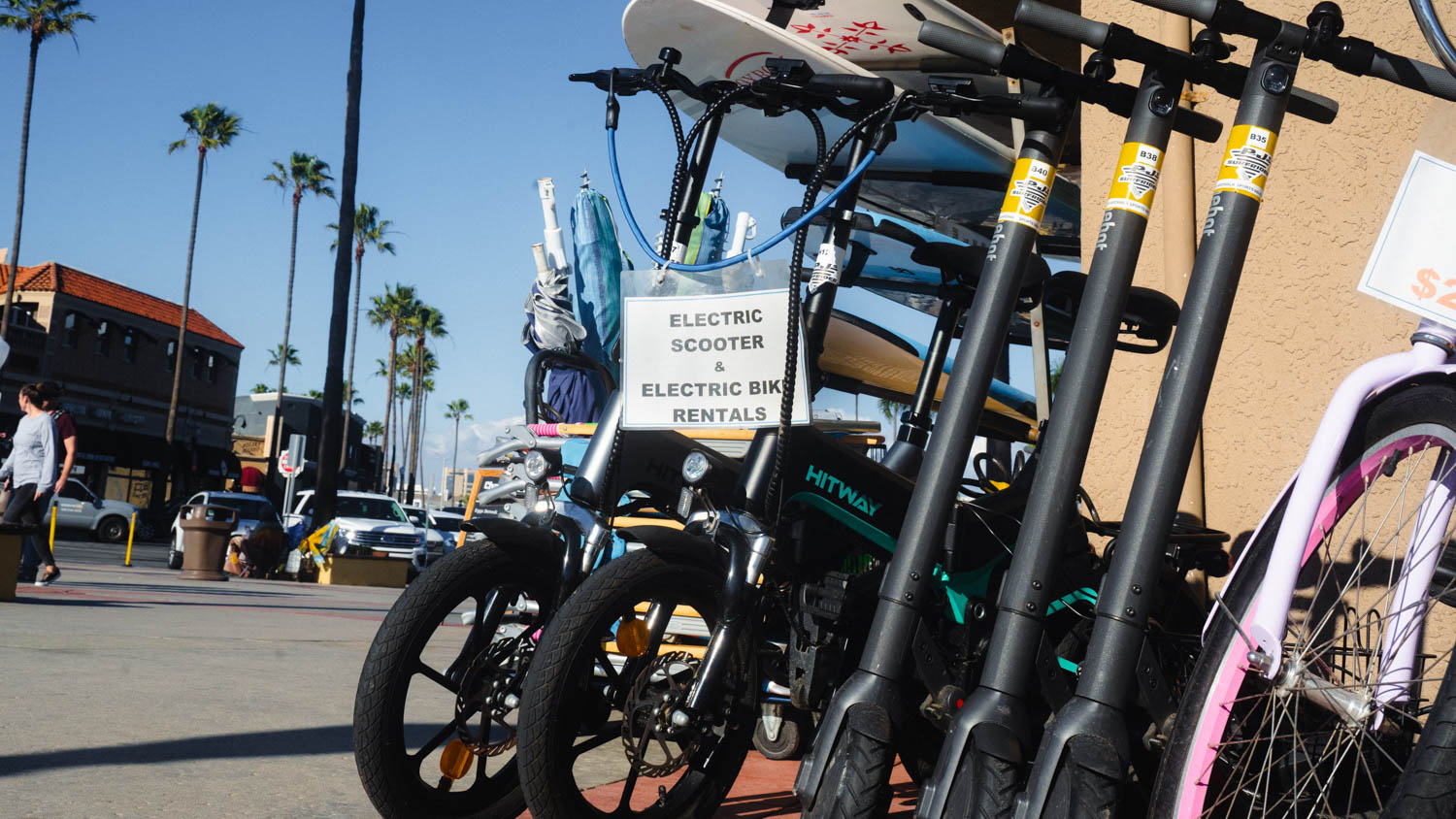
A host of middle and elementary school students in South Orange County could soon be barred from riding e-bikes to school.
It comes as Newport-Mesa Unified School District board members are revising a proposal to ban electric bicycles for elementary and middle school students after parents voiced concerns about how their children will get to school.
The proposed policy would ban e-bikes for students from kindergarten to eighth grade and add additional restrictions for high school students’ usage of e-bikes.
Additionally, the proposal would prohibit students in second grade and younger from riding any bicycle to school. Children from third grade to eighth grade would be banned from riding e-bikes but may ride conventional bicycles after completing a bike-safety training program and receiving consent from a parent or guardian.
High school students would be permitted to ride class 1 e-bikes to school with parental consent, but class 3 e-bikes, motorized vehicles and e-scooters would be prohibited. Parents or guardians would be required to sign a liability waiver for any bike riding for children in third grade to twelfth grade.

Editors’ Note: This dispatch is part of the Voice of OC Collegiate News Service, working with student journalists to cover public policy issues across Orange County. If you would like to submit your own student media project related to Orange County civics or if you have any response to this work, contact admin@voiceofoc.org.
E-bikes are most commonly divided into three classes.
Class 1 e-bikes are pedal operated with an electric boost. Class 2 e-bikes have a throttle and a maximum motor-assisted speed of 20 mph.
Class 3 e-bikes are pedal operated, have a maximum motor-assisted speed of 28 mph and require a driver’s license under state law.
On Oct. 21 of last year, potential e-bike regulations were brought up during a school board meeting. However, it wasn’t until March 10 that a policy was up for vote.
During that meeting, board members decided to make some changes to the proposed ban, so there was not a formal vote taken.
The new proposed policy will now be split into two policies: one for traditional pedal bikes and one for motorized transportation including both e-bikes and e-scooters.
The new proposed policies are expected to have different regulations based on grade levels. Board members are expected to discuss and vote on those proposed changes during their next meeting on April 21.
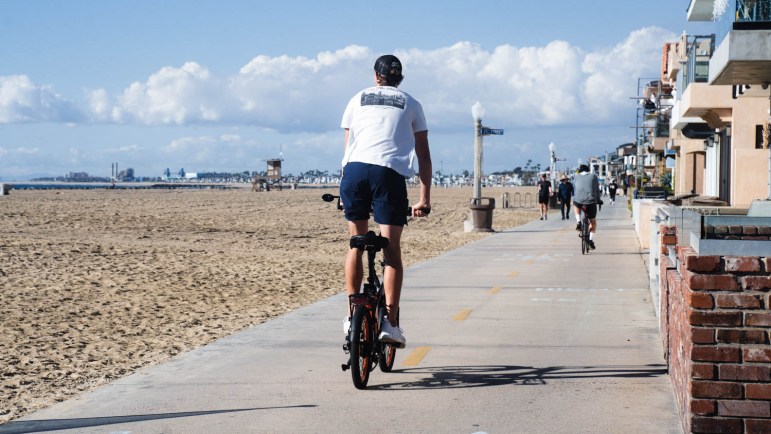 A man rides an electric bike on the Newport Beach Pier in Newport Beach, Calif. on Dec. 7, 2022. Credit: AMIR GHANI, Voice of OC
The district follows Newport Beach’s new municipal code regarding e-bikes.
As of January 2026, according to the city website, residents must now follow the new regulations or violations will consequently result in citations, fines and e-bike confiscation.
[Read: More Orange County Cities Grapple With E-bike Regulations, Youth Safety]
It comes after leaders in Huntington Beach passed stricter rules for unsafe e-bike riding, including community education and diversion programs. The coastal city is also using fines, impoundment and potentially charging parents with child endangerment under state law to deter unsafe e-bike riding.
That type of approach could become a model as cities like Garden Grove also look to crack down on e-bikes.
[Read: Is Huntington Beach’s E-Bike Program a Model for Orange County?]
Many parents within the Newport-Mesa Unified School District spoke out against the policy proposal, arguing the need for bikes as transportation and criticizing age restrictions and other regulations that don’t differentiate between bicycles and motorized e-bikes.
“Stop penalizing these kids that are just commuting to school on these slower e-bikes,” resident Chris Johnston said at the meeting on March 10. “It’s just a simple commuting tool. I think that these bikes build community, there’s camaraderie.”
Johnston said his two daughters attend Kaiser Elementary.
“I think that it is a fantastic opportunity that we have to help our children understand these safe bike lanes that we have in our city and the ways in which we can teach them to navigate roads,” he said. “Please reconsider this ban.”
Many parents voiced frustration with the proposed policy due to it grouping all grades — kindergarten to twelfth grade — together, as well as grouping together pedal bikes and e-bikes.
“The restrictions on kindergarten to second grade, the discouragement of biking for the middle schoolers and elementary, the failure to even address the problem products, which are the e-motorcycles,” said David Martinez, a resident who works in bike policies in Sacramento. “This is bad and doesn’t address the actual problems.”
“Ban the e-motorcycles, the motorized cycles,” he continued. “These are the more powerful devices that can go above 28 miles per hour, that can go above 750 watts. These are the devices we must target, we shouldn’t be targeting the electric bicycles for high school students.”
Board members went back and forth with editing the current policy, ultimately deciding to hold another hearing with representatives from the police department to change definitions and get rid of its broader language.
“The number one thing that parents come up and ask is when are we going to ban e-bikes,” said board member Krista Weigand. “So my opinion is that in middle school we need to ban all e-bikes, e-scooters and motorized bicycles.”
Some residents argued their children should be allowed to ride bikes to school so they can utilize the bike lanes the city recently created.
“The city of Costa Mesa has spent years investing in safer streets, bike lanes and safe routes to school, even adding a bike lane in front of Kaiser Elementary,” said Corey Hass, a father of children that attend Kaiser Elementary and Woodland Elementary.
“It’s hard to understand why the district would move backwards while the city is investing millions to make biking safer. This proposal doesn’t just target e-bikes, it bans biking to school before third grade.”
Related