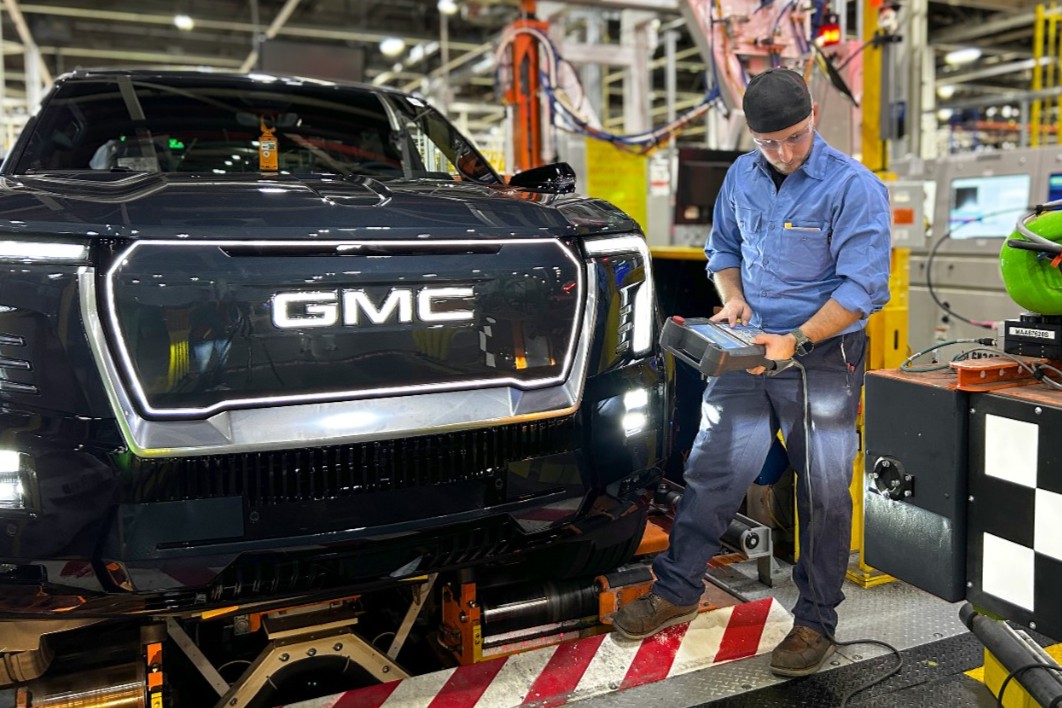
General Motors has announced that production at Factory Zero has been suspended since 16 March and is not expected to resume until 13 April. “Factory ZERO will temporarily adjust production to align EV production with market demand,” a GM spokesperson said. “Impacted employees will be placed on a temporary layoff and may be eligible for subpay and benefits in accordance with the GM-UAW national contract.”
Demand for the models produced at the plant—the GMC Hummer EV, Cadillac Escalade IQ, Chevrolet Silverado EV, and GMC Sierra EV—remains consistently weak. This is far from the first measure GM has taken to address the issue. For instance, production was significantly reduced between September and October 2025, following a similar measure in April 2025. At the end of 2025, GM laid off 1,140 employees at the plant.
Like the other two major players in the US market, Ford and Stellantis, General Motors had anticipated a much faster ramp-up of electric mobility and invested heavily in corresponding vehicles. However, since the political climate shifted following the inauguration of US President Donald Trump in January 2025, the Big Three have faced significant challenges—particularly after the $7,500 US tax credit was scrapped on 30 September for the purchase of new electric vehicles.
As a result, GM wrote off $1.6 billion in October, followed by an additional impairment $6 billion write-off in January. While GM emphasises that its current battery-electric models from Cadillac, Chevrolet, and GMC will remain in its lineup, the young electric van brand BrightDrop was discontinued as early as October.
Additionally, production at the Orion plant in Michigan is being shifted back from battery-electric vehicle production to internal combustion SUVs and pick-ups. Furthermore, GM has sold its stake in the Ultium battery cell factory in Lansing, Michigan, to its joint venture partner LG Energy Solution.