What Is the Semi-Solid-State Battery?John keeble – Getty Images
The race to bring solid-state EV batteries to market is well underway, but there is an intermediate stage before we reach that technological benchmark: the semi-solid-state battery. Chinese automaker MG has confirmed it will sell a production model with semi-solid state cells in Europe before the end of the year.
The MG name is likely familiar, but the brand has come a long way from its origins as a British sports car maker. Following the collapse of MG Rover in 2005, the name passed first to China’s Nanjing Automobile Corporation, which was subsequently bought by the much larger Shanghai Automotive Industry Corporation, now known just as SAIC. MG’s modern incarnation enjoys much more success than the original version did, selling more than 800,000 cars around the world in 2023, using a mix of pure combustion, hybrid, and EV powertrains. It even makes an electric roadster with scissor doors, the MG Cyberster.
MG Motors
As the name suggests, the semi-solid-state battery is a step on the path to full solid-state. Conventional EV batteries normally use either Lithium Iron Phosphate (LFP) or Nickel Manganese Cobalt (NMC) chemistry, with a liquid electrolyte used to move ions between the anode and cathode to create current flow. In such packs, this liquid is typically around 20 percent of the volume of the pack and has the disadvantage of being highly flammable.
At the other end of the scale, a solid-state battery uses a “dry” chemistry and a solid electrolyte, which brings many theoretical benefits, including improved energy density. But the huge technical challenge of creating a mass-production solid-state battery means that no automaker has won the race to get one to market yet.
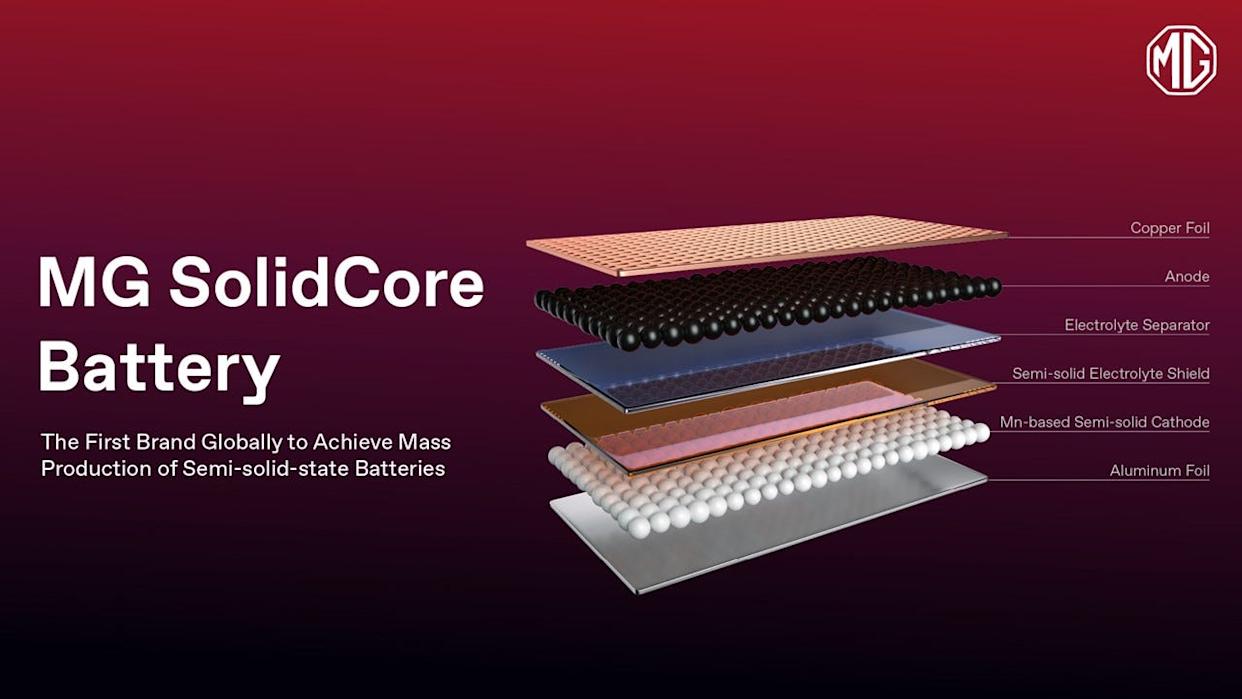
The semi-solid-state battery comes in the middle, normally using a solid matrix that contains a smaller amount of gel-like electrolyte. In the case of MG’s new Lithium-Manganese-Oxide “SolidCore” pack, only five percent of the battery’s volume is liquid. Built by SAIC’s battery partner, QingTao, the SolidCore has previously been offered in a small number of Chinese-market MG4 models—company executives say only around 2500 cars so far—but the European launch in the MG4 Urban later this year will mean significantly higher volumes. Intriguingly, MG will still sell the same car with a conventional LFP pack.
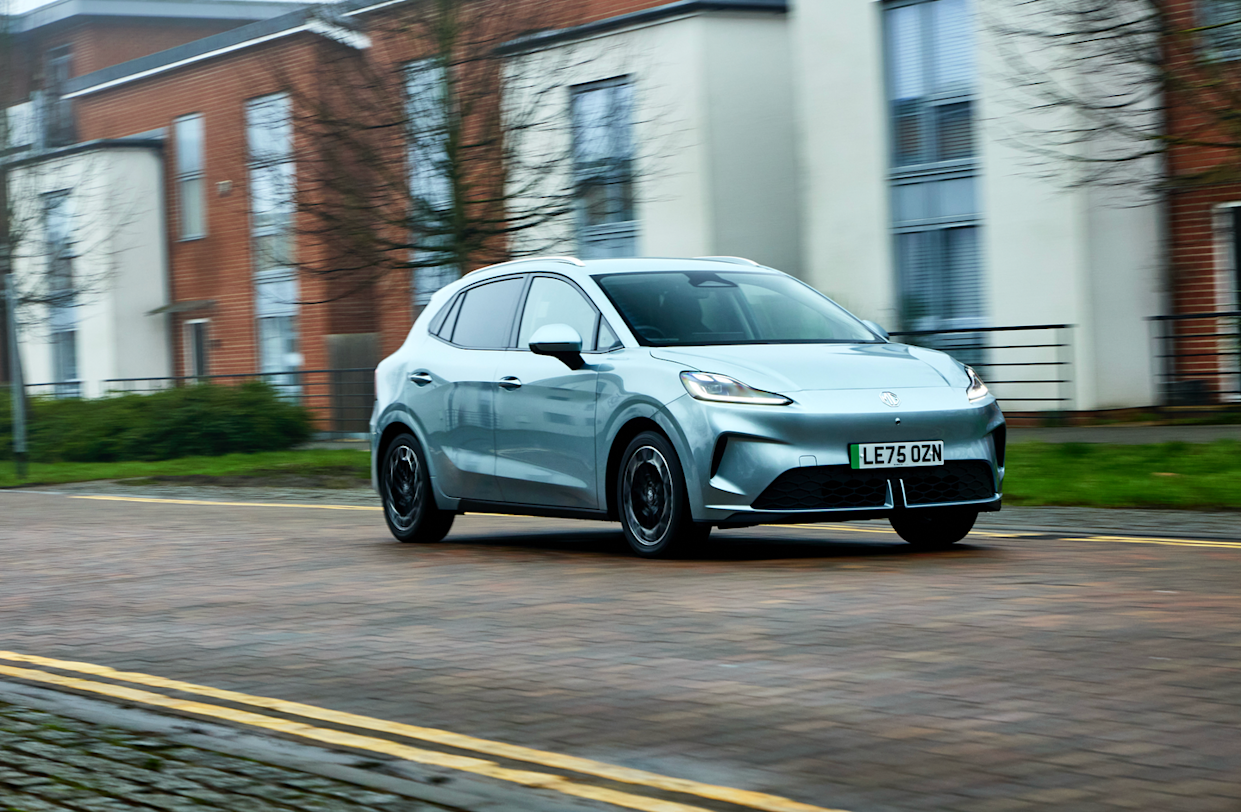
MG4 Urban is an inexpensive front-wheel drive EV sold in China and Europe.MG Motor
Despite its pioneering status, the MG4 Urban is definitely not a fancy EV. The basic Comfort Standard Range version is one of the cheapest electric cars on sale in Europe, costing the equivalent of $26,000 in the UK at current exchange rates, and with the most expensive Premium Long Range being $31,200.
To no surprise, given the MG4’s market position, the first application of semi-solid-state isn’t bringing huge breakthroughs in terms of battery capacity or charging speed. MG’s chief battery scientist, Li Zheng, refused to disclose figures for the European-spec SolidCore pack at a technical event in Frankfurt last week, but confirmed that capacity will be very similar to the existing LFP, which is 54 kWh for the MG4 Urban Long Range, and that weight is only slightly reduced. Instead, the emphasis is on significant improvements to cold-weather performance, with peak charging rates increased by up to 15 percent at below-freezing temperatures and power output improved at both low temperatures and low state-of-charge. Safety benefits include a big reduction in the risk of thermal runaway if the packs get punctured.
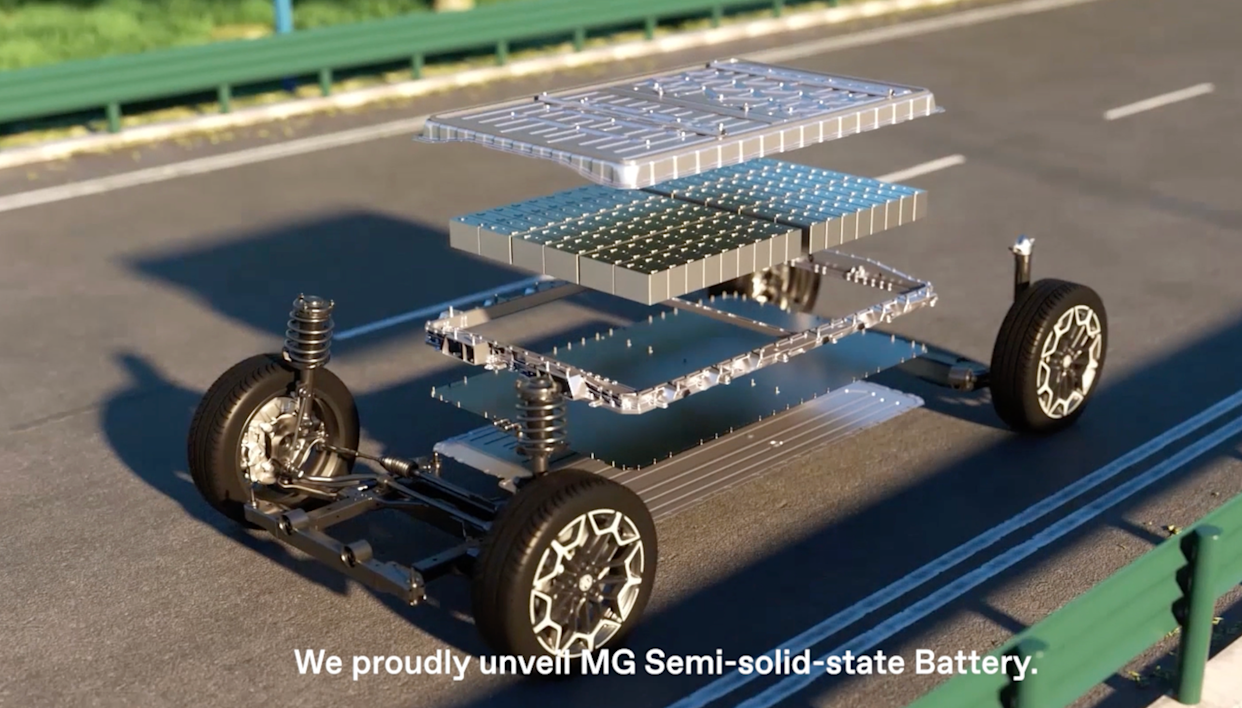
Screen capture from MG video on SolidCoreMG Motors
If none of this sounds revolutionary, you’re entirely right. MG’s decision to put semi-solid-state into broader production is undoubtedly inspired in part by the desire to claim to have gotten here first. SAIC’s relationship with QingTao means that other brands within the group will also be getting semi-solid-state packs, some of which are likely to bring additional performance, as well as the other marginal benefits. Like many rivals, SAIC is also pushing to get a full solid-state system to market as soon as possible.
So what does this mean for U.S. EV buyers? Likely not a huge amount, given both the declining market interest in electric cars, and also the fact that semi-solid-state technology will likely be exclusive to Chinese-built models for some time, none of those reaching the States. But the benefits of batteries better able to deal with frozen conditions do have an obvious appeal for EV buyers in colder parts of the country, and improved safety is a benefit to everyone. So we will wait to see if similar technology ultimately reaches America, or if it is overtaken by developments in other areas.
Because the steady improvement of existing car battery technology is making it harder to justify spending huge amounts chasing radical improvements. While the jumps are unspectacular, existing chemistry packs are improving power density and getting cheaper-per-kWh year-on-year. Fancier NMC-equipped models are now boasting performance that is getting close to the earlier predictions that were being made for solid-state. The recently unveiled BMW i3, for example, will have an EPA range of 440 miles and DC fast charging rates of up to 400 kW from a 109 kWh NMC pack.
The technological battle for sharp-end EV makers remains that of becoming the first to get a solid-state pack into a car that people can actually buy. But even after that point, much of the electric future will be powered by much simpler and less complex batteries.
You Might Also Like