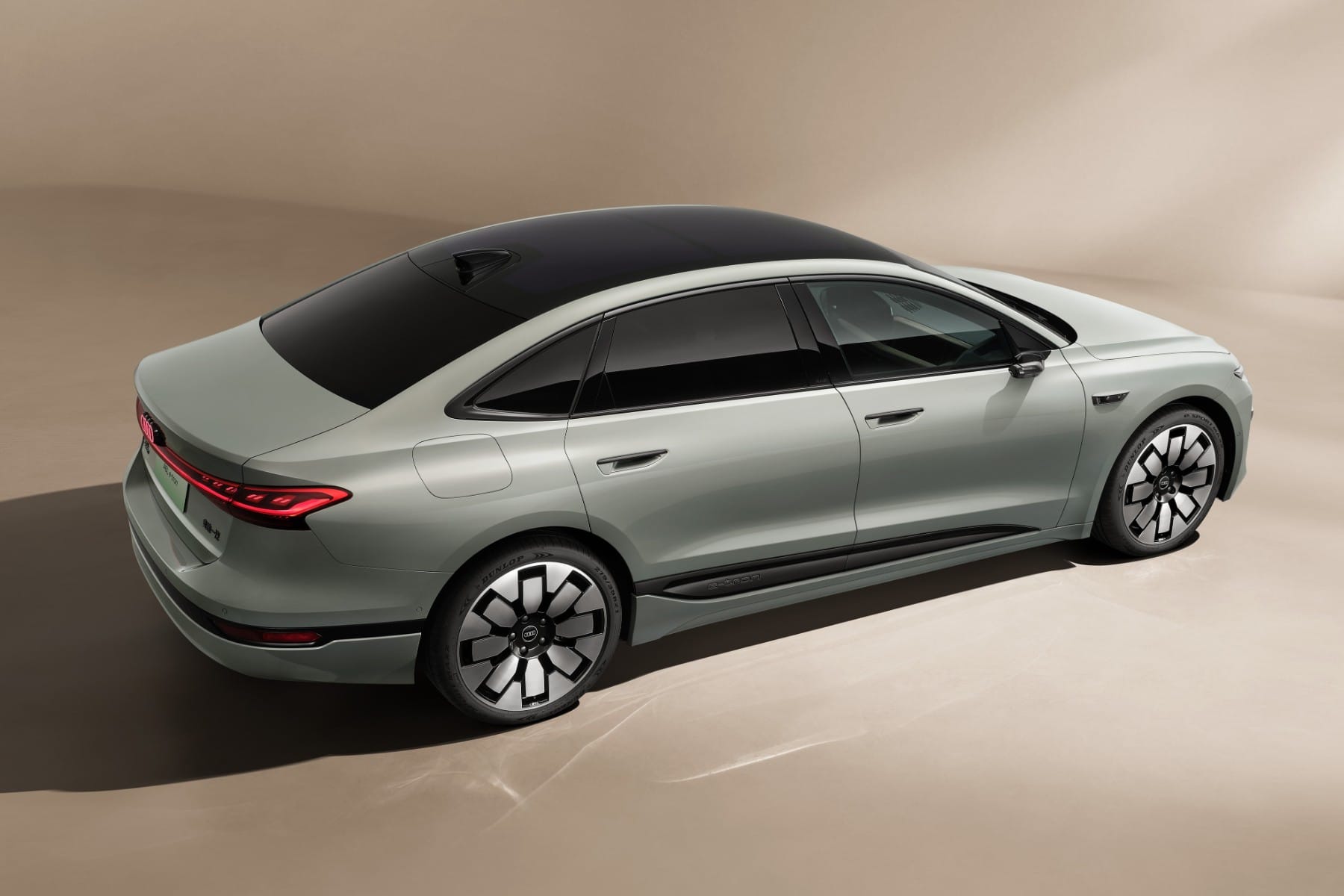
Audi’s Chinese joint venture has announced the pre-sales pricing for four variants of the A6L e-tron, with prices ranging from 313,000 to 443,000 yuan (approximately £39,300 to £55,670). As is typical in China, the official sales launch may see prices drop by several thousand yuan.
The A6L e-tron is the second China-specific model with an extended wheelbase to be produced at the Audi FAW NEV Company’s new plant in Changchun. Both premium battery-electric vehicles are based on the Premium Platform Electric (PPE). The Q6L e-tron is an SUV (currently priced from 348,800 yuan), while the A6L e-tron is a saloon. Compared to the standard A6 e-tron from Ingolstadt, which measures 4.93 metres in length, the long-wheelbase version in China features a wheelbase extended by around 13 centimetres.
The long-wheelbase version also offers an optional lithium-ion battery with a gross capacity of 107 kWh, which is 7 kWh larger than the standard model. This battery provides a range of up to 815 kilometres under the local CLTC standard. The same battery is used in the Q6L e-tron, though the SUV does not achieve the same range as the saloon, which benefits from a significantly lower drag coefficient of 0.22 due to its sleeker body design. Alternatively, buyers can opt for a smaller 95 kWh battery.
Both premium battery-electric models feature an 800-volt architecture and a charging capacity of up to 270 kW. Under optimal conditions, this allows the vehicle to gain enough charge for 300 kilometres in just ten minutes. To date, the only known power output is for the all-wheel-drive version, which delivers 405 kW. No figures have been released for the rear-wheel-drive variant.
For Chinese customers, autonomous driving functions and digital features are particularly important. As a result, the higher-spec versions of the A6L e-tron come equipped as standard with an adapted version of Huawei’s “Qiankun” system. The cockpit also includes an 88-inch augmented reality head-up display, among other features.
The vehicle is manufactured at a plant built specifically for the Audi FAW NEV Company. The foundation stone was laid in 2022, and the facility is designed to produce 150,000 cars annually. The factory is characterised by extensive digitalisation, a fully integrated IT solution, and a high degree of automation. In the body shop alone, 800 robots are in use, with Audi claiming a record automation rate in the Chinese automotive industry. A 24-metre-high automated warehouse also ensures reliable logistics.
The Q6L e-tron and A6L e-tron are primarily intended to strengthen Audi’s position in China, where the brand’s electric vehicle offerings have so far been limited. Whether they will appeal to the desired target group and build on Audi’s past successes in China remains to be seen in the coming months. In addition to the PPE-based battery-electric models from Audi and FAW, electric vehicles from the new Audi sub-brand, a collaboration between Audi and SAIC, are also expected to boost momentum.
Meanwhile, the Audi FAW NEV Company is appointing a new CEO: from 1 April 2026, Jörg Menges will take over as CEO of the joint venture. Helmut Stettner, the current CEO, will return to Ingolstadt. Menges brings over 31 years of international experience in the automotive industry, including roles in China.
“Since 2022, he has been Head of Product Engineering at AUDI AG in Ingolstadt. Previously, he was Plant Manager at FAW-Volkswagen-Automotive Co., Ltd., in Changchun, where he gained extensive experience in localized production and management,” Audi stated.
Gerd Walker, Board Member for Production and Logistics at the carmaker, commented: “Jörg Menges is an experienced manager, strong strategist, and proven production expert. Thanks to his previous role in China, he has a deep understanding of the market and is also well connected within the Group. He will lead the company into the next phase and consistently develop the production site as part of our electrification strategy for the Chinese market.”
Audi commended outgoing CEO Helmut Stettner for having ‘laid a solid foundation for Audi’s electrification strategy in China during his five-year tenure.’
Walker added: “I would like to thank Helmut Stettner for his enthusiastic commitment to the company. He has been responsible for the development of the company and the production site in Changchun from the very first second and, most recently, successfully implemented the market launch of its first product portfolio with his team.”
cnevpost.com, audi-mediacenter.com