A woman was caught on camera vandalising her ex-boyfriend’s Tesla in what has been described as a “petty” act of post-breakup revenge.
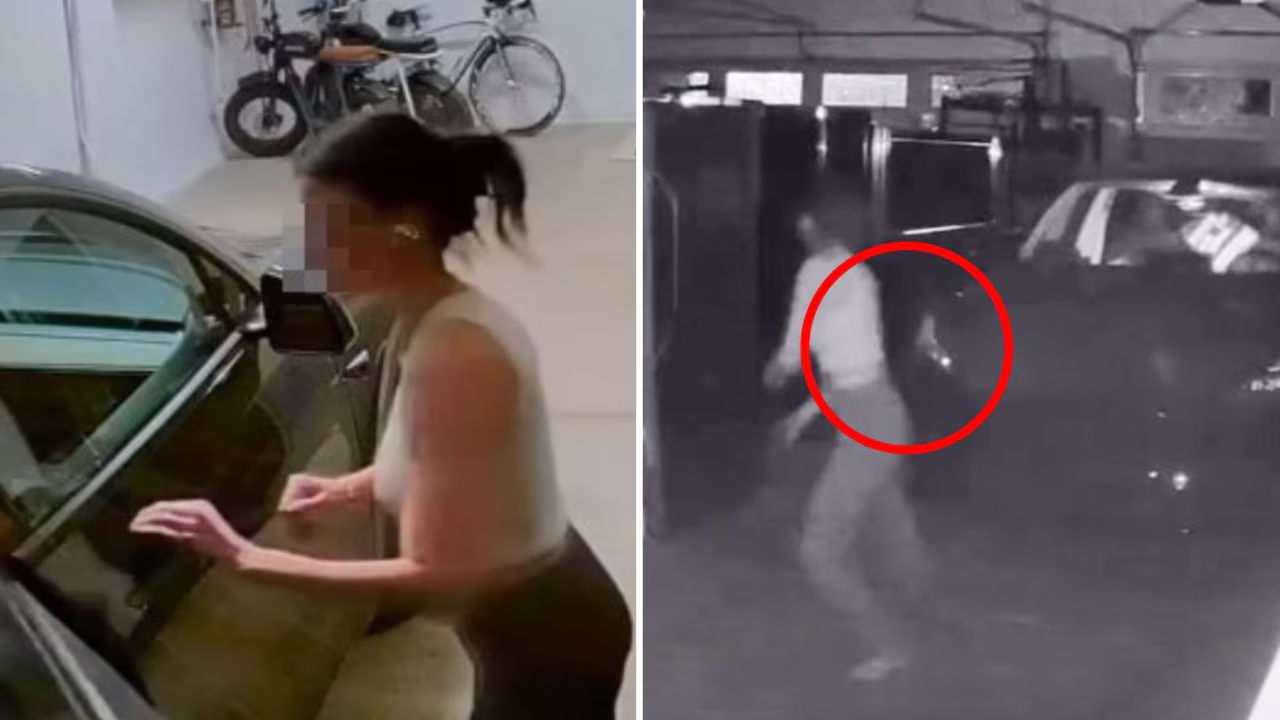
In the clip, which has gained over 400,000 views on Instagram after being shared by a news account in Lake Tahoe, on the border of California and Nevada, the woman causes thousands of dollars worth of damage to the electric vehicle inside a garage.
According to the caption, the man had allowed his ex-girlfriend to use his car to move her belongings out of their shared home after their split.
But his gesture of goodwill appears to have backfired spectacularly.
The CCTV footage shows the woman packing boxes into the back of the Tesla, but her focus is clearly on damaging the car.
In the first few moments of the clip, she approaches one of the side doors calmly.
However, as she loads the car, she begins repeatedly slamming the doors past their hinges and scraping them against the side of the garage wall.
At one point, she walks up to the front of the car and uses what appears to be a hammer to smash the bonnet, leaving significant dents and scratches.
Perhaps the most chilling part is her demeanour – she seems completely unfazed throughout the ordeal, often walking out of shot to grab another box before returning to continue her destruction.
The woman’s face is clearly visible in the video but news.com.au has chosen to blur it.
The clip was instantly flooded with comments, with many people stunned by her behaviour.
“The court is going to love this,” one user pointed out.
Others praised the man for getting out of the relationship, with one saying he “dodged a bullet”.
“She probably thought she was so smooth, couldn’t wait to tell the girls about it,” one said.
Another called the behaviour “petty” and “immature”.
However, some were confused about the breakup, questioning how a split could be civil enough for him to lend her the car but bitter enough for her to want to damage it.
The incident carries serious legal weight under California law.
In the United States, “vandalism” is a “wobbler” offence, meaning it can be charged as either a misdemeanour or a felony depending on the dollar value of the damage.
Because the vehicle is a Tesla – where even minor repairs can cost upwards of five figures – the woman would likely face felony charges.
If the damage exceeds $400 (~$580 AUD), she could face up to a year in county jail and hefty fines, not to mention a civil suit for the repair costs that would probably follow.
While the incident took place overseas, Australian law is equally strict when it comes to this type of vandalism.
Vandalising a vehicle in Australia is a criminal offence that can result in significant penalties, including fines and jail time, depending on the state or territory.
In Queensland, for example, the act of “keying” a car or smashing a bonnet falls under serious criminal codes.
“Vandalising someone’s vehicle could lead to a criminal charge of ‘wilful damage’ under Section 469 of the Criminal Code,” criminal lawyer Avinash Singh, Principal Lawyer at Astor Legal, previously told news.com.au.
“The maximum penalty is usually five years’ imprisonment. That’s consistent with similar offences across most Australian states.”
Even though the car in the video is an expensive Tesla model, the make itself isn’t the legal issue – it’s the cost of repairs.
“The value of the vehicle defaced wouldn’t influence the penalty, however, the cost of fixing the damage would,” Mr Singh explained.
“If the defacement of a luxury vehicle was expensive for the owner to repair, then this would escalate the seriousness of the offence and usually result in a higher penalty.”
Australian courts also take a very serious view of damage motivated by a breakup.
“Courts consider the motivation for the offending. Victim blaming is frowned upon,” Mr Singh explained.
“If a person tried to justify their behaviour in court, they would likely be punished more severely.
“It should also be noted that damaging a partner or ex-partner’s property is a form of domestic violence, so the courts would want to send a clear message that the behaviour is unacceptable.”