Base Model Not Slouching About
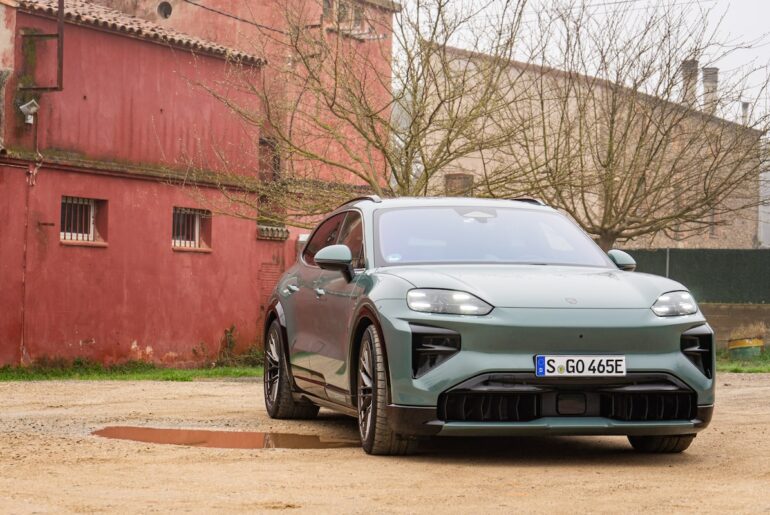
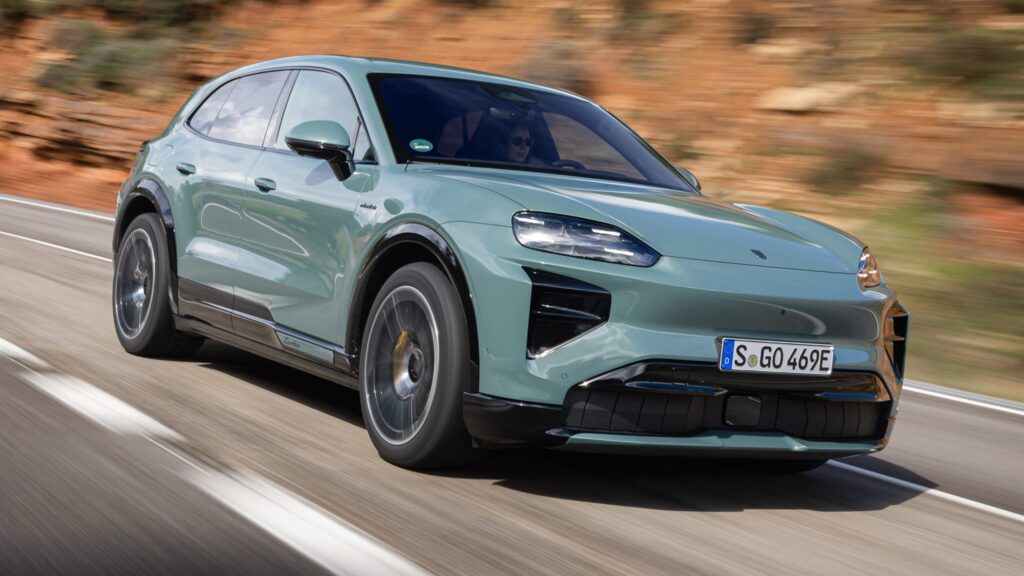
We also had a chance to whip a base Cayenne Electric around a challenging section of glorious Spanish mountain roadway (note to self: Come back and drive them again). With roughly half the horsepower, no Active Ride (it’s not available for it), and no fancy rear motor (also not available), predictably, it wasn’t quite as engaging at the extreme end of the driving envelope.
Yes, there was more lean as we navigated into and out of challenging sections, midcorner steering corrections were often necessary, and there wasn’t the explosive acceleration given its 402 total horsepower (quoted 0–60 mph is 4.5 seconds with launch control and power dialed up to 435 hp and 615 lb-ft; the quicker Cayenne S Electric is listed at 3.6 seconds).
But the base model still proved plenty of fun to hustle as we explored its capabilities, and its brakes felt just as responsive, powerful, and progressive in operation as the Turbo’s when called upon. In around-town driving situations, it also came off as being as composed, easygoing, and smooth-riding as the Turbo. If you want to take your electrified Cayenne to the dragstrip, handling circuit, or relentlessly attack a mountain pass, you’re going to want a Turbo. Just be prepared to pay a hefty premium to get the full, physics-bending experience.
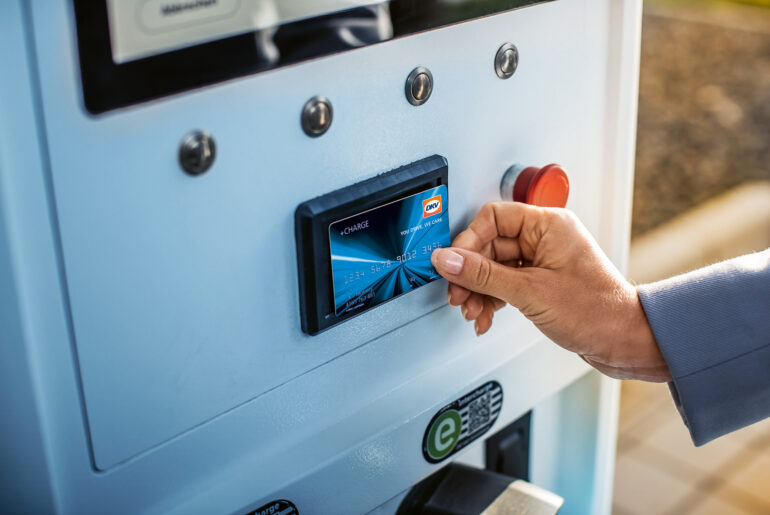
One thing all Cayenne Electrics get standard is a 113.0-kWh gross (108.0-kWh usable) lithium-ion battery. The pack itself, which is divided into 12 sections and lines the floor of the vehicle, charges at speeds of up to 400 kW if you can find a charger to push that kind of power. All vehicles also have two charge ports, one located at each rear fender, one a NACS (aka Tesla Supercharger) connection and the other a common home-charging port.
ADVERTISEMENT – CONTINUE READING BELOW
Given our prior experience with Porsche’s electric-powered models and our recent experience with a Cayenne Electric prototype, we expect to see an EPA -rated range in the 300-plus-mile neighborhood (we tested a prototype recently that reached 350 miles), depending on model. Given our experience with charge testing other Porche electric models, we also expect the vehicle to perform along the lines of what Porsche is estimating, anywhere from 16 to 26 minutes from 10 to 80 percent depending on the charging station. Oh, and it can tow up to 7,716 pounds. We’ll report back as soon as we can get our hands on one to test.
Off-Road Ready, Just in Case
Over the years since the Cayenne’s launch, Porsche has played up the SUV’s all-terrain versatility and backed it up with an impressive off-road track record, and it wants its electric versions to be perceived the same way. Timo Bernhard helped make sure of that.
We got two hot laps with the Porsche ambassador and championship-winning race car driver on a big-boy rallycross track, and all we can say is, OMG, that was freaking amazing. Sliding and bounding and crashing and whirling around the circuit in a way that only a seasoned professional driver can, Bernhard did more to demonstrate in five minutes what this SUV is capable of off-road than virtually any amount of trail running we might do. It was a physics-defying experience along the lines of a Group B rally car.
ADVERTISEMENT – CONTINUE READING BELOW
When the dust finally cleared, we asked Bernhard what impressed him most about the Cayenne Electric. “The power delivery,” he said, adding that he also appreciated how well it manages torque (Porsche’s Torque Vectoring Plus is standard for the Turbo). We appreciated how you managed to make our day, Timo. What a ride.
Porsche also had us traverse a mildly challenging off-road course in the Cayenne Electric, which can be optioned with a package that marginally improves its capability (tires and other minor enhancements that help with armoring, and approach and departure angles). It does what you’d expect, turn the dial to Off-Road mode, and it easily traverses sandy uphill sections, muddy ruts, and navigates declines thanks to a solid hill descent setup. So, yeah, it can do off-road things.