B2B News | Source: Motorcycle Global | A new industry report argues the debate about electric motorcycles is largely missing the point: for most of the world, electrification is already winning.
Despite recurring claims that electric motorcycles are struggling to find their footing, new research suggests the global market tells a very different story.
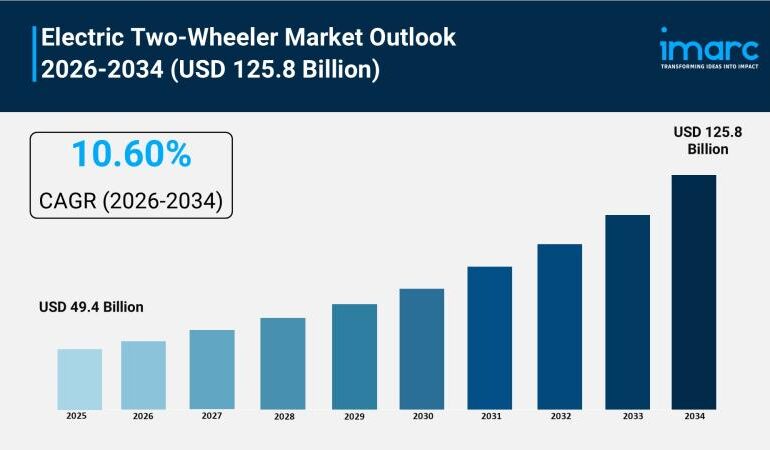
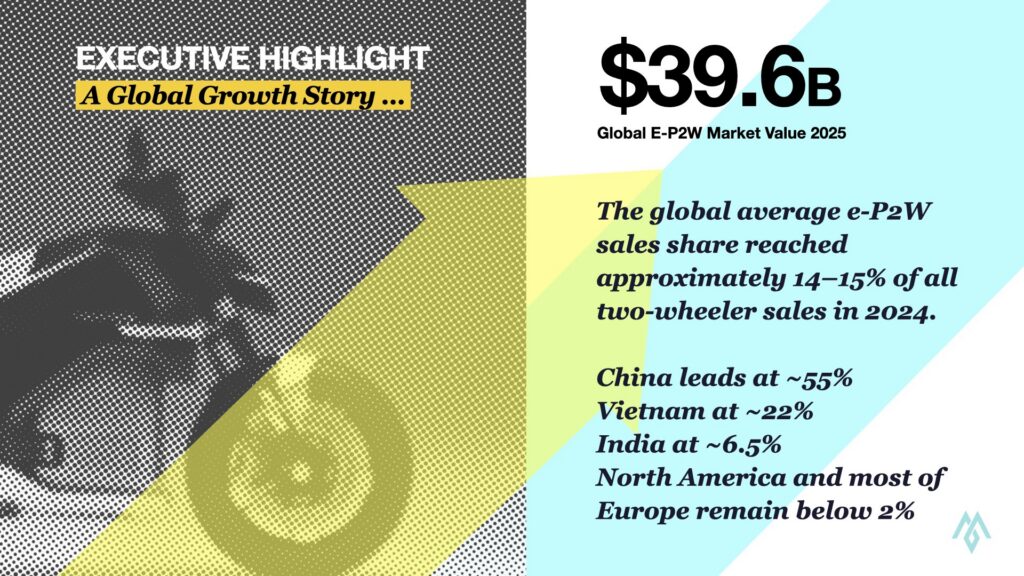
According to the Global Electric Motorcycle Report 2025–2030, published by Motorcycle Global, electric two-wheelers are not a niche experiment but a rapidly expanding mobility category. The report estimates the sector already represents $40 billion in annual revenue, accounting for 14% of global new vehicle registrations, and continues to grow at roughly 12% annually.
For Michael Uhlarik, founder of Motorcycle Global and longtime industry analyst, the numbers speak for themselves.
“So much ink has been spilled about the supposed death of the electric motorcycle,” Uhlarik notes. “But the data from 2025, like every year since 2009, shows global demand for battery-powered two-wheelers continues to grow in most markets.”
Understanding the Why behind the numbers
However, Uhlarik argues that raw data alone rarely tells the full story of the two-wheel industry. Questions like why Indian consumers continue to buy motorcycles instead of cars, why step-through scooters dominate parts of Southeast Asia, or why younger riders in the United States are registering more motorcycles even as overall sales fluctuate reveal the deeper dynamics shaping the market.
Motorcycle Global’s research approach is built around that premise: purchasing decisions in the motorcycle world are rarely purely rational.
Instead, the report links sales data with social, economic and cultural contexts, arguing that understanding the motivations of riders is essential to interpreting the electric transition.
Two very different electrification narratives
One of the key findings of the report is the stark contrast between how electrification has been framed in Western markets versus the rest of the world. In Europe and North America, electric motorcycles have largely been positioned as an ideological choice, combining environmental benefits with cutting-edge technology.
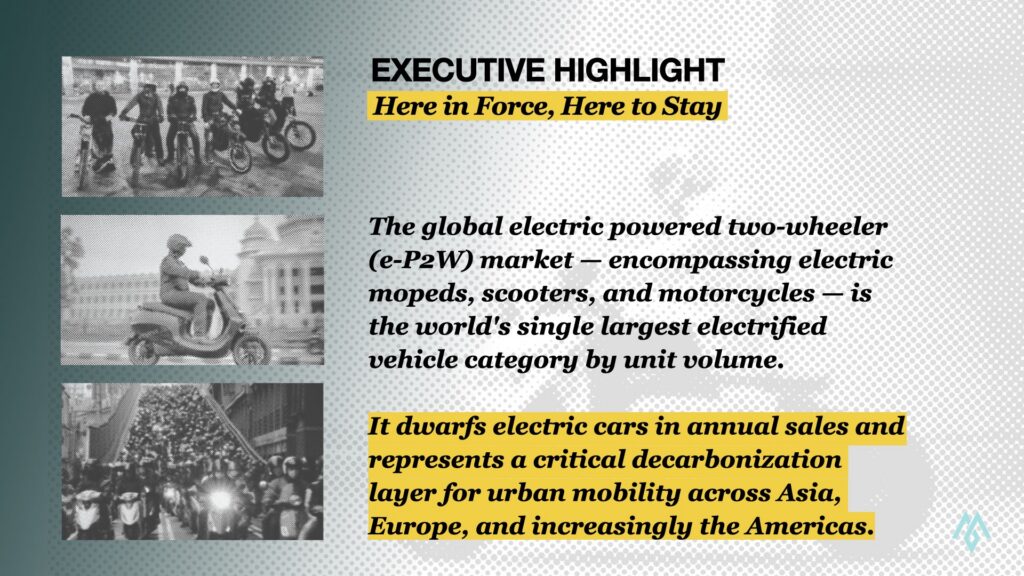
In many emerging markets, however, the value proposition is far more pragmatic:
electric two-wheelers are simply cheaper to run, easier to use, and smoother to ride.
Government incentives have certainly helped accelerate adoption, the report notes, but they are rarely the decisive factor. Where affordable electric models exist, they often outperform their internal-combustion counterparts.
The power segment that matters
Another central insight: the global two-wheel market is overwhelmingly dominated by low-power commuter vehicles.
Stylish step-through scooters and entry-level commuter motorcycles producing under 14 horsepower (around 10 kW) account for roughly 98% of global motorcycle sales. In that context, the success of electrification becomes far easier to understand.
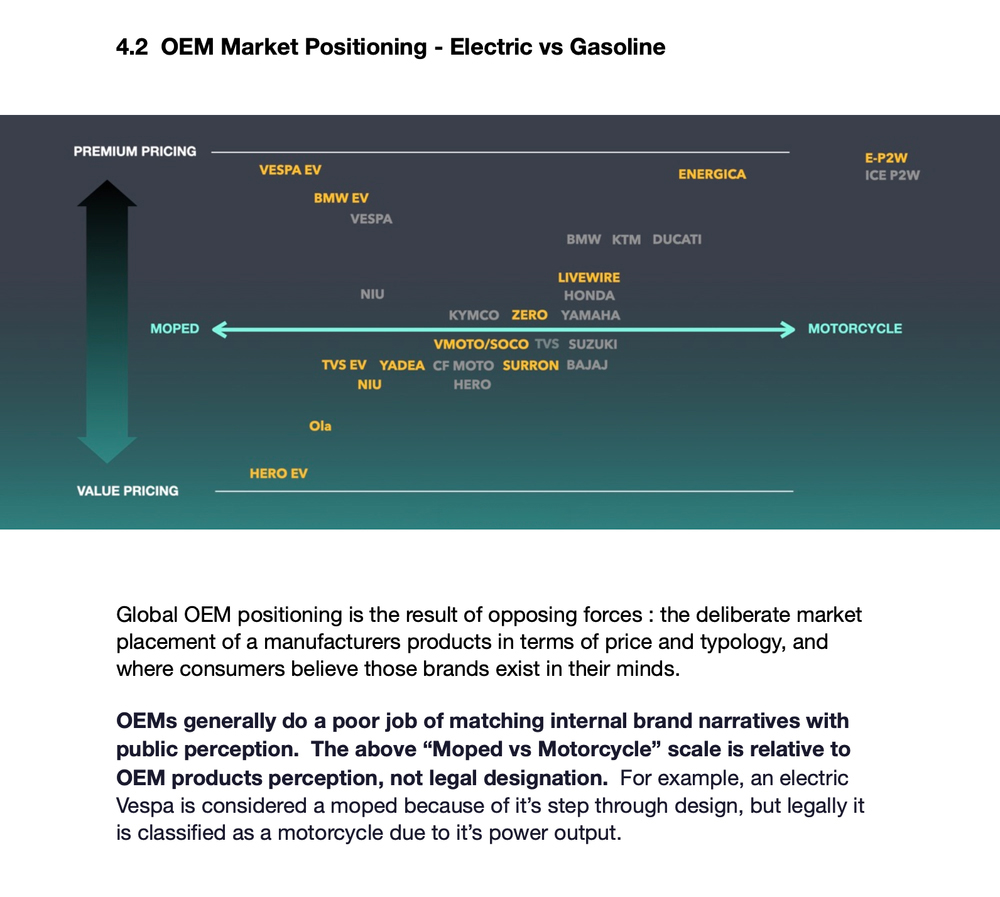
Electric drivetrains are particularly well suited to these vehicles, offering lower running costs, simplified maintenance, and a smooth riding experience, advantages that resonate strongly with urban commuters across Asia, Latin America and parts of Africa.
A deep dive into the global market
The 50+ page Global Electric Motorcycle Report 2025–2030 aims to provide a comprehensive overview of this evolving landscape.
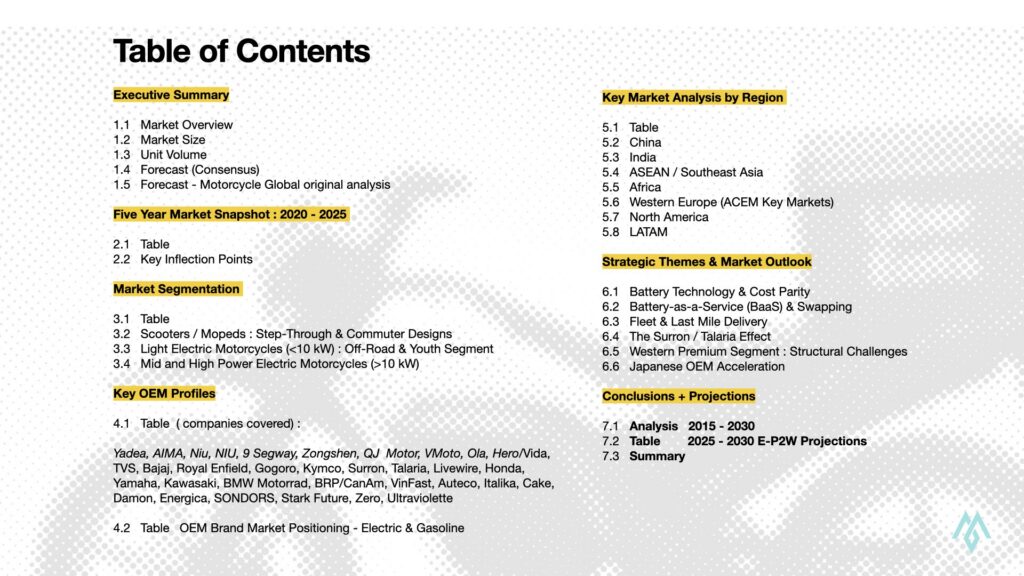
The study combines data from more than 60 sources and includes:
Global market data from 2020–2025
Forecasts through 2030
Detailed analysis of 8 global regions
33 manufacturer profiles
Multiple data tables and charts mapping industry trends
Assessment of major macroeconomic and policy impacts
The report also examines the shifting competitive balance between China’s dominant electric two-wheel ecosystem and the ongoing challenges faced by premium brands in Western markets.
The author behind the research
Motorcycle Global was founded by Michael Uhlarik, an award-winning motorcycle designer with more than 25 years of experience working with OEMs across Europe, Asia and North America.
Raw Data is meaningless without human context.
Beyond market analysis, Michael is widely known in the industry for his work in motorcycle design and electrification. He was a co-founder of the Amarok P1 electric race bike project and also helped launch SURU, an e-bike manufacturer.
His approach blends product design insight, market analysis, and consumer psychology, aiming to go beyond spreadsheets to understand what actually drives riders to choose a particular motorcycle.
A premium industry report
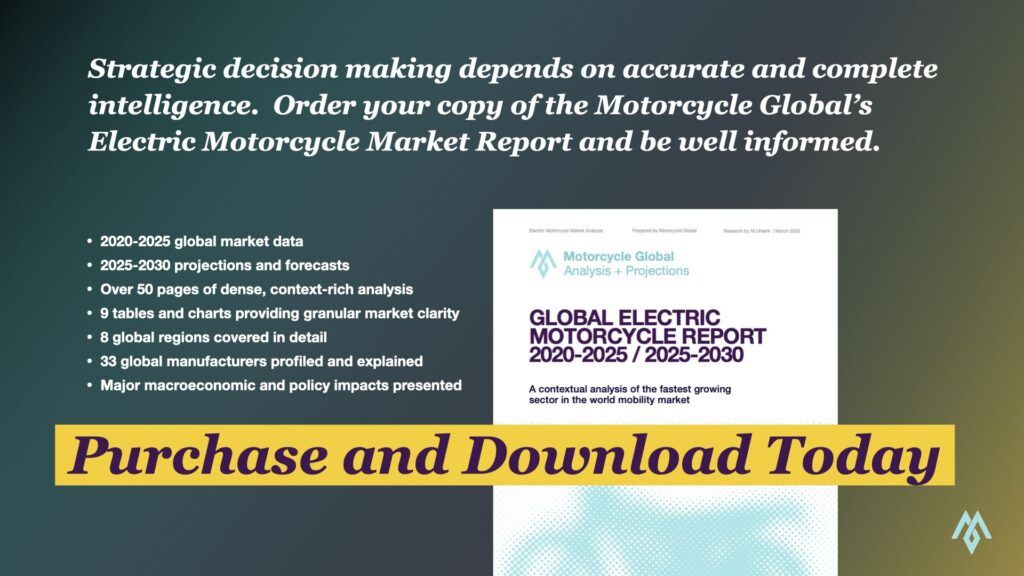
Motorcycle Global positions the report as a strategic intelligence tool for manufacturers, suppliers, and investors active in the two-wheel sector. The Electric Motorcycle Market Report 2025–2030 is available for CA$3,200, reflecting the months of original research and industry interviews behind the publication.
For companies trying to navigate the rapidly evolving electric two-wheel landscape, Uhlarik’s message is simple: ignore the headlines, and look at the data.
THE PACK editorial note
While headlines in Europe and North America often focus on the struggles of premium electric motorcycle brands, the global reality looks very different. As this report highlights, the electric two-wheeler transition is largely being driven by affordable commuter vehicles in emerging markets, not high-performance machines in the West.
For the electric motorcycle industry, the real question may therefore not be whether electrification is working, but whether Western manufacturers are building the kinds of motorcycles that the majority of the world actually needs.