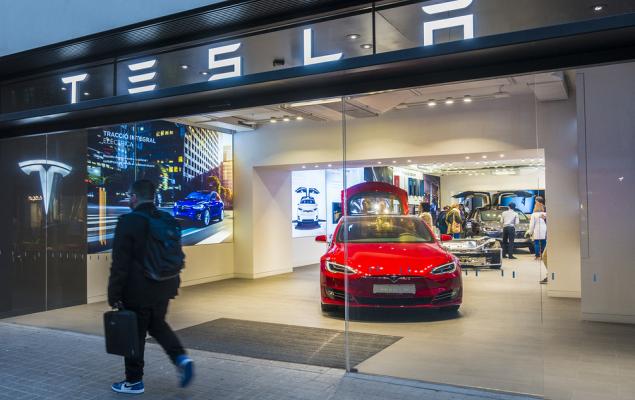
Tesla is executing one of the most aggressive capital reallocations in modern market history. The company is actively shrinking its decelerating legacy automotive segment to fund a massive pivot toward a high-growth, “physical AI” performance brand.
So far, the market has rewarded this shift with a staggering valuation re-rate, pricing the stock at $1.2 trillion on the promise of humanoid robots and steering-wheel-free Cybercabs. But there is a blind spot in this 180x forward-earnings narrative.
A sweeping federal probe into Tesla’s camera-only autonomous tech threatens to expose a hardware flaw. If regulators mandate a physical redesign, this trillion-dollar AI thesis could shatter overnight, risking a rapid transformation from market darling to a secular falling knife.
 Image by JackieLou DL from Pixabay
What Is the Investigation Target?
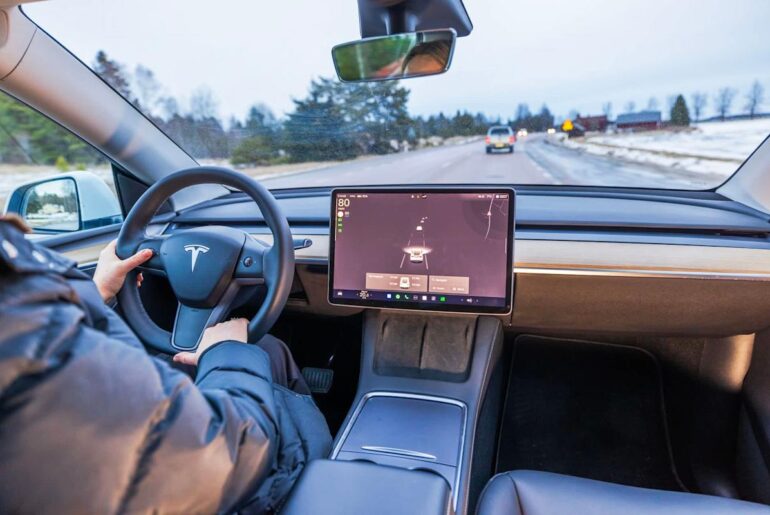
The National Highway Traffic Safety Administration (NHTSA) recently escalated its probe into Tesla’s Full Self-Driving (FSD) technology. The Engineering Analysis (EA26002), launched in March 2026, represents the final procedural step before a potential remedy ranging from software updates to a hardware mandate for approximately 3.2 million vehicles. Investigators have identified nine significant crashes – resulting in one fatality and two injuries—where Tesla’s camera-only “Vision” system allegedly failed to detect hazards in low-visibility conditions. The probe found that FSD frequently loses environmental tracking during fog, sun glare, and dust. The NHTSA also indicates that Tesla’s software fails to warn drivers that camera visibility is compromised until milliseconds before impact. Tesla has long bet that cameras alone can see the world well enough to be trusted with human life. Unlike competitors such as Alphabet’s (GOOGL) Waymo, which use LiDAR and radar for redundancy, Tesla relies on neural networks to mimic human sight. Even AI titan Nvidia’s (NVDA) broader “Physical AI” stack is built around multimodal sensor fusion across cameras, LiDAR, radar and other sensors.
Overall, this appears to be not just a dispute over software, but overall hardware systems. If the NHTSA determines that “Vision” is fundamentally insufficient for all-weather safety, this has broader implications for Tesla.
Will This Have Ripple Effects?
Tesla uses the same “Unified Brain” (FSD software and vision system) for its cars, Cybercab robotaxi, and Optimus robots. So any regulatory problem with FSD could affect all of Tesla’s physical AI plans. The Cybercab is scheduled to begin a gradual production ramp in April 2026 and is central to Tesla’s robotaxi ambitions. If NHTSA requires a recall that forces Tesla to add LiDAR or radar, the Cybercab’s current design could be inadequate, and this could call for a redesign of the body and wiring.
For Optimus, the implications may be more nuanced. Industrial environments are controlled, workflows are predictable, and safety layers can be engineered around the robot. That gives Tesla more room to adapt, whether through operational constraints, redundancy, or environment design. But the core question would still linger: if vision struggles in degraded conditions on roads, regulators may ask why similar limitations wouldn’t surface in factories, even if the consequences are easier to contain. That skepticism could extend further, potentially slowing adoption in less controlled settings like homes, where variability is higher and safety margins are harder to enforce.
While real-world AI is a big buzzword, a subtle shift is happening in the AI compute space as companies move from training to higher-volume inference – which is the practical execution of trained models. This shift could have an unlikely beneficiary in Intel (INTC). Read The AI Shift That Nobody Is Pricing For Intel Stock.
The Next Steps?
Historically, an NHTSA engineering analysis can take up to 18 months. But given the safety sensitivity of a steering-wheel-free cybercab, the timeline could potentially compress, with a preliminary ruling or mandated action emerging by late 2026. If a recall is ordered, the most likely first step could be an over-the-air software update, consistent with Tesla’s past approach to regulatory issues. That said, these investigations incrementally erode confidence in a strategy that hinges on scaling autonomous driving and a robotaxi fleet.
The bigger risk is a hardware mandate. If regulators require sensor redundancy such as LiDAR or radar, the Cybercab program could face a multi-year redesign, delaying its production ramp. At the same time, Tesla is targeting aggressive scale for Optimus, aiming for a production rate of as much as 1 million units annually by the end of 2026. A federal determination that its vision-based system is unreliable in degraded conditions could spill over to workplace regulators like OSHA, raising barriers to deployment in industrial settings.
How Could This Impact Valuation?
Tesla now trades at over 180x consensus FY ’26 earnings, a valuation that assumes its AI ambitions materialize at scale.
Yet the underlying business is slowing, with growth for this year projected in the single digits and margins under pressure.
At the same time, Tesla is making a radical shift that few automakers would attempt: deliberately shrinking its core vehicle business. In Q1 2026, it discontinued the Model S and Model X and began retooling Fremont for Optimus Gen-3 production. With oil prices elevated and EV demand facing cyclical pressure, Tesla is walking away from near-term revenue in favor of a long-dated, uncertain payoff. This is a high-stakes reallocation of capital and focus. It only works if autonomy and robotics scale quickly and credibly. But if regulatory action undermines confidence in its core autonomy stack, the gap between narrative and reality could widen sharply. At a trillion-dollar valuation, there may be little margin of safety for investors.
While the promise of a robotaxi future is an exciting narrative, hoping for a flawless regulatory outcome is not a viable investment thesis. At the end of the day, successful capital allocation requires strict downside protection and a focus on companies already executing on their product moats. If you want to deploy a rigorous, high-conviction strategy across your portfolio without the stress of day-to-day management, our Trefis HQ strategy provides exactly that. By systematically focusing on quality over hype, HQ has outperformed its market benchmark (the S&P 500, S&P mid-cap, and Russell 2000) to deliver over 105% returns since inception. Discover the full HQ performance metrics and the 5 data-backed reasons why it outperformed.