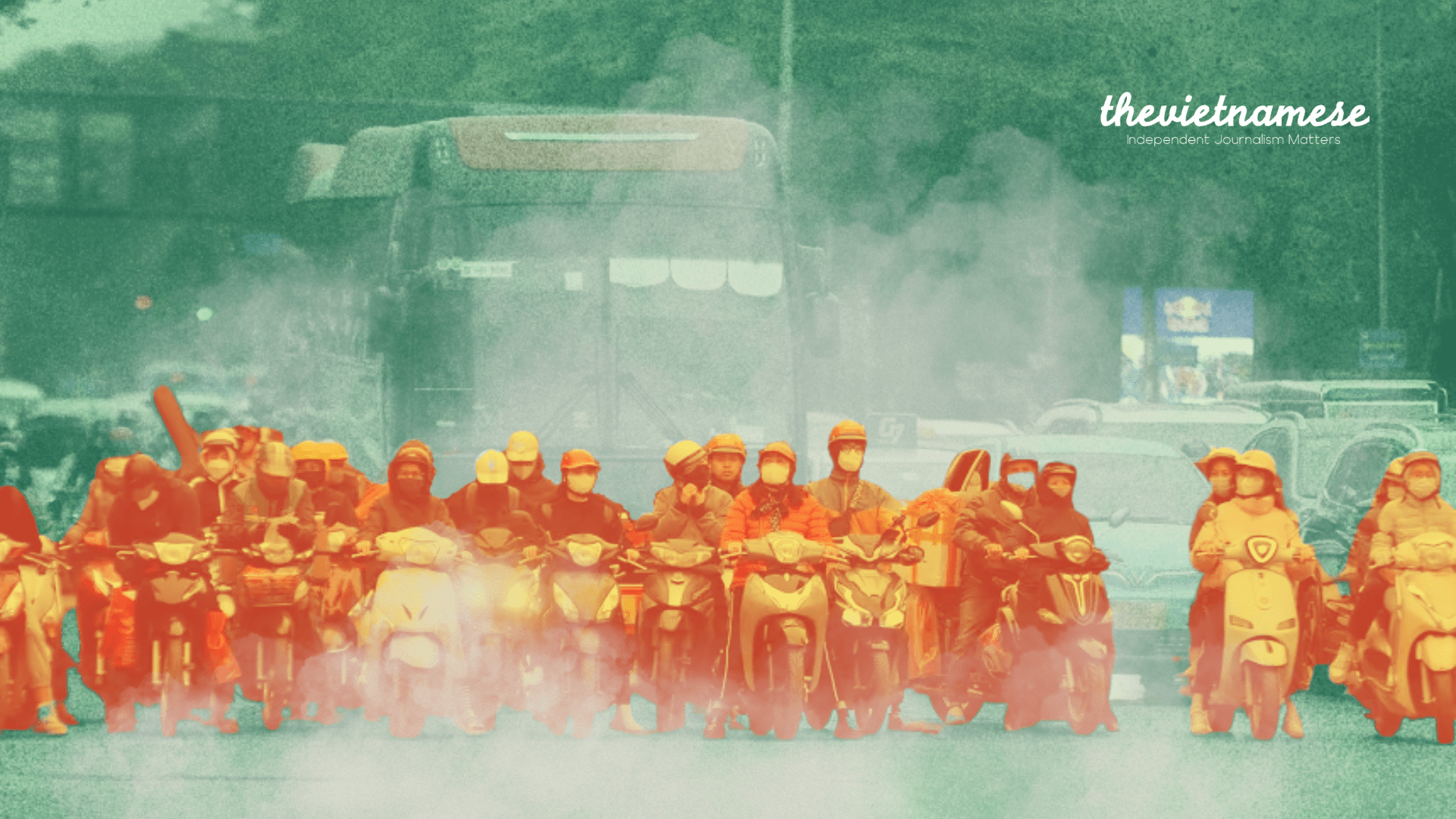
To many Vietnamese residents, a motorcycle is more than a means of transportation. These two-wheelers are an omnipresent feature of Việt Nam’s urban landscape on which millions of people rely for commuting to workplaces, fetching their children from school, or carrying daily groceries from the market.
In the country’s often underestimated but crucial gig economy, a motorcycle’s flexibility and its compact design—an essential adaptation to navigate among Vietnamese alleyways and its packed streets—are also perceived as a productive asset for ride-hailing operators, delivery drivers, and small traders to make their living.
Official statistics show that as of 2024, Việt Nam has one of the highest shares of two-wheelers in the world, with an estimated 77 million vehicles roaming through the country’s roads.
Per capita, there are roughly seven motorcycles for every 10 people. A majority of motorcycles and scooters in the country, more than 95%, run on fossil fuel. Electric motorcycles, on the other hand, only account for around 4% of the total vehicles. But the government wants to change this proportion.
As part of the country’s ambition to move towards a “green development,” the government has introduced a slate of public policies and new requirements, many of them controversial, to swap gas-reliant two-wheelers for electric vehicles (EVs) and turn existing motorcycles into more environmentally friendly ones.
The government’s Decision 876/QĐ-TTg [1] on green transition and carbon emissions reduction aims to gradually replace all fossil fuel-powered vehicles, including motorcycles, with electric alternatives by 2050.
The first contentious move was made public in July 2025, when the Hà Nội City authorities announced [2] the ban on internal-combustion motorcycles on its Ring Road 1, a major transportation route connecting the city’s surrounding suburban districts, by mid-2026.

ADVERTISEMENT
The authorities will extend the restrictions to Ring Road 2 and Ring Road 3 by 2028 and 2030, respectively.
The ban has provoked intense public backlash due to the limited time for preparation and the financial burden on motorcycle owners, who worry about the costs of switching from their current petrol bikes to pricier EV models.
At the same time, it has raised speculation about corporate influence since this policy would benefit VinFast, an electric automobile and motorcycle manufacturer owned by Phạm Nhật Vượng’s Vingroup conglomerate, as this company is seeking a larger share of the EV market.
In broader conversations on social media, Vietnamese commentators and critics question the efficacy and credibility of this EV transition, as gasoline-powered vehicles only contribute to around 50% of the city’s PM2.5 fine dust concentrations.
External factors, such as industrial fumes from coal-fired factories and cement kilns, trash burning, and dust from construction sites and real estate projects [3], comprise the remaining polluting factors.
Meanwhile, the investment cost of a new electric two-wheeler and limited options of other affordable brands apart from VinFast’s models raise questions over whether the green transition is to create a cleaner environment or enrich crony corporations.
But this year, another two policies targeting petrol motorcycles will be enforced to accelerate Việt Nam’s green transition. One of them is the mandatory nationwide sale of E10 bio-petrol, a blend of petrol and bioethanol.
The other requirement mandates all existing petrol two-wheelers undergo emissions quality testing. Although the new policy momentum brings Việt Nam closer to the carbon neutrality goal, it nonetheless disproportionately affects the lower and middle-lower income populations in the country whose livelihoods are closely intertwined with the humble gas-powered scooters.
Compulsory Switch to E10 Bio-Petrol
Last February, Prime Minister Phạm Minh Chính signed into effect Directive 07/CT-TTg [4], which mandates the blending and sale of biogasoline (E10) nationwide, including the implementation of a propaganda campaign urging gasoline-powered vehicles to adopt the government-sponsored environmentally friendly fuel.
Previously, the Ministry of Industry and Trade made a proposal [5] demanding the total adoption of E10, which includes 10% of bioethanol, for commercial sales starting January 2026. Currently, E10 is available alongside conventional fossil-derived gasoline types such as RON92, RON95, and RON97.
From 2030 on, according to the plan, the country will fully adopt E15 biogasoline with at least 15% biofuel content. If the proposal is approved, the fossil gasoline sales will be halted, and two-wheeler drivers can only buy biogasoline for their consumption.
Although the proposal is aimed at reducing fossil fuel usage and emissions across cars and motorbikes, thus promoting the adoption of clean energy, it has raised concerns among drivers and vehicle owners about engine compatibility.
Many of them worry that the E10 petrol is incompatible with all engines, especially older ones, which are designed to run on fossil-type gasoline. The adoption of this new fuel can lead to performance issues or costly repairs, raising maintenance fees and affecting the long-term functioning of their vehicles.
Two-wheeler owners and riders have expressed their anxiety on social media about the potential damage of biogasoline after they use it in their motorcycles. Some observers found that E10 makes their scooters hotter while running on the road compared to regular RON95 and that it takes more time and effort to jumpstart their scooters from temporary hibernation mode.
Other motorcycle technicians used the new petrol on popular motorcycles and grimly suggested that some older models’ ignitor plugs are incompatible with the biofuel and might cause the engine to overheat, which could lead to internal combustion.
Meanwhile, the coercive implementation of E10, despite its promoted environmental benefits, strips consumers of their right to choose in a market economy. Reduced fuel options also spark public criticisms on social media that they are left with no other choice apart from biogasoline, especially for those owning older vehicles and who rely on them for everyday work.
And notwithstanding public reluctance, the trade ministry on March 9 called on [6] fuel retailers to speed up the sales of E10 due to the nation’s strained fuel reserves as supply from the Middle East interrupted petroleum imports.
The Vietnamese government is resolute in its commitment to E10, despite disputed benefits, low consumer readiness, and the potential disruption to daily commutes.
The mandatory nature of this policy also makes skeptics believe that the move could pave the way to push out gasoline-fueled vehicles and boost VinFast electric vehicle sales indirectly.
Motorcycle Emissions Quality Control and Testing
Earlier this year, the government announced another policy targeting petrol motorbike owners. According to Circular No. 92/2025 from the Ministry of Agriculture and Environment, the government will require mandatory emissions testing for well over 70 million motorcycles and scooters, starting in Hà Nội and Hồ Chí Minh City on June 30, 2026, to ensure they meet the new national emissions standards.
The new requirements introduce four measurements tightening allowable hydrocarbon and carbon monoxide levels for all gasoline-powered two-wheelers. Vehicles owned by the Ministry of Public Security and the Ministry of Defense will be exempt from examinations.
The authorities provide [7] a timeline for enforcement, including a plan to upgrade the capabilities of testing infrastructure across the country.
To cope with increased demands for policy implementation, Việt Nam needs [8] a network of 5,000 testing facilities equipped with measurement tools and inspectors, along with a database infrastructure capable of storing information about all examined vehicles. Currently, the country has around 300 inspection facilities.
State media quoted officials saying that a majority of new inspection facilities are upgraded motorcycle maintenance units of businesses belonging to the Việt Nam Motorcycle Manufacturers Association.
Vietnamese officials also stated [9] that this requirement “helps contribute to controlling air pollution and promoting sustainable transportation development in major cities.”
But in contrast to the authorities’ optimism, many motorcycle owners have expressed concerns about the costs and time spent on emission tests and older vehicles’ possible non-compliance with stricter standards, especially those used for transportation by lower-income individuals, such as delivery services and ride-hailing drivers.
The circular ignores the financial burden on citizens and offers no subsidies for those forced to replace motorcycles that the new standards render obsolete.
The demand for inspections in Vietnam exceeds the capacity of the current network, which only tests cars and four-wheel vehicles. Effective March 1, new emission standards will apply to all cars and other four-wheeled vehicles across the country.
On the first day of the enforcement of new inspection regulations, many car owners experienced long delays caused by system software congestion and technical glitches. Car owners said that they needed to wait a whole day before their turn to get their vehicles examined.
One inspection facility in Hồ Chí Minh City said [10] that they could run inspections for only two cars in the morning due to an overloaded system and technical incapabilities. Previously, this center was able to process between 80 and 100 cars a day. Other inspection facilities across the country reported similar issues.
When Green Policy Backfires
In a country where petrol bikes are more than transportation vehicles—they determine how people move and earn a living—any major policy changes can result in discontent among its citizens and even widen social inequality, as they have a disproportionate impact on lower-income households.
The authorities remain resolute in their plans, despite widespread opposition. Enforcing the new requirements may not yield measurable improvements in air quality across Vietnamese cities.
The lack of infrastructure, system readiness, public consultation, and civic participation in shaping environmental policy risks turning the country’s ambitious green energy transition into a sequence of financial strain, cumbersome procedures, and conditions conducive to crony capitalism.
A beneficial public policy needs to balance the well-being of the environment and the economic conditions of its citizens. Without these factors, the country’s sustainability ambitions may prove unsustainable in the long term.
References:+
[1] Vietnamese Government Portal. Quyết định số 876/QĐ-TTg của Thủ tướng Chính phủ: Phê duyệt Chương trình hành động về chuyển đổi năng lượng xanh, giảm phát thải khí các-bon và khí mê-tan của ngành giao thông vận tải. Cổng Thông Tin Điện Tử Chính Phủ – http://vanban.chinhphu.vn. https://vanban.chinhphu.vn/?pageid=27160&docid=206188
[2] Hutt D. Vietnam opting for electric motorbikes over fossil fuel. dw.com. https://www.dw.com/en/vietnam-opting-for-electric-motorbikes-over-fossil-fuel/a-73964262. Published September 17, 2025.
[3] Vietnam among Top 10 most polluted major cities. IQAir. Published August 14, 2025. Accessed March 12, 2026. https://www.iqair.com/newsroom/hanoi-vietnam-air-quality-8-14-2025
[4] Vietnamese Government Portal. Chỉ thị số 07/CT-TTg của Thủ tướng Chính phủ: Về việc đẩy mạnh việc sản xuất, phối trộn, phân phối và sử dụng nhiên liệu sinh học tại Việt Nam. Cổng Thông Tin Điện Tử Chính Phủ – http://vanban.chinhphu.vn. https://vanban.chinhphu.vn/?pageid=27160&docid=217053
[5] Người Lao Động Online. Buộc dùng xăng E10 từ 1-6, hàng chục triệu xe máy, ô tô cần chú ý gì? Báo Người Lao Động Online. https://nld.com.vn/buoc-dung-xang-e10-tu-1-6-hang-chuc-trieu-xe-may-o-to-can-chu-y-gi-196260301105741854.htm. Published March 1, 2026.
[6] Hậu P. Sớm đưa xăng sinh học E10 ra thị trường để giảm áp lực nguồn cung xăng dầu. Báo Thanh Niên. https://thanhnien.vn/som-dua-xang-sinh-hoc-e10-ra-thi-truong-de-giam-ap-luc-nguon-cung-xang-dau-185260309180854929.htm. Published March 9, 2026.
[7] Voice of Vietnam. Có thể huy động 300 trung tâm đăng kiểm và đại lý xe máy kiểm tra khí thải. https://vov.vn/xa-hoi/co-the-huy-dong-300-trung-tam-dang-kiem-va-dai-ly-xe-may-kiem-tra-khi-thai-post1261654.vov?jskey=gublNUPY44PABnT7tD%2FYc%2B7FBZ%2FBFj7kAg%3D%3D
[8] VnExpress. Chuẩn bị năng lực để kiểm định khí thải hơn 70 triệu xe máy. vnexpress.net. https://vnexpress.net/chuan-bi-nang-luc-de-kiem-dinh-khi-thai-hon-70-trieu-xe-may-5011637.html. Published January 29, 2026.
[9] Hạnh M. Hơn 70 triệu xe máy trên cả nước phải kiểm định khí thải từ 30.6.2026. Người Lao Động Online. Published February 22, 2026. https://laodong.vn/xe/hon-70-trieu-xe-may-tren-ca-nuoc-phai-kiem-dinh-khi-thai-tu-3062026-1658736.ldo
[10] Hùng B. Ngày đầu áp dụng quy định đăng kiểm mới: Tắc nghẽn, chờ đợi do… lỗi phần mềm. Báo Thanh Niên. https://thanhnien.vn/ngay-dau-ap-dung-quy-dinh-dang-kiem-moi-tac-nghen-cho-doi-do-loi-phan-mem-185260302202008381.htm. Published March 4, 2026.
Like this:
Like Loading…