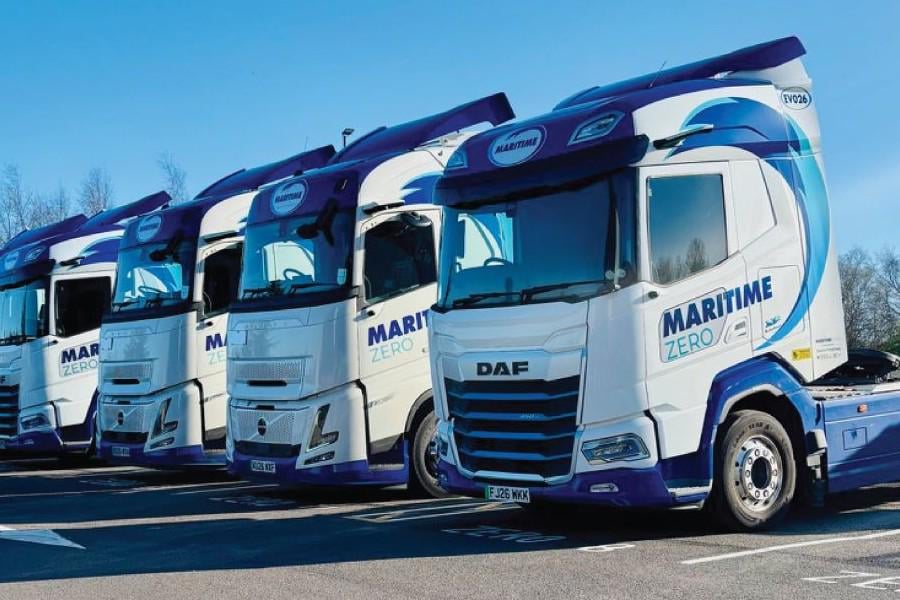
Maritime Transport, based in Felixstowe, UK, is significantly expanding its investment in battery-electric trucks. Nineteen units have recently been delivered to the logistics provider, comprising models from Volvo Trucks, Mercedes-Benz Trucks, and DAF. The company has announced that its electric fleet will grow to 56 units by the end of this year, which are ‘expected to achieve ranges of between 300 and 500 kilometres per charge depending on duty cycle, making it well suited to a wide range of regional operations.’
To meet the power demands of its trucks, Maritime is simultaneously developing one of the UK’s largest independent heavy goods vehicle charging networks. Once completed, the network will have a total installed capacity of over 22 megawatts and the ability to charge 100 electric HGVs simultaneously. Maritime also plans to make its chargers available to third parties to ‘unlock wider adoption of eHGVs across the sector.’
The introduction of electric HGVs at Maritime is part of the government-backed ‘Zero Emission HGV and Infrastructure Demonstrator’ (ZEHID) programme, which is funded by the Department for Transport and delivered in partnership with Innovate UK. The ZEHID project is divided into sub-projects: ZENFreight, Electric Freightway, and eFREIGHT 2030, with Maritime actively involved in all three. The company is providing critical data that will inform future investments and policy decisions, according to the British firm.
The first phase of Maritime’s transition to zero-emission transport began in January at its Wakefield transport depot. As part of the ‘ZENFreight’ sub-project, nine Mercedes-Benz eActros 600 trucks were integrated into the fleet and are charged on-site at six charging stations with up to 400 kW capacity.
According to the project team, the vehicles are now used for container transport and curtain-sided trailer operations, ‘providing early insight across a range of operating conditions.’ In March, four Volvo Aero and six DAF XF trucks were added in the Midlands. Specifically, these ten units are deployed under the ‘Electric Freightway’ sub-project at the Birmingham Rail Freight Terminal.
Further expansions under ‘ZENFreight’ are imminent: Maritime plans to soon deploy 18 electric HGVs and charging stations in Wakefield, Doncaster iPort, and the London Distribution Park in Tilbury. Additionally, for the Electric Freightway project, Maritime will increase its fleet from ten to 20 battery-electric trucks to strengthen operations at the Birmingham Rail Freight Terminal and the Manchester transport depot. Finally, another 18 vehicles will be added across five Maritime sites as part of eFREIGHT 2030, including the Segro Logistics Park Northampton.
The large-scale project is being implemented by Maritime ZERO, a subsidiary founded last year to specialise in zero-emission road transport.
“ZERO uses a hub-and-spoke model integrating long-distance rail with eHGVs completing onward journeys from inland terminals and port locations,” the logistics specialist explained. The subsidiary leverages Maritime’s intermodal network, which includes 40 daily train services, among other assets.
Tom Williams, Deputy Managing Director of Maritime Transport, commented: “Bringing our first eHGVs into operation, together with the charging infrastructure behind them, is a really important milestone for Maritime and the result of a huge collaborative effort across our business and with our partners.” Through ZEHID, the company has the opportunity to learn quickly and contribute to building the knowledge and confidence required to bring zero-emission trucks into the mainstream.
“Maritime’s investment in eHGVs and charging infrastructure is an important step forward for the UK logistics sector, and through ZEHID is helping show how zero-emission road freight can begin to be integrated into real-world operations,” added Simon Buckley of Innovate UK. “It also underlines the importance of combining vehicle deployment with the right infrastructure and operational planning if this technology is to move into more widespread use. By working through these challenges, Maritime is helping build the knowledge the industry will need in the years ahead, and Innovate UK is pleased to support this important work as the sector continues to decarbonise.”
The project-based ZEHID funding has been in place since October 2023 and totals £200 million, of which £120 million had already been disbursed as of early January. The beneficiaries include large consortia involving companies such as Amazon, Marks & Spencer and Royal Mail, as well as manufacturers including DAF, Volvo Trucks and Scania. By March 2026, “almost 300 zero-emission trucks will be deployed” through ZEHID, as the UK Department for Transport recently announced.
At the same time, the Department for Transport this week announced new funding to support individual businesses in procuring electric trucks. Under the ‘Zero Emissions Truck and Van’ programme, the government will subsidise up to 40 per cent of the cost of trucks, amounting to as much as £81,000 (approx. €93,500) per vehicle for the heaviest electric trucks. Even higher subsidy levels currently apply until the end of March.
by ApprehensiveSize7662
![The Kia EV2 is cheap, so is the GT-Line worth $10K more? [Video]](https://www.evshift.com/wp-content/uploads/2026/03/1774473893_Kia-EV2-Seltos-electric-770x515.jpeg "The Kia EV2 is cheap, so is the GT-Line worth $10K more? [Video]")