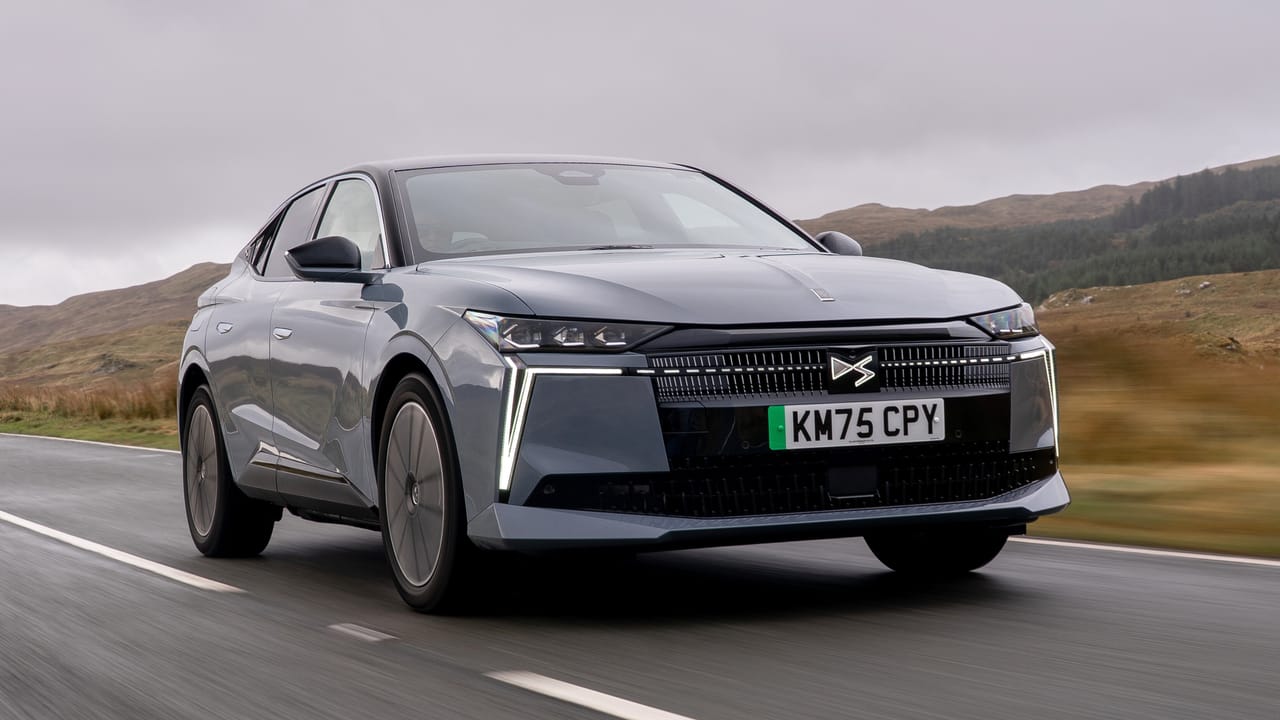
It’s the artist formally known as the DS 4, now wearing a new scent to align it with its bigger siblings, the No 7 and No 8. DS remains mildly eccentric, somewhat posh and self-consciously French. Its cars subtly transgress the conventions of size and template. The DS No 4 we have here drives a wedge into the wafer-thin gap between a tallish hatchback and a lowish crossover.
It sits on the same platform as the Peugeot 308 and Vauxhall Astra, but it’s got far more premium-hatch suspects in its crosshairs: Audi A3, Mercedes A-Class and BMW 1 Series. But the extra height means it tangles against the BMW X2, Cupra Formentor and Lexus UX as well. But very few of those are quite like the No 4, which is DS’s intention.
Advertisement – Page continues below
Striking innit?
It’s a good-looking thing, mostly because of the proportions. A comparatively short front overhang and low bulkhead bring a strong flat bonnet. Big wheel wells allow up to 20-inch alloys, pushed out flush with the body sides.
The sheetmetal is slashed with multiple diagonal creases. Too busy for some tastes perhaps, but it’s all distinctive and confident. The hatchback sweeps rakishly down, under an optional two-tone roof. Pop-out door handles and flashy textured LED lighting add to the upmarket look.
It’s also more aerodynamic than your usual crossover, thanks in part to the low roof, a flat floor and narrowish tyres that derive their grip from a large diameter.
What’s under the angular skin?
Take your pick from self-charging hybrid, plug-in hybrid and fully electric powertrains. The self-charger is carried over from the old one, and produces a combined 143bhp/170lb ft from its 1.2-litre turbocharged three-cylinder petrol engine, 28bhp electric motor and teeny tiny battery. It offers a small amount of e-running, recovering energy during deceleration and braking.
Advertisement – Page continues below
Next up is the PHEV, which has been tinkered with. It produces a combined 222bhp/266lb ft – no change there – courtesy of its 1.6-litre turbocharged, four-cylinder petrol engine and a 108bhp electric motor, but the bigger news is it now claims up to 50 miles of WLTP range, courtesy of its 14.6kWh battery. That’s up 30 per cent on the old one.
Then there’s the electric variant. It’s called the No4 E-Tense, gets a 210bhp/253lb ft front driven electric motor, and claims 280 miles of range from the 58.3kWh battery (aero has been improved thanks to an active front grille and 10mm lower height). A 20 to 80 per cent charge takes around half an hour on a 120kW charger, or five hours 20 mins on a home wallbox. Phew.
What about in the cabin?
Clasp the pop-out door handles and you’re into what’s in some ways a typical DS environment. Lots of glinting knurled metalwork, and soft puffy stitched leather or Alcantara. And screens.
Like you expected anything less. It now gets a new 10.25in instrument cluster, similarly styled to that in the No 8, plus a 10in central touchscreen… which is the same as beofre and these days feeling a little tired. It’s slow to respond, the graphics are a bit naff, and premium it ain’t.
The little touchscreen down by your knee has been lobbed in the skip too. That’s a shame – it was configurable so you could perform your most frequent operations as shortcuts with a simple swipe – and proper physical switchgear is few and far between. Lonely ‘home’ button is odd too…
There’s also a big and informative head-up display, ambient lighting, ‘invisible’ air vents (take that with a pinch of salt) and ChatGPT. Boot space measures up to 430 litres, less in the PHEV and electric variants.
How much does it cost?
Good question. Prices start at £32,200 for the hybrid. If you’re wanting the PHEV you’ll have to fork out at least £39k.
The electric one splits the two, kicking off at £36,995 and is eligible for a £1.5k government EV grant. Head over to the Buying tab for more info.
DS
157kW E-TENSE Pallas+ 61kWh 5dr Auto
£39,095
See prices and specs
What’s the verdict?
“Mildly eccentric and self-consciously French, but underneath its fancy frock it remains an Astra/308 in disguise. It shows”
Whether or not you actually want a car with such self-conscious styling is a question that comes up with any DS model. With looks that are as subjective as they are here, we’ll leave it up to you to decide whether you like it.
But we will say this. It’s sharply styled, with the interior host to lots of knurled metal and fancy stitching, but underneath its fancy frock it remains an Astra/308 in disguise. It shows, with the parts sharing obvious in the cabin, the material finish not quite as premium as DS would have you believe and the ride quite fidgety.
It was always going to take some doing to tempt people away from stuff like the Audi A3, BMW 1 Series and Merc A-Class. That’s some serious talent right there – too much for DS No 4 to compete with.
Find another car review
Manufacturer296 Special Edition (2025)AbarthAlfa RomeoAlpinaAlpineArielAston MartinAtlasAudiBACBentleyBMWBrabhamBugattiBYDCadillacCaterhamChanganCheryChevroletChryslerCitroenCorollaCorvetteCupraDaciaDodgeDSEagleElementalFerrariFiatFiskerFordFrontlineGeelyGenesisGMCGordon Murray AutomotiveGWMGWM ORAHondaHyundaiIneosInfinitiIsuzuJaecooJaguarJeepJensenKGMKiaKimera AutomobiliKoenigseggKTMLamborghiniLanciaLand RoverLeapmotorLexusLincolnLockheed MartinLotusLucidMaseratiMazdaMcLarenMercedes-BenzMG Motor UKMiniMitsubishiMorganNioNissanNobleOmodaPaganiPeugeotPininfarinaPipistrelPolestarPorscheProdriveRadicalRAMRenaultRimacRivianRolls-RoyceSeatShelbySkodaSkywellSmartSoyuzSsangyongSubaruSuzukiTeslaThe Little Car CompanyTop Gear Technology CentreToyotaVauxhallVolkswagenVolvoXpengYukonZenvo
CONTINUECONTINUE