In March 2025, EVs and PHEVs accounted for around one in 10 new vehicle registrations.
Market leader sells out
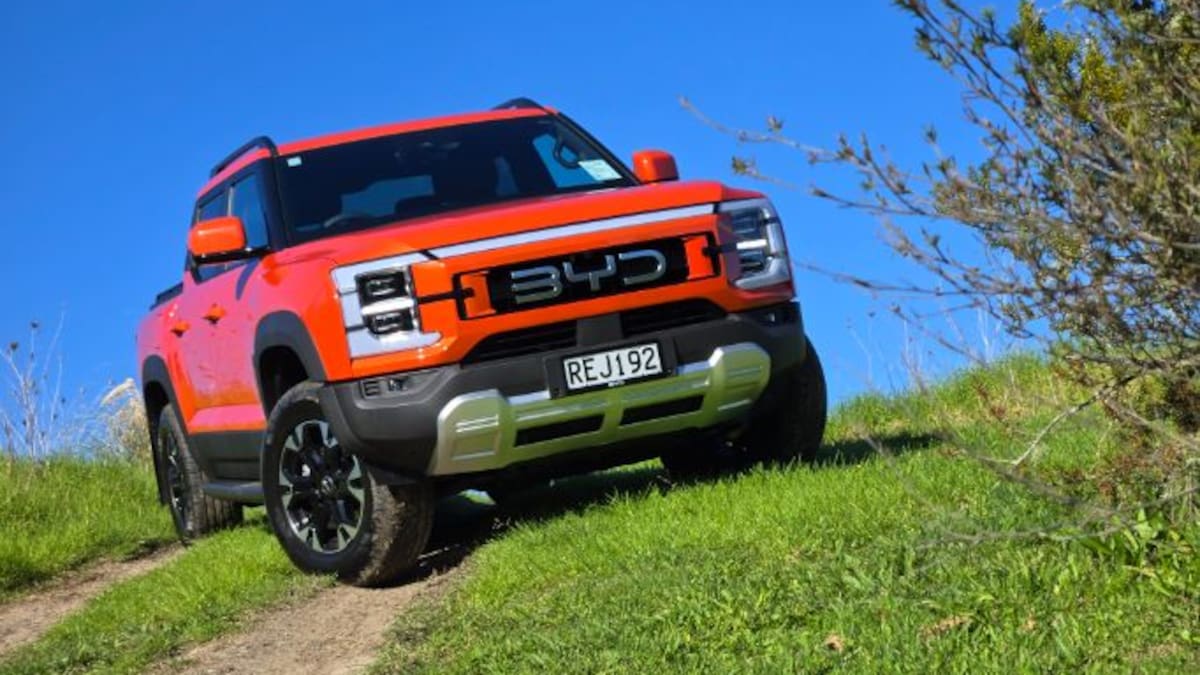
BYD, the Chinese giant that recently passed Tesla in global EV sales as Elon Musk’s company reported its second year of declining sales, has easily been the strongest-selling electric vehicle brand in New Zealand this year.
The Iran crisis has delivered another bump in its sales, but the flipside is local stock levels have come under pressure.
“BYD New Zealand is completely sold out,” country manager Warren Willmot said.
Willmot spoke to the Herald from China. “I’ve been here to secure more stock,” he said.
EV and plug-in hybrid new vehicle registrations from January 1, 2026 to March 11, 2026. Source / Ministry of Transport
“I’ve managed to get an additional 130 cars coming from Australia and 60 Atto 3s from China to arrive in April.
“BYD has upped our production allocation so we will have plenty more cars coming in May and June.
“Currently, we are selling between 50 to 100 cars a day.
“At this run rate, we could sell up to 5000 cars over the next 100 days.
“BYD China has guaranteed to supply every car.”
The maximum wait times for New Zealand customers will be 90 days, he said.
That compares to around seven days before the US and Israeli attacks on Iran.
EV incentives redundant?
Lobby group Drive Electric has called on Transport Minister Chris Bishop to lower the road user charges (RUCs) for electric vehicles that were introduced at the start of 2024 (at $76 per 1000km for an EV and $38 per 1000km for PHEVs, which also pay petrol tax).
But are any leg-ups needed if electric vehicle sales are surging?
Drive Electric chairwoman Kirsten Corson says the effect could be transitory. She compares it to the spike at the start of Russia’s full-scale invasion of Ukraine.
Corson said large organisations like NZ Post whose vehicles clock high kilometres would buy more EVs if RUCs were lowered.
Her group also argued that more EVs would be better for New Zealand’s balance-of-payments and energy security.
“New Zealand has 86% renewable energy, which isn’t going to get stuck on the back of a boat on the Strait of Hormuz,” she said.
“The only silver lining [about the Iran war] is that it’s got people thinking about how we’ve a country with no fuel independence and $8 [billion] to $9 billion leaving our economy every year for fossil fuels.”
More chargers, FBT exemption
Last week, the Government announced a $52 million plan to double the number of public EV chargers by 2030.
Corson welcomed the news, but said much more was needed. She said the Government had promised more than $200m to go towards fast chargers several years ago.
Drive Electric also wants EVs to be exempted from Fringe Benefit Tax (FBT) to increase business uptake.
Businesses have a high vehicle turnover, Corson said. Her group sees an FBT exemption helping to supply the second-hand electric car market.
“The average person buying a car in New Zealand spends $7000,” she said.
“That’s enough for a second-hand Nissan Leaf, but not if you’ve got kids and sports and camping gear and need a larger vehicle. EVs are not accessible for a whole segment of our community.”
Investment Boost boost?
Corson pins the increase in EV sales on the Middle Eastern conflict.
“Who would have thought Donald Trump would be an environmentalist?” she said, pointing to the US President’s perhaps unintentional role in boosting fossil-fuel alternatives.
There is also one other possible factor in play: the looming end of the tax year on March 31.
The Motor Industry Association (MIA) has credited the Government’s Investment Boost accelerated depreciation measure, which came into effect from May 22 last year, for helping to return the overall new vehicle market to growth.
Investment Boost, which has been promoted by ChargeNet and others, allows a business to claim a tax deduction of 20% in the year of purchase of any productive business asset.
Deloitte tax partner Robyn Walker noted: “The 20% is able to be claimed in full, even if the vehicle is only owned for a fraction of the income year.”
Tax relief on the way
It’s possible Drive Electric will get its wish on a Fringe Benefits Tax exemption for EVs, even if it’s a side-effect of a push to simplify the tax code rather than save the planet.
“The National-led Government had plans to reform the Fringe Benefit Tax rules for motor vehicles. These proposals are still under consideration,” Walker said.
“But if they were to proceed, they would improve the tax outcomes for businesses that use EVs. At present, there is a ‘work-related vehicle’ exemption from FBT, which typically benefits double-cab utes.
“Because of various quirks of the rules, it’s generally not possible for an EV to fall into those rules.
“Under those proposals, a vehicle would be exempt from FBT on the basis of how the vehicle was used, not what type of vehicle it was – so an EV could equally qualify for the exemption.
“It was also proposed that there would be a more concessional calculation of FBT for EVs. It would be great to see these rules progress.”
Chris Keall is an Auckland-based member of the Herald’s business team. He joined the Herald in 2018 and is the technology editor and a senior business writer.