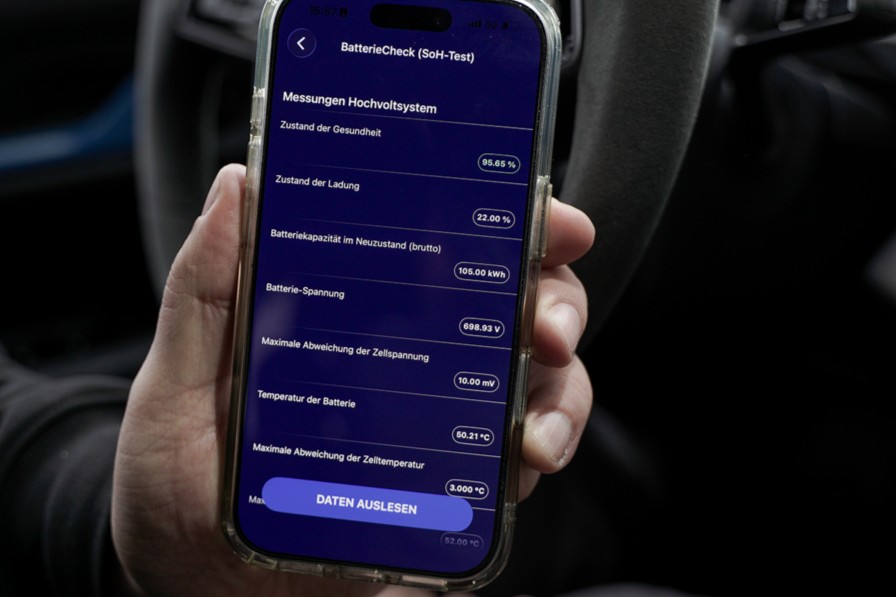
Traction batteries in EVs are significantly more durable than previously assumed. This is the conclusion reached by TÜV Nord and the Munich-based company Carly after analysing the State of Health (SoH) of batteries in around 50,000 battery-electric and plug-in hybrid vehicles. The median SoH of all batteries examined was 96%. This should not be confused with a simple average (arithmetic mean); instead, it means that exactly half of the vehicles analysed were above this value, while the other half were below it. However, neither company provided a simple average.
Unsurprisingly, the analysis shows that battery condition is generally better in newer vehicles. However, the findings become particularly interesting when considering the age and mileage of the vehicles. For instance, older models from brands such as Hyundai, Kia, or Mercedes-Benz often still retain a battery capacity of around 90 to over 95%. In contrast, batteries in older models from VW, Renault, or Citroën sometimes exhibit a State of Health of only 70 to 80 per cent. Depending on the vehicle’s age, this results in a difference of roughly two to ten SoH percentage points between brands, according to the study’s authors. However, this gap narrows significantly in newer models. Further details were not disclosed by TÜV Nord and Carly.
Sharp decline after 90,000 kilometres
The analysis becomes even more intriguing when examining battery degradation – the term experts use to describe the ageing process of the traction battery, which leads to a permanent loss of storage capacity and, consequently, reduced range—in relation to vehicle mileage. A notable finding is a sharp decline in the SoH curve: while battery capacity decreases by an average of only 0.7 percentage points per 10,000 km within the first 90,000 km, this value rises relatively suddenly to 2.3 percentage points per 10,000 km after 90,000 km of mileage.
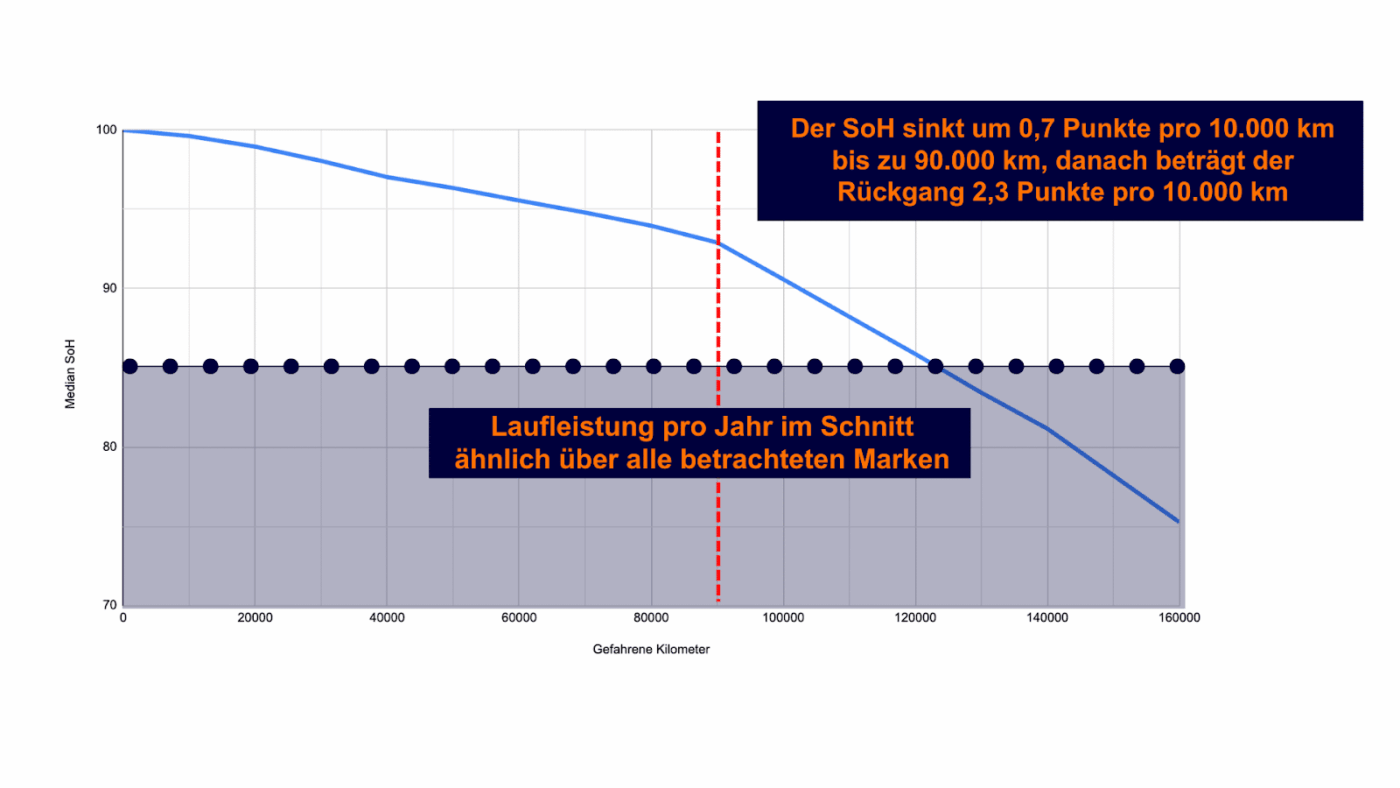
The study does not clarify whether mileage or vehicle age has a greater impact on declining battery capacity. Additionally, Carly and TÜV Nord do not address other factors that could influence SoH beyond brand, age, and mileage. For example, Geotab recently analysed how frequent use of ultra-fast chargers instead of AC chargers slightly accelerates degradation, though within tolerable limits. Battery thermal management and ambient temperature can also play a role: Geotab found that batteries age somewhat faster in hotter regions compared to cooler ones. Lastly, individual driving behaviour may have a minor impact on degradation.
The key takeaway is that most electric vehicle batteries today last significantly longer than previously assumed—and nearly every new electric car now performs better in terms of SoH than what manufacturers guarantee. Currently, the market standard is a warranty of eight years or up to 160,000 km, by which the battery must retain a minimum residual capacity of 70 per cent.
Batteries more robust than assumed
“Our data shows that batteries are more robust than often assumed, but at the same time age measurably with increasing mileage. Especially against the backdrop of a growing but still uncertain used car market, SoH data is becoming a decisive factor: it creates an objective basis for pricing and purchasing decisions and significantly reduces the risk for all market participants,” says Avid Avini, CEO of Carly.
“The used car market for electric cars is currently characterised by a great deal of uncertainty, particularly with regard to the condition of the battery. This is precisely where objective SoH data comes in: For the first time, they make the battery condition comprehensible and comparable, thus replacing to a certain extent the previous assessment based on assumptions. For consumers, dealers and financiers, this is a decisive step towards greater transparency and trust in the market,” says Hartmut Abel, CEO of TÜV Nord Mobilität.
Since December, Carly and TÜV Nord have jointly offered a standardised battery assessment solution (link in German) for used cars with CARA certification. At its core, this is a check for battery-electric and plug-in hybrid vehicles to evaluate the battery’s health status.
mycarly.com (link in German), tuev-nord-group.com