E-bikes have been a source of ire in New South Wales.
While offering an accessible form of transport and exercise, their rapid growth has also seen injuries, speed concerns, misuse and lithium-ion fires.
In response, the state government recently announced “measured and staged reforms aimed at improving safety for riders, pedestrians and the wider community”.
A power output enforcement has been introduced from this month, while a minimum age requirement for riders is also currently being explored.
Here’s what the new rules will look like for those who use the estimated 760,000 e-bikes across the state.
What are the new standards?
European safety and performance standards have been introduced from March for new e-bikes, following in the footsteps of WA.
An e-bike marked as “EN 15194” now meets manufacturing requirements to keep them acting like bicycles rather than motorbikes.
It means e-bikes must have a maximum power output of 250 watts, and pedal assistance has to cut out at 25 kilometres per hour.
Additionally, no assistance will be delivered after 6km/h if the rider is not pedalling.
The government says the standard also has battery, electrical and fire-safety requirements, as well as anti-tampering protections to prevent the alteration of power or speed limits.

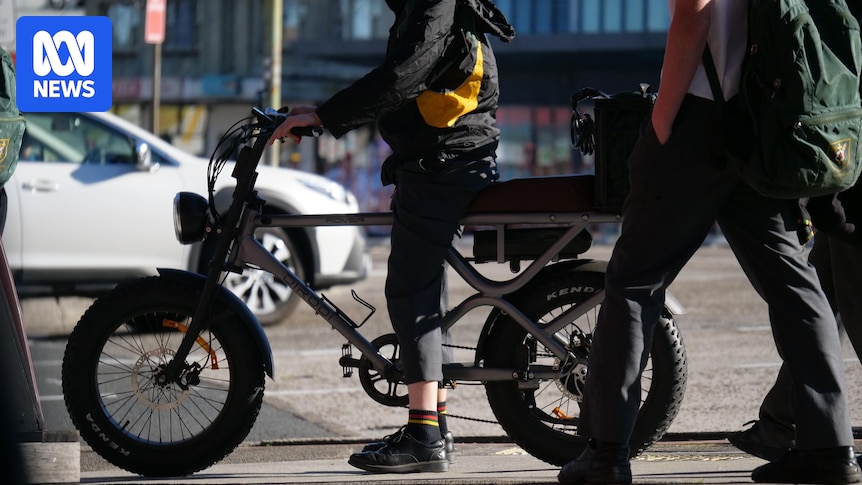
There are more than 700,000 e-bikes in NSW. (ABC News: Emma Wynne)
In 2023, NSW enforced a 500-watt standard for e-bike motors — or the maximum continuous energy output.
Chief executive officer at advocacy group Bicycle NSW, Peter McLean, said there were “not a huge number” of 500-watt devices on the roads because “not many companies actually make” them.
Meanwhile, “some of the high-powered bikes out there which we’re commonly seeing referred to as just e-bikes, they’re illegal devices,” he said.
“They’re not classified as an e-bike in the first place because they don’t meet the definitions, and they generally start at 1,000 watts … and that is obviously four times more powerful than the EU standard.”
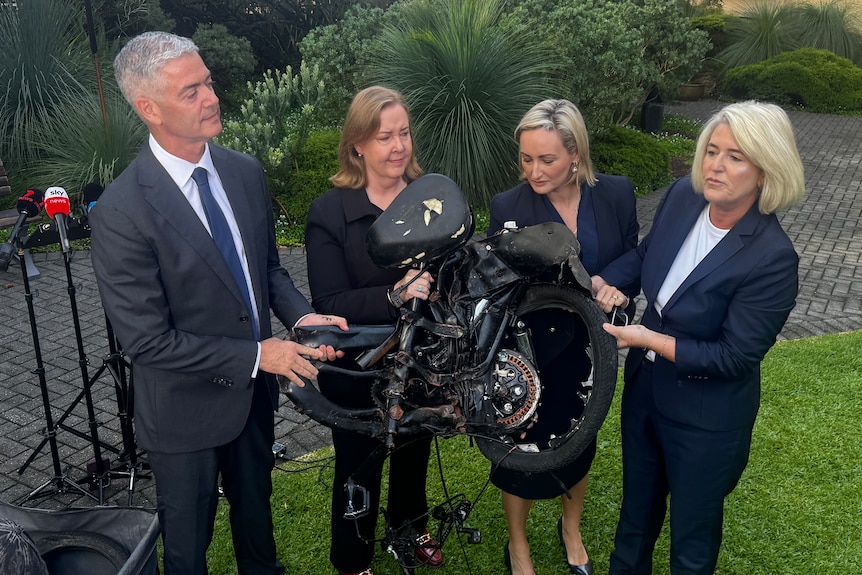
John Graham and Jenny Aitchison (second from left) hold a crushed e-bike. (ABC News: Nick Dole)
Retailers will also be required to clearly specify a bike meets the EU standard after a period of consultation.
Mr McLean said there were many “gold standard” e-bikes out there that didn’t have the now-required stickers or markings, which weren’t previously required at time of sale.
“So we’ve got to look at how we can make sure … to still accommodate those people who have bought the right devices in the past,” he said of the changes.
Loading…What is the age proposal?
Currently, a child of any age can ride or be carried as a passenger on an e-bike.
The NSW government has argued that e-bikes were “heavier and faster” than traditional bicycles, leading to increased force with crashes and more difficulty controlling them.
Minister for Transport John Graham said he held concerns about “primary school-aged children” trying to control e-bikes, as well as “groups of teens pilling on to fat bikes”.
In February, police condemned teens who rode over the Sydney Harbour Bridge on an assortment of e-bikes, electric motorcycles and motorcycles, prompting a call for illegal e-bikes to be outlawed on all public roads.
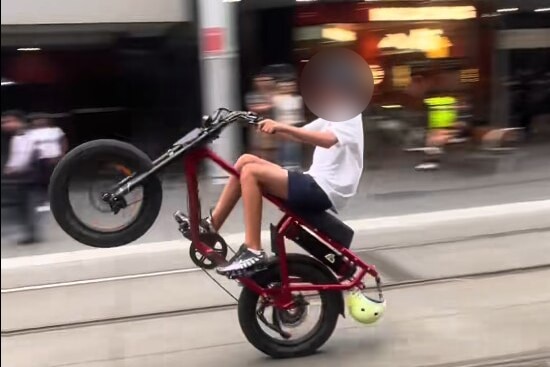
The teens performed wheelies on the e-micromobility devices in Sydney.
A Transport for NSW review, currently in establishment, is expected to recommend the legal minimum age to be set at between 12 and 16 years old for riding an e-bike.
It will also consider whether children and teenagers have the skills or maturity to safely carry passengers.
“We want to make sure riders are physically and cognitively capable to handle e-bikes, so they can be ridden safely within the road rules,” Minister for Roads Jenny Aitchison said.
“Age restrictions for young riders will help ensure this can be done and reduce the risk of injury for not just young people but also other road users too.”

Peter McLean wants to see more education and awareness around e-bikes. (Supplied: Peter McLean)
Mr McLean said an age limit should go hand-in-hand with the safety standards, because e-bikes were vital for young people’s independence, as well as social, school or work commitments.
“If we have them using these safe devices, then obviously they’re not going to pose [the same] risk as a high-speed, overpowered device which we’re currently seeing commonly used,” he said.
How and when will they be enforced?
A three-year transition period has been granted for owners to adjust to the new power limit.
From March 1, 2029, only EU-compliant e-bikes will be road legal in the state.
Mr McLean said the standard primarily affected “what we’re purchasing and importing moving forward” instead of targeting e-bikes previously purchased legally.
Are there speed limits for e-bikes?
The transport minister said NSW Police powers had been extended to seize and crush “souped-up motorbikes masquerading as an e-bike” for those exceeding 500 watts.
It accompanies the introduction of roadside dyno units to test the speed of e-bikes going above the 25km/h limit.
Advice and findings relating to the minimum age reform will be handed to Mr Graham and Ms Aitchison in June, with a final call expected afterwards.
It comes as independent MP Jacqui Scruby last week introduced a private member’s bill pushing for e-bike licensing, registration and education, arguing the government’s current approach focused “too heavily on punitive measures”.
She said she believed that if e-bikes had number plates, it would curb “anti-social and illegal behaviour”.
“It’s not that hard. We already have trials of education and license plates … currently being undertaken at high schools.”

![Startling E-Bike Crash on Industrial Boulevard and NW HK Dodgen Loop Injures 1 [Temple, TX]](https://www.evshift.com/wp-content/uploads/2026/03/1774370512_Double_Yellow_Bike-1024x768-770x515.jpg "Startling E-Bike Crash on Industrial Boulevard Injures 1")