Safety issues and related recalls have been part of the car industry since automobiles became a major part of daily American life in the early 20th century. The issue extended into other industries, such as insurance, and gave rise to a cottage industry of research into which car brands and models are the safest and which have the most serious safety flaws.
Today, many Americans make safety judgments based on research from industry heavyweights including JD Power, Consumer Reports, automotive media outlets such as Car and Driver, and the Insurance Institute for Highway Safety (IIHS), a nonprofit whose primary mission is reducing dangerous car accidents, injuries, and fatalities. The IIHS also specializes in insurance loss data.
Safety is also, in part, self-governing. Car companies that discover flaws in their vehicles often issue recalls voluntarily. When a manufacturer’s response to a safety issue is deemed insufficient, it falls to the Department of Transportation’s National Highway Traffic Safety Administration (NHTSA) to enforce safety regulations.
Recalls happen with great frequency and often affect millions of vehicles. According to Car Dealership Guy , Ford issued 152 recall notices last year — nearly double the previous record set by General Motors — covering just under 13 million Ford and Lincoln vehicles, the most of any automaker.
The largest recall in automotive history did not involve a car manufacturer at all, but rather a parts supplier. Takata, one of the world’s biggest airbag suppliers, provided airbags to 19 automakers spanning 34 brands. A defect in those airbags triggered a recall totaling more than 67 million vehicles. In the United States alone, the defect killed 26 people and injured over 400. Takata subsequently filed for bankruptcy.
The development of safer cars has been a gradual process. The federal seat belt law took effect in 1968. Front airbags became mandatory in 1998, and antilock brakes were required starting in 2012. Even with these advances, driving remains deadly. According to the NHTSA, an estimated 17,140 people lost their lives in motor vehicle crashes from January through June 2025, down from 18,680 fatalities during the same period in 2024.
Each year, the IIHS and its affiliate, the Highway Loss Data Institute (HLDI), test dozens of new vehicle models across eight crash scenarios: small overlap front, moderate overlap front, side impact, headlights, front crash prevention vehicle-to-vehicle, front crash prevention pedestrian, seat belt reminders, child seat latch systems, and whiplash prevention.
In each category, vehicles are rated Good, Acceptable, Marginal, or Poor. To earn a Top Safety Pick designation, a vehicle must score Good in four categories and Acceptable in the remaining three; any Marginal or Poor rating disqualifies it. The higher designation, Top Safety Pick+, requires Good ratings in five categories and Acceptable in two.
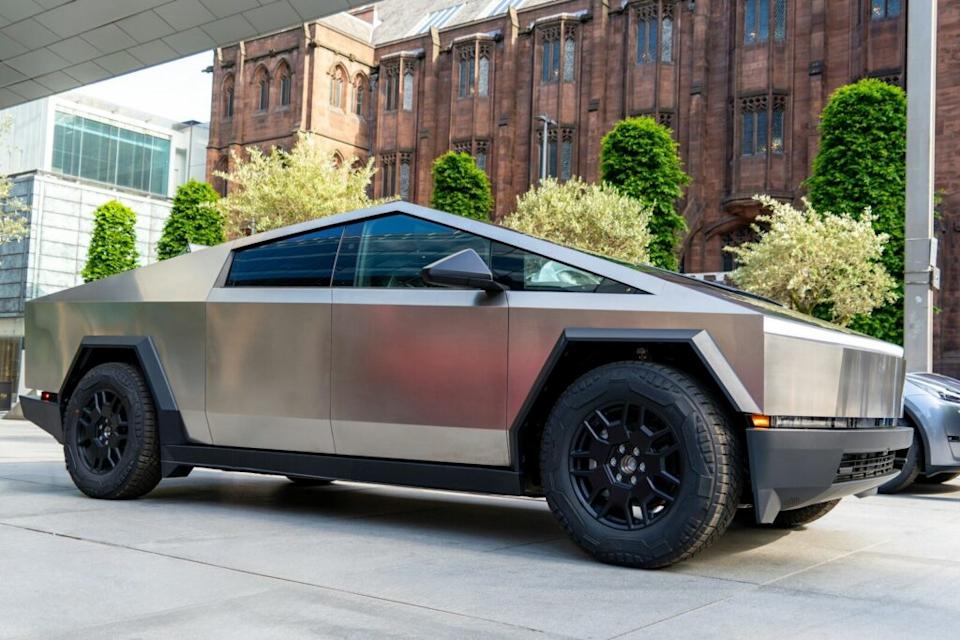
In September 2025, the IIHS tested seven 2025-model electric vehicles, with a particular focus on the updated moderate overlap front crash test. Five of the seven performed at an award-worthy level, while two struggled to adequately protect rear passengers. The stronger performers included the BMW i4, Chevrolet Blazer EV, Nissan Ariya, Tesla Cybertruck, Tesla Model 3, and Volkswagen ID.Buzz. None of the seven, however, received either a Top Safety Pick or Top Safety Pick+ award.
The one clear outlier was the Ford F-150 Lightning. Despite being the best-selling electric pickup truck in the United States, it performed poorly in protecting rear occupants during the moderate overlap front crash test. As the EV market continues to mature, many models have yet to undergo this level of scrutiny — but testing will continue to expand over the coming years.