Tesla may be getting ready for one of the biggest solar manufacturing moves in America. Reuters reports that the company is looking at buying about $2.9 billion worth of equipment from Chinese suppliers to make solar cells and solar panels in the United States.
If the plan moves forward, it could help Tesla build up to 100 gigawatts of solar manufacturing capacity on American soil by the end of 2028. That is a huge number. It also shows how serious Elon Musk may be about turning solar into a much bigger part of Tesla’s future.
But the report also reveals a bigger problem for the U.S. clean energy sector. Even when companies want to manufacture in America, they still often depend on Chinese tools, machinery, and supply chains to make it happen.
Tesla’s Solar Dream Is Getting Bigger
According to Reuters, Tesla is in talks with several Chinese companies that make solar manufacturing equipment. Suzhou Maxwell Technologies is one of the main names in the discussion. The company is known as the world’s biggest maker of screen-printing equipment used in solar cell production.
Other possible suppliers include Shenzhen S.C New Energy Technology and Laplace Renewable Energy Technology, Reuters said, citing people familiar with the matter.
Some of the equipment may need export approval from China’s commerce ministry before it can be shipped. Reuters reported that the companies were asked to deliver the machinery before autumn, and two sources said the equipment would likely head to Texas.
These details suggest Tesla’s plan is not just an idea or a long-term goal. The company seems to be preparing for a major manufacturing buildout in the U.S. However, the company has not publicly confirmed the reported order. The Chinese suppliers and China’s commerce ministry also did not respond to Reuters’ requests for comment, according to the report.
In January, Musk said solar power could meet all of America’s electricity needs, including rising demand from data centers. Reuters also noted that Tesla job postings said the company wants to deploy 100 GW of “solar manufacturing from raw materials on American soil before the end of 2028.”
The Cost Gap Keeps China in Charge of Solar Supply Chains
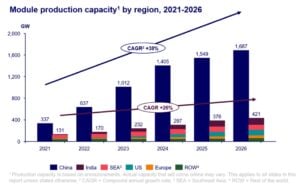
After years of heavy investment, China controls most of the world’s solar manufacturing chain. According to Wood Mackenzie, China is expected to hold more than 80% of global polysilicon, wafer, cell, and module manufacturing capacity from 2023 to 2026.
Wood Mac also said a solar module made in China is about 50% cheaper than one made in Europe and 65% cheaper than one made in the United States. That price gap makes it hard for U.S. factories to compete, especially in the early stages.
 Source: Wood Mackenzie
So even when U.S. companies want to build locally, they still often need Chinese equipment and expertise. Reuters pointed out that the Biden administration excluded solar manufacturing equipment from tariffs in 2024 after U.S. solar companies said they had no real alternative source for the machines needed to launch domestic factories. That exemption has since been extended by the Trump administration.
In other words, America’s solar manufacturing push still depends, at least in part, on Chinese technology.
Why Tesla May Be Making This Move Now
Tesla’s reported plan is about much more than one company. It highlights a major challenge for the United States as it tries to build a stronger clean energy economy.
U.S. electricity demand is rising again, and solar is growing fast. The Energy Information Administration said U.S. power use hit its second straight record high in 2025. It also expects demand to keep rising in 2026 and 2027.
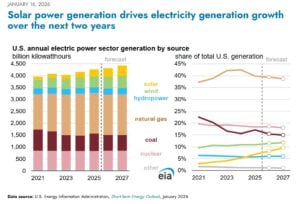
At the same time, solar is becoming one of the country’s fastest-growing power sources. In its latest outlook, the EIA said utility-scale solar generation in the U.S. is expected to grow from 290 billion kilowatt-hours in 2025 to 424 billion kilowatt-hours by 2027.
The EIA also said nearly 70 GW of new solar capacity is scheduled to come online in 2026 and 2027. That would increase U.S. solar operating capacity by 49% compared with the end of 2025.
Texas Solar Capacity Supports Tesla and SpaceX
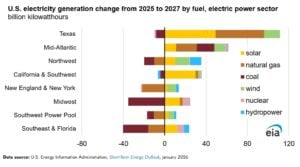
Texas is expected to lead much of that growth. Solar generation in the ERCOT grid is forecast to rise from 56 billion kilowatt-hours in 2025 to 106 billion kilowatt-hours by 2027. Battery storage is also growing to help balance solar power throughout the day.
This helps explain why Texas is such an important part of Tesla’s reported plan. The state already plays a big role in Tesla’s manufacturing footprint. It is also one of the hottest solar markets in the country.
For Tesla, building solar equipment or solar products in Texas could support more than just the grid. Reuters said Musk plans to use much of the capacity for Tesla itself, while some could also help power SpaceX satellites.
That would turn solar into a strategic asset across Musk’s wider business empire. It would also tie clean power more closely to Tesla’s long-term growth story, especially as energy demand from artificial intelligence and data infrastructure keeps rising across the country.
Snapshot of US Solar Imports
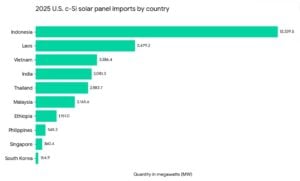
Even with more local manufacturing, the U.S. solar market still depends heavily on imported parts. Solar Power World reviewed U.S. International Trade Commission data and found that the United States imported 33 GW of silicon solar panels in 2025. It also imported 21 GW of silicon solar cells.
That cell figure is especially important because it shows that U.S. panel assembly is growing faster than domestic cell production. America may be building more panels at home, but it still imports many of the core components needed to make them.
 Source: Chart: Solar Power WorldSource: U.S. ITCGet the dataCreated with Datawrapper
The report said the U.S. has around 50 GW of silicon panel assembly capacity, but less than 5 GW of domestic cell manufacturing output. That means plenty of cells still have to be imported. Notably, most imported cells came from Indonesia and Laos in 2025, while South Korea was also a major supplier.
This is where Tesla could make a difference. If it builds large-scale solar cell and panel manufacturing in the U.S., it could help close one of the biggest gaps in the domestic solar supply chain.
Still, there is an irony here. To reduce America’s dependence on foreign solar products, Tesla may first need to buy Chinese machines.
A Massive Opportunity, But Also a Huge Challenge
If the deal happens, it would be a major win for Chinese solar equipment companies. Many of them have faced weak domestic demand because China has already built too much manufacturing capacity.
For Tesla, the order could lay the foundation for a giant U.S. solar platform. It could support the company’s long-term energy strategy at a time when America needs more electricity, more solar, and more battery storage.
But the challenge is enormous.
Building 100 GW of solar manufacturing capacity in just a few years would be a staggering task. Tesla would need factories, workers, permits, raw materials, logistics, and smooth equipment delivery. It would also need stable trade rules and a supportive policy environment.
The company has already faced supply chain setbacks before. Reuters previously reported that production preparations for the Cybertruck and Semi in the U.S. were disrupted last year after component shipments from China were suspended following higher tariffs on Chinese goods. This history shows how exposed U.S. manufacturing can still be to trade tensions.
If speculations are true, Musk appears to be thinking far beyond electric vehicles, i.e., building a larger clean energy system around solar, batteries, manufacturing, and power demand from new technologies like AI.
For now, Reuters’ report shows a simple reality. The U.S. wants a homegrown solar industry. Tesla may want to help build one. But China still holds many of the tools needed to make that goal real.