Across the world the motor industry is in a state of flux. Draconian emissions and safety legislation, stiff environmental penalties, import tariffs (although not in the UK) and heavy competition, particularly from China, makes any straightforward comparison between vehicles and their manufacturers almost impossible; measures such as supply and demand, or price and size, make little sense anymore.
Are China’s low costs of production and government subsidies making it uneconomic to produce in Europe? Should you cave in and consider a Chinese-made vehicle? We took two very similar PHEVs to discover whether a European car is worth the extra cost.
The market: Europe’s largest
BYD is the unstoppable force of Chinese car production. Last year, it sold more than 4.5 million cars, more EVs than Tesla, and was in the top-five car producers by volume. Cheap and tough lithium-iron-phosphate (LFP) “Blade” batteries and low costs of production make its cars decent value for money.
As with the rest of the Chinese herd, BYD’s cars offer a mix of powertrains and its bestsellers are the tax-friendly (for the moment) plug-in hybrids (PHEVs), such as the smallest Atto 3, the Seal U and this new Sealion 5 (the largest Sealion 7 is a pure EV).
Quite why BYD requires four SUVs of similar size is a pertinent question – but you might equally ponder why the Volkswagen Group requires a range of very similar SUV models based on the same platform, such as the VW Tiguan and Skoda Kodiaq – but it keeps costs down in what is Europe’s largest market segment. Other key players in this sector are the Kia Sportage, Nissan Qashqai and MG HS, all popular cars in the UK.
Under the skin
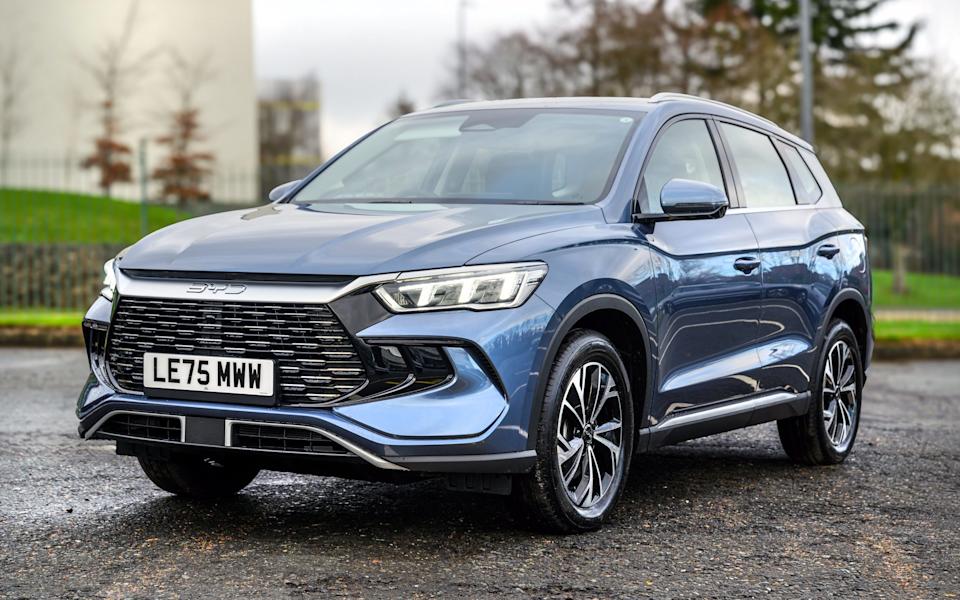
The Sealion 5 has a 1.5-litre, 95bhp petrol engine and a 194bhp electric motor, giving an overall output of 209bhp and 221lb ft of torque. The hybrid set-up features twin electric motors – one drives the car, the other acts as a starter/generator.
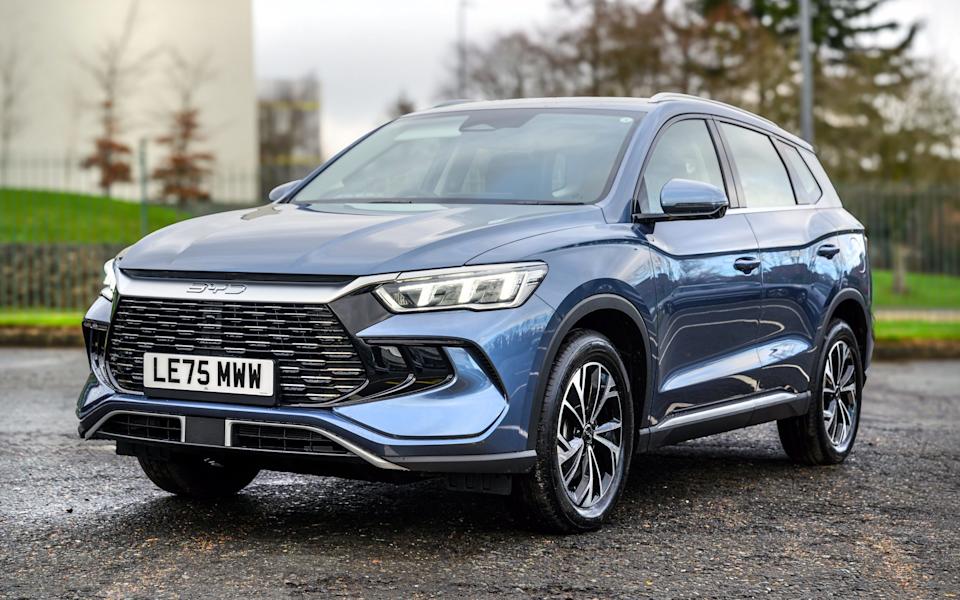
The Sealion 5 has a 1.5-litre, 95bhp petrol engine and a 194bhp electric motor – Paul Cooper
The drivetrain can run solely as an EV, in “parallel mode” where the wheels are powered by the electric motors and/or petrol engine, or in “series mode”, where the engine does not turn the wheels but drives the generator to charge the battery or power the electric motor. The front wheels are driven via a continuously variable transmission (CVT) and suspension is MacPherson strut front, multi-link rear.
The Comfort trim starts at £29,995 and offers 40 miles of EV range from its 13kWh battery, a top speed of 106mph and 0-62mph in 8.1sec. The £32,995 Design achieves 53 miles of EV range from an 18.3kWh battery.
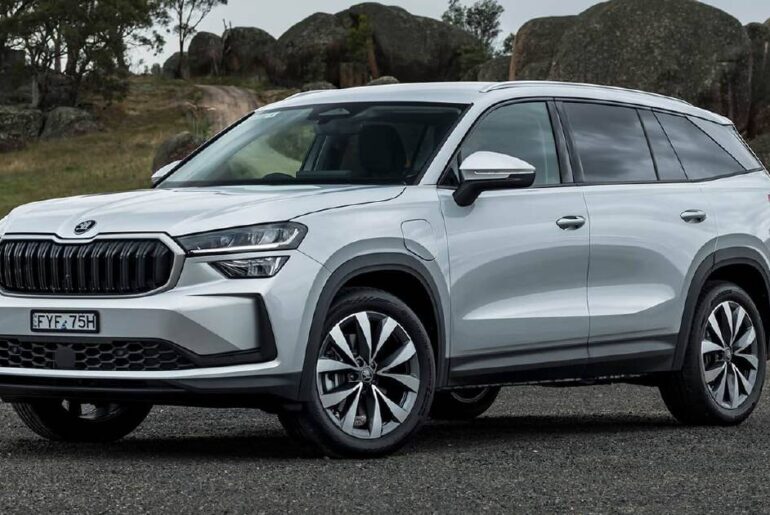
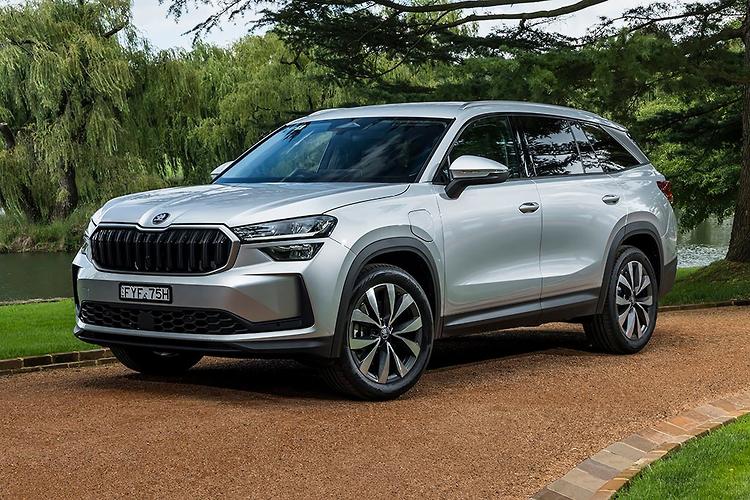
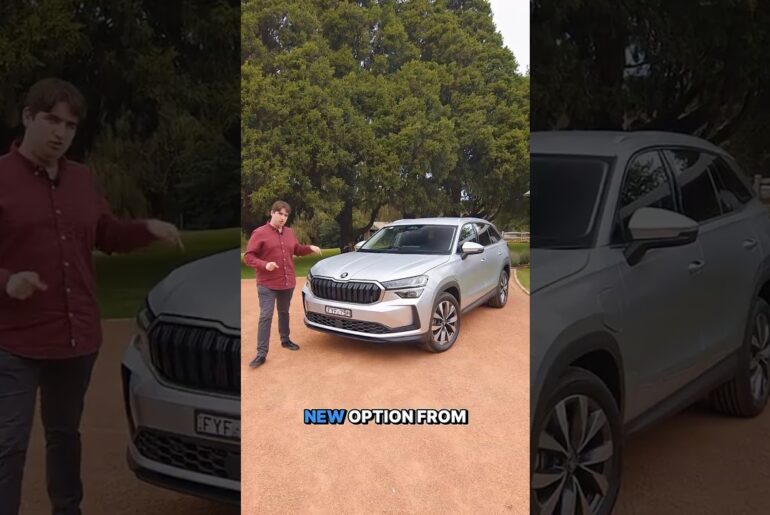
The Kodiaq has been through a number of upgrades since launch in 2016. Its combination of practicality and comfort makes it one of Skoda’s best sellers, regularly exceeding sales of more than 100,000 annually and totalling 130,400 last year.
This PHEV has a 1.5-litre four-cylinder engine producing 148bhp with a 104bhp electric motor coupled to a six-speed DSG transmission and driving the front wheels. The EV range is 73 miles in the WLTP cycle, with a top speed of 130mph and 0-62mph in 8.4sec.
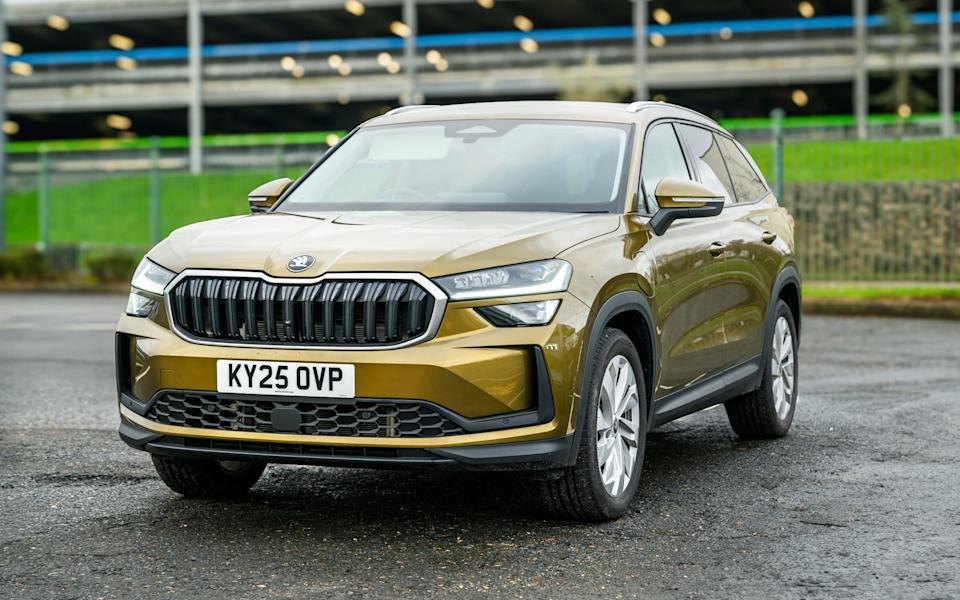
The Kodiaq has become one of Skoda’s best sellers, with sales of 130,400 last year – Paul Cooper
Prices start at £39,025, rising to £54,575 for the high-performance vRS. The PHEV starts at £44,745; as tested in the well-equipped SE L trim it costs £47,120.
So, £33,995 for the BYD versus at least £45,000 for the Skoda. A clear win for the Chinese, surely. Yet while the Skoda is more expensive when new, its residual value after 36 months and 30,000 miles is 53 per cent (£23,850); the equivalent value for the BYD is 50.7 per cent (£17,238). However, since the Sealion 5 is brand new and the market is moving so fast, there’s a certain amount of guesstimation in that figure.
Inside job
Both are spacious, with reasonable storage space around the front seats and roomy rear seats with leg and head room to spare. The BYD suffers in boot space, trading 463 litres (others in the class boast up to 600 litres) compared with the Skoda’s 745 litres.
The Kodiaq has a similar amount of interior surface changes as the Sealion 5, but the surfaces themselves are more pleasing to the eye and the touch – it simply feels classier. And the Kodiaq also feels like a big car, with a wide sweep of the facia underpinned with a gentle green highlight illumination, which is a lovely feature. The controls are based on a combination of touchscreen tiles with separate rotary heater controls and they are lovely to use. Similarly the digital instrument binnacle, which can show the map navigation instructions with digital instruments projected on top, was debuted by Audi and is easy to use and clear.
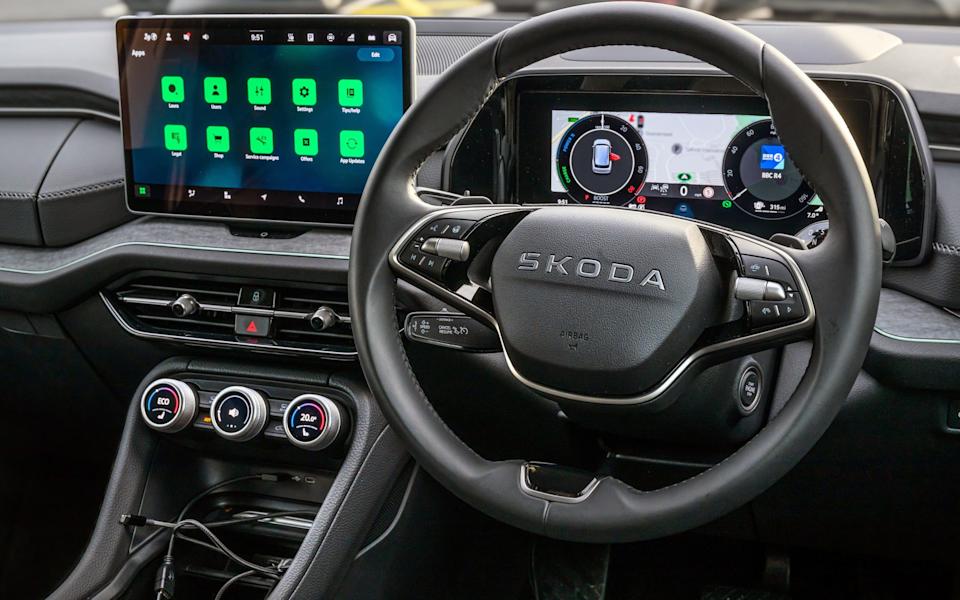
The Kodiaq’s interior surfaces are more pleasing to the eye and the touch than BYD’s alternative – Paul Cooper
Not so with the BYD, its huge central screen being the gateway to just about everything. There’s a new heating and ventilation three-finger swipe system but it’s hardly intuitive. Finding the rest of the functions is tricky, especially if you look across at the screen – whereupon the driver monitoring system admonishes you for averting your eyes from the road. Even when you find them, the functions are tough to activate, often requiring several stabs at the screen.
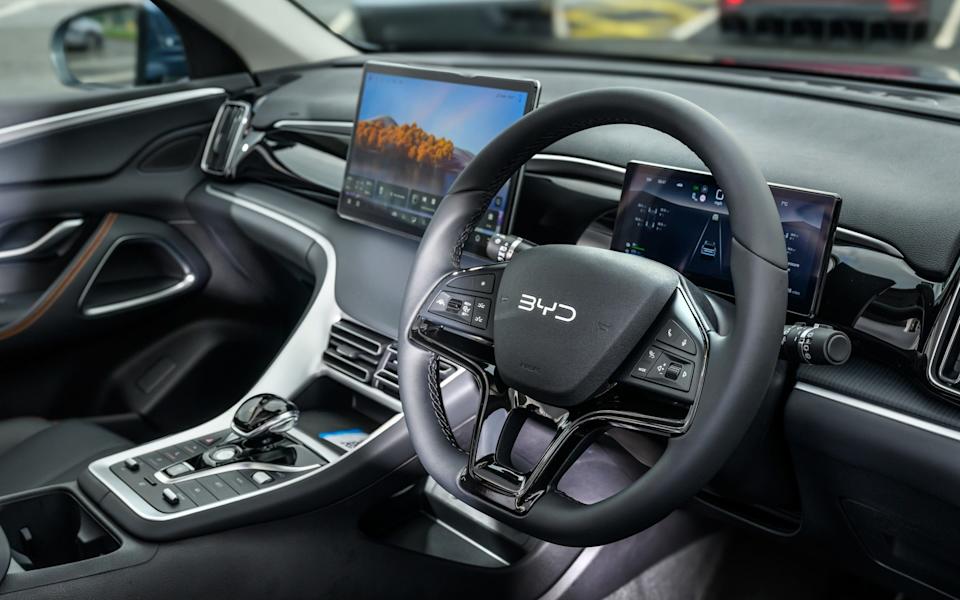
The BYD features a huge central screen that isn’t always intuitive to use – Paul Cooper
On the road
From the off the Skoda feels refined and well-finished, with a smooth petrol engine and better suspension damping. The combined regeneration and friction braking is well-balanced and smooth; the brake pedal feels strong and linear with good initial bite.
The ride and handling are firm and positive with good feedback to the steering wheel and well-judged resistance to body roll. Some might find it too firm, but after almost a day at the wheel it proved relaxing and comfortable.
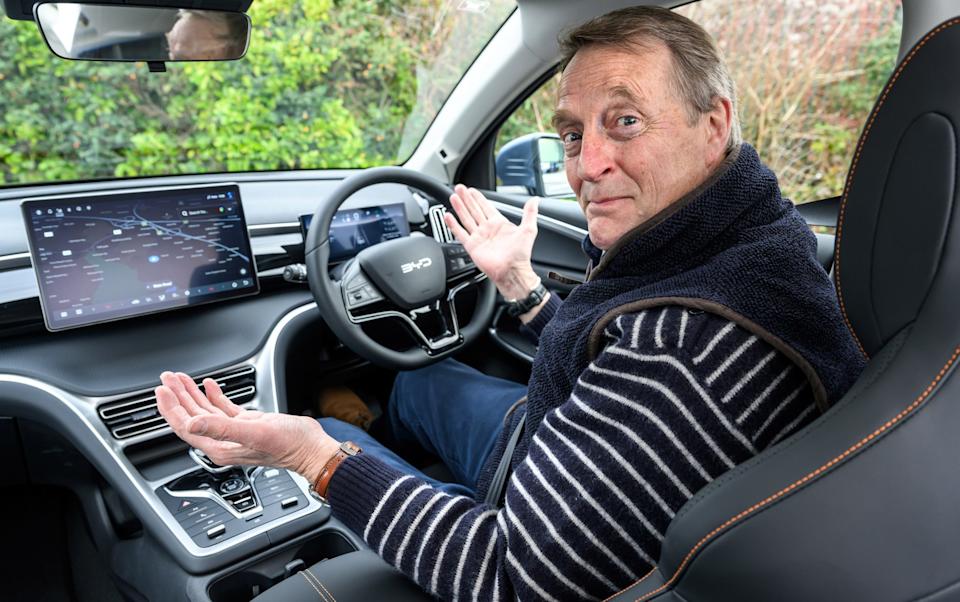
English inside the BYD: ‘A car set up for comfort rather than driving pleasure’ – Paul Cooper
The BYD is primarily a range-extended battery car, more EV than internal combustion. The electric motor does most of the shifting, with the 95bhp petrol engine only starting when the battery power is diminished. Like all EVs it pulls away smartly from standstill, but runs out of puff at higher speeds, although if you stand on the accelerator it all feels a bit frantic.
Dynamically, the BYD is set up for comfort rather than any form of driving pleasure. The springs and dampers are soft, it’s brisk but not fast and it’s far from the most responsive of drives, with a dull-feeling steering system and soggy-feeling brakes. In addition, the driver assistance systems are aggressive, distracting and often inaccurate (especially the speed-limit detection). You need to think hard about the money you are saving when driving the Sealion 5.
The Telegraph verdict
Both cars are well equipped, the Skoda IV SE L trim pack has the Virtual Cockpit, 13-inch sat-nav screen, 19-inch wheels, part-leather upholstery and heated seats. The metallic paint was £680, however, the head-up display £540 and the additional driver assistance package another £830.
BYD also has a high specification (although the paint options start at £850) but first you have to find your way around the screen-dominated operations, which isn’t the work of a moment.
This comparison is a case of perspective. While I would bear the extra cost to have the Kodiaq in my drive, in this fiercely competitive market sector there is a bewildering choice. The BYD looks down at its Chinese competitors, while the Skoda looks upwards, vying for attention with rivals such as the Mercedes-Benz EQB, or rivals from its sister Volkswagen Group companies.
If you require a cheap plug-in hybrid family SUV, the BYD is firmly in the frame. If you’re after a cheap plug-in premium car, the Skoda is a starting point. The choice is yours.
The facts