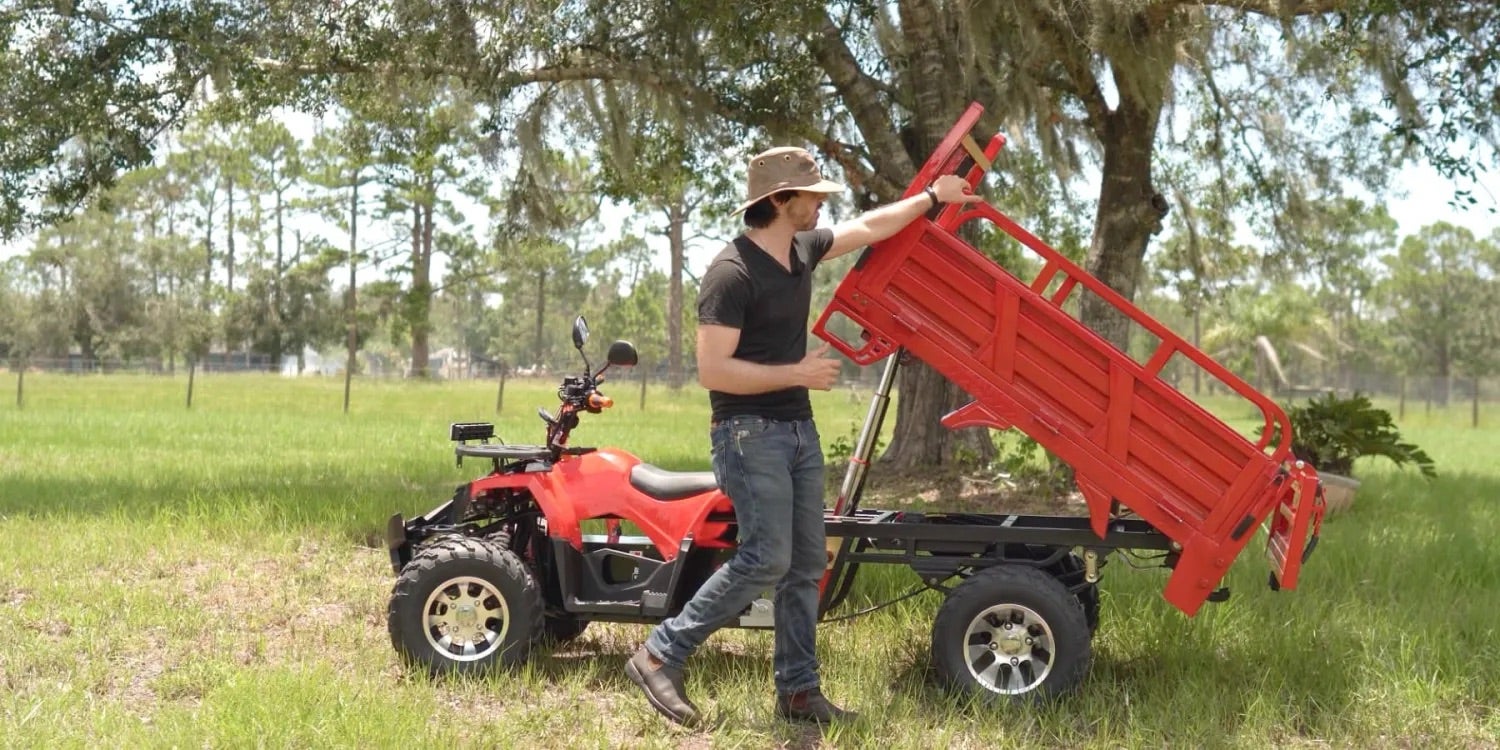
A writer at Electrek ordered a $2,000 electric ATV direct from a Chinese factory. Twelve weeks later, a janky wooden crate arrived in the driveway — and what came out of it is legitimately fascinating for anyone watching where budget off-road electrics are headed.
The off-road electric vehicle market has two speeds right now. On the one hand, you have professional machines like the Can-Am Outlander Electric, priced at $13,000 and up — refined, warranted, and backed by a major manufacturer. On the other end, there’s a sprawling catalog of Chinese-manufactured EVs operating in the Wild West of direct factory imports, where you might receive something surprisingly capable or something that disintegrates on the third run. One Electrek writer decided to find out which category a $2,000 electric ATV falls into. The answer is more interesting than either extreme.
What He Actually Ordered
The machine isn’t a standard quad. It’s a hybrid ATV/dump truck concept — what the writer describes as “the mullet of off-road electric vehicles.” The front end is a conventional four-wheeler layout with handlebars. The rear is a cargo bed with a hydraulic dump mechanism, designed to carry and unload material on a farm or rural property. It’s a utilitarian design common in Chinese agricultural equipment markets but largely absent from the North American off-road space.
After digging through factory catalogs online, the buyer went direct and custom-ordered a few upgrades: a longer cargo bed, a custom winch setup, and a motor bump from the stock 1.5 kW unit to a 3 kW version. Total price: approximately $2,000 USD. One catch: the factory shipped it without batteries, which is standard for this class of Chinese EV and worth knowing before you wire money overseas expecting a fully turnkey machine.
The Arrival and Assembly
Twelve weeks after placing the order, the ATV arrived on a trailer inside what the writer called “the jankiest wooden crate I’d ever seen.” No instructions were included. Assembly was an improvised process. For the battery pack, he sourced two 72V 30Ah LiFePO4 cells from BatteryHookup.com and wired them in parallel, yielding a 60Ah pack with a total capacity of 4.32 kWh. That’s a modest but workable number for a utility ATV running cycles around a property.
First impressions after powering it up: startling torque delivery. The 3 kW motor had essentially no throttle ramp — twist the grip at all and the thing lurched forward like a spooked horse. Fun in short bursts, problematic for practical use on a farm where you might be navigating around livestock or buildings. After some experimentation, the writer swapped the motor back to the factory-spec 1.5 kW unit and found the machine dramatically more usable.
The nuance here matters. Chinese manufacturers typically rate electric motors at continuous power rather than peak output. The actual wattage pulled in real-world use is considerably higher than the nameplate figure suggests, which is why a 1.5 kW motor on these machines drives like something with considerably more grunt than you’d expect. It’s a different rating convention from what North American buyers are used to, and it often leads people to underestimate what these motors can actually do.
What It Can Actually Do
With the more sensible motor installed, the ATV proved genuinely capable as a farm utility vehicle. As a real-world payload test, the writer loaded a 650-pound (300 kg) electric bus battery into the cargo bed. The machine pulled it around without drama. That’s a meaningful data point — 650 pounds is roughly the weight of three adult passengers, and the ATV handled it without complaint.
The hydraulic dump mechanism worked as advertised, making it a legitimate tool for moving material around a property — gravel, soil, feed, firewood, whatever the job calls for. Build quality isn’t in the same category as a Polaris Ranger or a Kubota, but it’s also not a toy. The motor mounts visibly off the rear axle, making it accessible for basic maintenance. Simple vehicles, it turns out, are easy to work on — which is either a feature or a necessity depending on how you look at it.
The Bigger Picture
The Chinese direct-import EV space is difficult for North American buyers to navigate, and experiments like this provide a useful reality check. A $2,000 electric utility ATV can become a functional workhorse — but it requires comfort with sourcing and assembling your own battery pack, operating without any warranty infrastructure, and the general understanding that you’re building rather than buying. For the right owner — someone with land, some electrical literacy, and a willingness to tinker — the value proposition is surprisingly real.
It also illustrates how far ahead of the U.S. market Chinese factories are operating at the budget end of the off-road EV space. While Polaris, Can-Am, and Honda are all investing heavily in battery-powered off-road vehicles priced at $10,000–$20,000, Chinese factories have been selling utilitarian electric ATVs and utility vehicles to agricultural buyers across Asia and Europe for years at a fraction of the cost. The gap in refinement is real. So is the gap in price. Whether the North American market eventually develops a more direct path to machines like this — or whether the major brands close the price gap from above — is one of the more interesting questions in off-road right now.
The full unboxing and testing video is available on YouTube. The original write-up ran on Electrek.
Source: Electrek — March 15, 2026