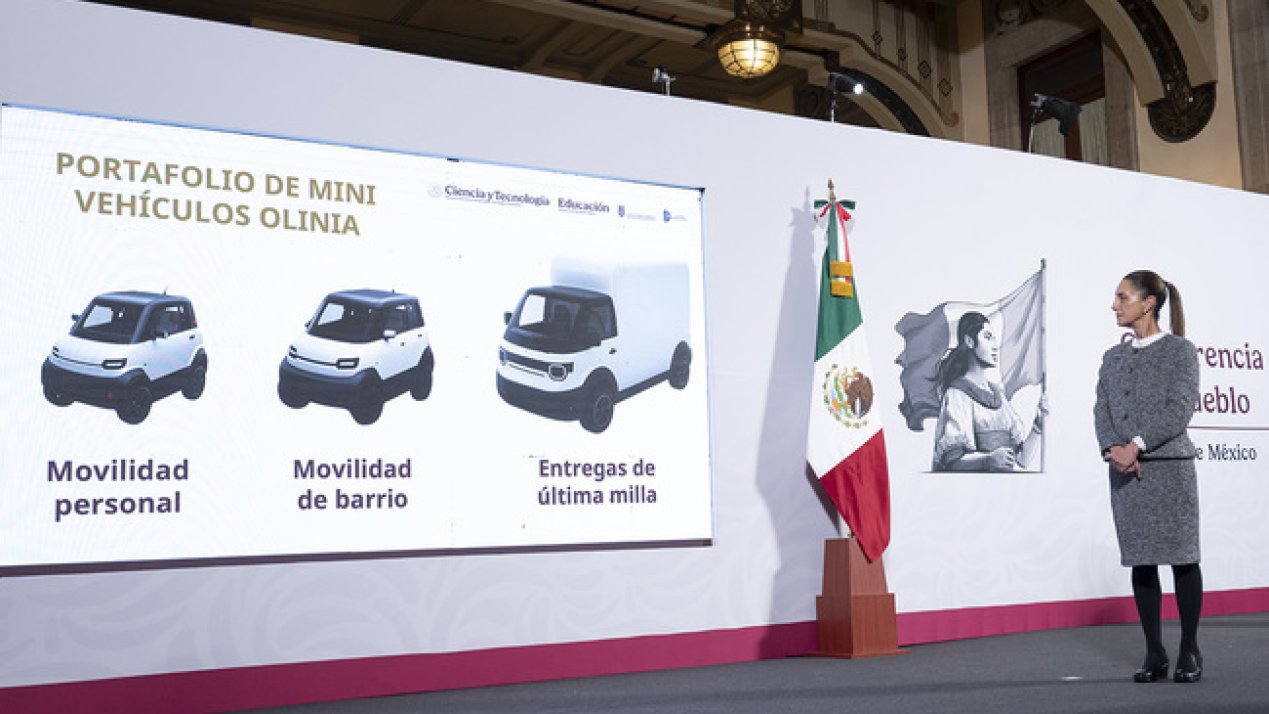
Olinia, a Mexican electric vehicle (EV) startup backed by the federal government, has announced plans to conclude its engineering phase this month ahead of a June prototype debut. The company is currently seeking MX$200 million (US$11.25 million) in private investment to transition from design to large-scale manufacturing, aiming to establish a new vehicle category in the domestic market by 2027.
The project, a central industrial initiative under the administration of President Claudia Sheinbaum, focuses on light urban vehicles of low and medium capacity. “We estimate sales of 100,000 Olinia cars per year,” said Roberto Capuano, CEO, Olinia, targeting a niche currently underserved by traditional automotive manufacturers.
Prototyping and Production Infrastructure
According to Capuano, the engineering work for the initial prototypes is scheduled for completion by the end of March 2026. Following this phase, Olinia will begin early-stage manufacturing and rigorous testing. This technical data is expected to facilitate negotiations with private investors by providing verified specifications and performance metrics.
The company plans to unveil two distinct low-speed plug-in models on June 11, coinciding with the World Cup. The first is a passenger vehicle designed to accommodate a driver and up to five passengers. The second is a commercial cargo variant with a two-passenger cabin and a payload capacity of 600 kg. Both models are engineered for a maximum speed of 50 km/h, positioning them specifically for short-distance urban transit and “last-mile” delivery services.
“Olinia is staying completely in Puebla; the broader project has already begun. The automotive design house was originally at the Technological Institute of Puebla, and now the plan is for all assembly to be done here,” stated Celina Peña, Federal Undersecretary of Technological Development, Linkage, and Innovation, Ministry of Science, Humanities, Technology, and Innovation (SECIHTI).
The development team includes engineers from the Technological Institute of Puebla, the National Polytechnic Institute (IPN), and the National Technological Institute of Mexico (TecNM).
Financial Structure and State Support
While Olinia is a state-promoted initiative, its business model relies heavily on a public-private partnership. To date, public expenditure has been categorized as seed and research funding. The company received less than MX$50 million (US$2.8 million) in initial seed capital from federal and Puebla state sources.
Additional funding streams include:
MX$100 million (US$5.62 million)in recently approved research and development funds.
MX$175 million (US$9.84 million) from the Ministry of Energy and LitioMx, the state-owned lithium company, dedicated to constructing a battery pack manufacturing plant.
Public research institutes are currently subsidizing the salaries of participating scientists and engineers.
Capuano emphasized that the MX$200 million (US$11.25 million) in private capital is essential for establishing the supply chain and covering the working capital required for factory operations during the first two years.
“The way to understand Olinia is like when a baby is born into a large family and everyone contributes so that the baby grows up healthy,” Capuano said.
Market Positioning and Economic Strategy
The projected retail price for the entry-level Olinia models is approximately MX$150,000 (US$8,400). This pricing strategy is intended to compete with low-cost imports from China and India, as well as to provide an alternative to modified motorcycles currently used for public transport in regions like Puebla.
“We are creating a category called ‘light urban vehicle of low and medium capacity. It is a niche that does not exist today, in which we can enjoy a first-mover advantage,” Capuano said.
The project arrives as the Mexican government implements aggressive fiscal incentives for the EV sector. Under Plan Mexico, electric and plug-in hybrid vehicles purchased through 2030 are eligible for an immediate tax deduction of nearly 90% of their value. Furthermore, the CFE is offering specialized metering for EV charging at lower commercial rates to incentivize adoption.
Regulatory and Competitive Landscape
Olinia is not the only domestic player in the micro-mobility space. Zacua, another Mexican firm, currently produces mini-EVs, though its output has remained limited due to manual assembly processes. Olinia intends to differentiate itself through higher volume and state-integrated infrastructure.
Government procurement is expected to play a vital role in early revenue. Capuano noted that purchase orders from federal and state governments could provide the necessary momentum for initial sales.
“Our intention has never been to create a monopoly on mini-mobility. This project is unprecedented in the country. The reason it has so much eloquence is because the business opportunity is very attractive,” Capuano said.