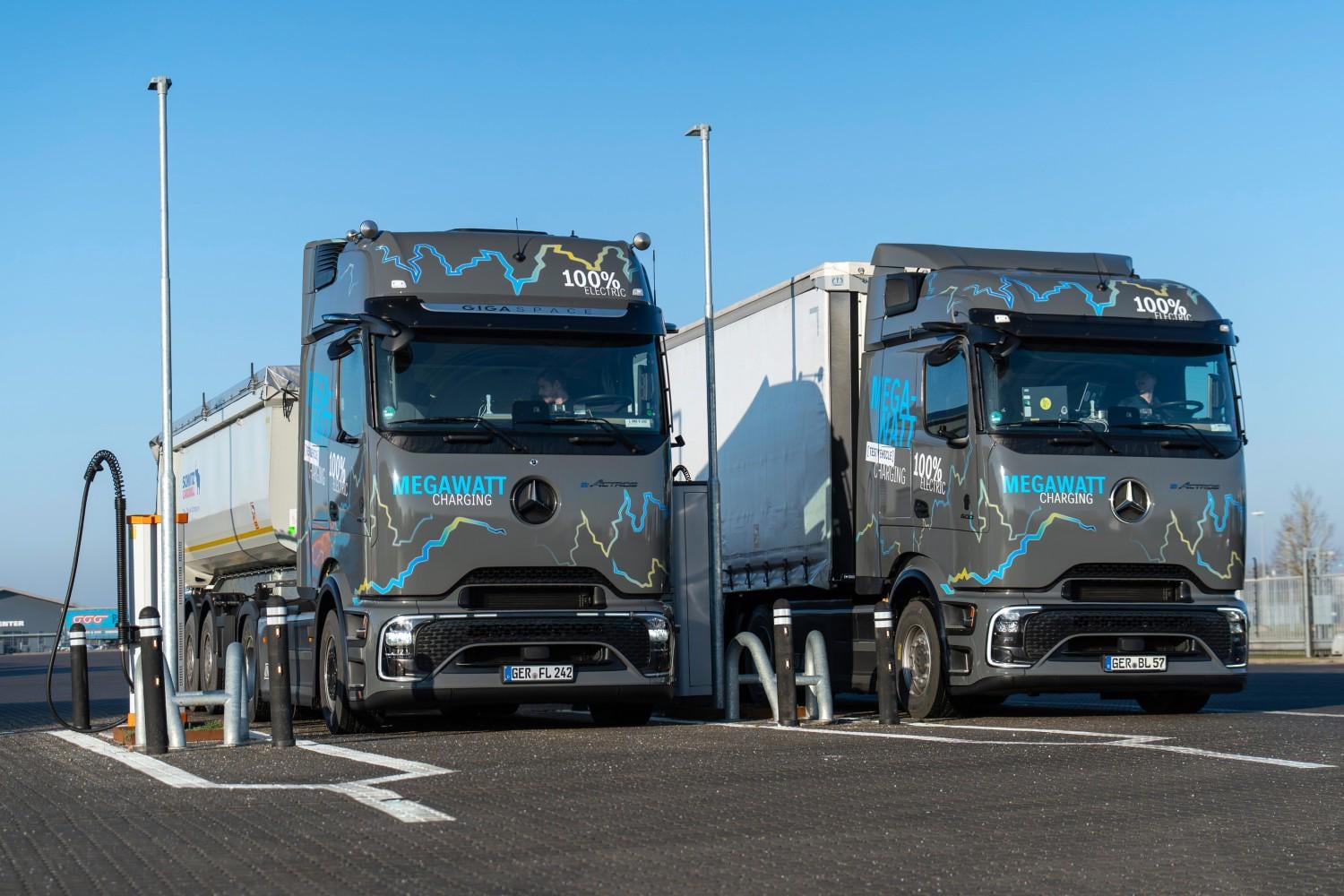
Mercedes-Benz Trucks plans to launch initial customer trials of MCS-compatible eActros 600 trucks in the second half of the year. The electric trucks will be deployed under real-world conditions in the company’s inbound logistics operations.
Since the start of series production of the eActros 600 in November 2024, Mercedes-Benz Trucks has been equipping its flagship battery-electric truck with a placeholder that can later be replaced by an optional Megawatt Charging System (MCS) port. As the MCS standard is still being finalised, the interface is not yet installed.
The German manufacturer is nevertheless preparing for the upcoming rollout of megawatt charging and plans to begin testing MCS-enabled eActros 600 units in the second half of this year.
Within the current portfolio, the eActros 600 is the only model designed to support optional megawatt charging. The eActros 400 and eArocs 400 are not set to offer MCS capability at this stage.
The first customer trials with MCS-compatible eActros 600 trucks will soon take place as part of the company’s own project, ‘Electrify Inbound Logistic.’ The initiative aims to fully electrify the inbound logistics of the plants in Wörth am Rhein, Gaggenau, Kassel, and Mannheim in the coming years. As part of the newly announced tests, an MCS-capable charging station will be commissioned at the Wörth am Rhein plant site by mid-year. The customer trials will initially focus on this main plant.
Here is some background on the MCS standard: Within the CharIN organisation, industry stakeholders have worked for years to standardise megawatt charging to ensure that large commercial vehicles can be charged using the MCS plug under all conditions.
Little information has been shared by the working groups, but in early February, CharIN announced on LinkedIn: “We are thrilled to announce that IEC 63379, the standard for the Megawatt Charging Systems, is now officially published! ”
However, IEC 63379 is just one of several standards for the MCS system. It focuses on the connector interface—which has indeed been standardised since February. However, software and communication aspects remain unfinished. According to industry experts, CharIN is expected to need the rest of the year to complete these.
That aligns with the timeline for MCS customer trials at Mercedes-Benz Trucks.
“We see megawatt charging as a key enabler for the global electrification of heavy long‑haul transport and fully support the MCS standard as an open, manufacturer‑independent solution,” said Peter Ziegler, Head of E-Charging Components at Mercedes-Benz Trucks. “Given the dynamic global market development of battery‑electric commercial vehicles, the importance of a uniform, internationally compatible charging standard continues to grow. From our perspective, MCS provides the foundation for interoperability, scalability and long‑term investment security across markets and manufacturers.”
Mercedes-Benz Trucks recently demonstrated its commitment to leading the implementation of the Megawatt Charging System with an MCS-focused long-distance test drive. The journey covered approximately 2,400 kilometres from Germany to Sweden. Charging was primarily conducted at MCS charging stations.
Onboard, Mercedes-Benz Trucks’ development engineers closely monitored the trucks’ performance. Following the tests, one of the two MCS-enabled eActros 600 trucks detoured to the Finnish Arctic Circle, where it underwent additional winter tests at temperatures as low as –20 degrees Celsius.
According to Ziegler, the test drives and winter trials provided valuable insights, particularly regarding battery thermal management and interoperability between the vehicle and charging infrastructure.
“The results confirmed that charging power in the megawatt range is also achievable at low temperatures, provided that the battery is at a sufficiently high operating temperature. Since we expect megawatt charging in real‑world use to typically take place during the legally mandated driving breaks following a driving cycle, this condition is met in practical operation.”
At the same time, Ziegler noted that successful charging processes were achieved at several charging points during the test drives, demonstrating the system’s fundamental practicality.
In parallel, the parent company Daimler Truck is participating as an industry partner in the flagship project ‘HoLa High-Performance Charging in Long-Haul Trucking‘ and will introduce the eActros 600 into real-world testing as part of this initiative later this year. MCS charging processes will also be trialled here.
One thing is clear: with charging outputs of up to 1,000 kW, the batteries of electric trucks can be recharged significantly faster via MCS than with the currently common CCS technology. For the eActros 600, charging from 20 to 80 per cent at an MCS charging station is expected to take around 30 minutes. For comparison, the same process takes about an hour at a CCS charging station with up to 400 kW charging power.
Mercedes-Benz Trucks emphasises that faster recharging with MCS will enable customers to achieve more efficient and flexible logistics processes in long-haul operations—provided the necessary charging infrastructure is in place. Currently, there are only a few public MCS charging sites available in Europe, which is linked to the fact that there are still hardly any MCS-capable trucks on the road. If any exist, they are typically test vehicles.
Developers at Mercedes-Benz Trucks first demonstrated charging an electric truck at one megawatt as early as 2024. At the time, it was a prototype of the eActros 600. The megawatt charging was successfully achieved at a charging station at the company’s own development and testing centre in Wörth am Rhein.
by ApprehensiveSize7662