A new study from Porsche Consulting and the eFuel Alliance makes it plain why we’re going to continue needing gasoline (preferably, the “renewable” kind) for the foreseeable future. And, the study says, if we are going to use gas anyway, why not make it out of green energy and captured carbon dioxide? But a big ramp up—and considerable cost reduction—is needed.
Gas and diesel cars and trucks in Europe, the report said, “will continue to play a role, and demand for liquid fuels will remain substantial through 2050,” the report says. “The share of internal-combustion engine vehicles (IC) and plug-in hybrid electric vehicles (PHEVs) will remain substantial across all mobility fleets, even by 2040. Despite the ambitious electrification assumed in this scenario, IC powertrains in on-road mobility fleets are expected to represent approximately 37% of passenger cars and up to 62% of trucks and buses.”
Related Story
But these conventional vehicles needn’t rely on fossil fuels, the report says. “The EU could be entirely free of fossil fuels by 2046—replaced by renewable alternatives.”
Keep in mind that we’re talking about Europe, which until recently was on a path to ban IC cars entirely by 2035. But as Autoweek reported, that 100% certainty has been replaced with a proposed plan that calls for a 90% cut (from 2021 levels) in tailpipe emissions by that date. It opens the door, slightly, to e-fuel—gasoline made from renewable energy and captured carbon dioxide.
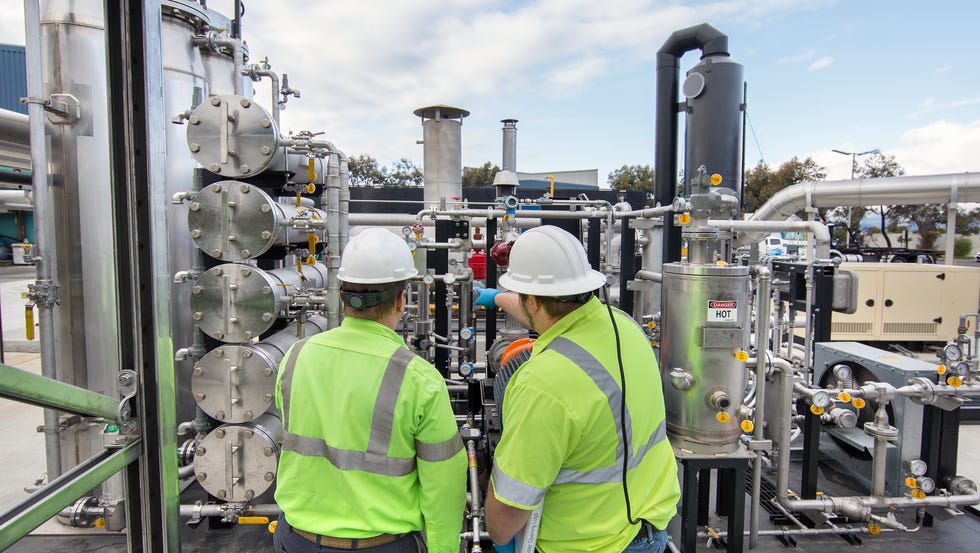
Billy Hustace//Getty Images
Under the new regulations, it will still be possible to sell hybrids and plug-in hybrids after 2035, with the extra 10% of emissions offset by the use of e-fuels and biofuels (as well as “green” steel). The rules are even friendlier to sustainable aviation fuel, allowing for it to be 6% of the mix by 2030, and up to 70% in 2050.
The new Alliance/Porsche report is pretty optimistic that the current and rather daunting cost of producing a gallon of e-fuel today (some say $45) will come down dramatically with mass production—to as little as $5.20 per gallon.
“The common criticism is that e-fuel is quite cost-prohibitive,” Dr. Tobias Block, chief strategy officer at the eFuel Alliance, told Autoweek. “But nobody is doing it in large scale right now, so we’re talking apples and oranges when we use numbers like $45 a gallon for e-fuel. What did energy from the first photovoltaic panels cost, or from the first windmill?”
“The common criticism is that e-fuel is quite cost-prohibitive. But nobody is doing it in large scale right now, so we’re talking apples and oranges.”
There are 300 announced e-fuel projects that theoretically could be in line to meet a demand for 20 billion liters (5,283,441,047 gallons) of renewable gasoline by 2040, but Block said only 6% of those projects have a final investment decision attached. Much more investor cash is needed.
Interestingly, west Texas, with its huge wind resource and technical expertise, is a prime target for e-fuel production. “The terminals and the fuel tanks are there for handling export to Europe, as well as highly qualified personnel available to run operations,” Block said.
 halbergman//Getty Images
Storage tanks in Houston.
That brings us to HIF Global, the Chilean e-fuel company that made waves by attracting a Porsche investment of $75 million in 2022. Porsche, presumably, sees e-fuel keeping its gas cars on the road long after fossil fuels are banned.
HIF is well aware of the e-fuel potential of West Texas, and announced a $7 billion plant in Matagorda County to annually produce 590 million gallons of carbon-neutral e-Methanol there, adding 4,000 jobs. The plant should be ready to go by 2027. The methanol can be refined into 200 million gallons of e-gasoline.
Related Story
Europe’s plans still clearly favor EVs, but they assume a fairly robust adoption rate. The goal is to achieve an 80% battery-electric vehicle (BEV) share in the whole passenger car fleet and a 48% share in the truck and bus fleet by 2050. That would require new registrations of BEVs to reach 80% by 2034 at the latest, with 7.4 million new registrations by 2030. It would mean a 400% jump in seven years.
But as Autoweek also reported, the European BEV adoption rate isn’t hugely higher than in the US—except in countries such as Norway, which heavily penalize IC purchases. In 2025, BEVs had a 17.4% share in Europe overall, up from 13.6% in 2024. The US hit 10.5% for BEV adoption in the third quarter of 2025, but the numbers fell in the fourth quarter after the federal tax credits were ended.
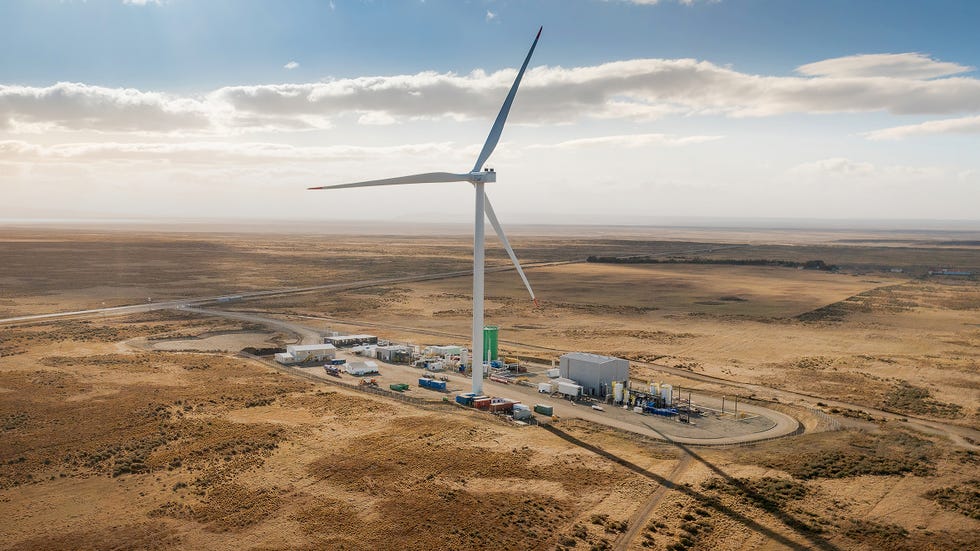 HIF Global
HIF Global in Texas.
Complicating the EU adoption rate are likely problems accessing raw materials such as lithium and nickel—the report cites likely mining deficits of up to 30% for the projected BEV numbers. The shortages are expected to last until 2035, the report says.
The eFuel Alliance would clearly like to see the EU further adapt its rules to become friendlier to renewable gasoline. According to Ralf Diemer, executive director of the eFuel Alliance, “Financing is the make-or-break issue. Closing the gap between supply and demand requires a stable, predictable regulatory framework. Whether e-fuels reach their potential will come down to political choices.”

Jim Motavalli is an auto writer and author (nine books) who contributes to Autoweek and Barron’s Mansion Global. He has written two books on electric cars, Forward Drive (2000) and High Voltage (2010), and hosts the Plugging In podcast.
Motavalli’s writing has appeared in the New York Times, CBS Moneywatch, Car Talk at NPR, Forbes, US News and World Report, Sierra Magazine, Audubon, and many more. In his spare time, he reviews books and jazz.