Don’t take your eyes off the road. That mantra in driver safety – more than any other – might help you avoid side-swiping the sleek BMW 5-Series on the motorway this week.
Studies show that driver distraction is the number-one cause of accidents on the road. And the main culprit? That shiny plastic gizmo we use for texting and doomscrolling on social media all day long. Looking at your phone while driving increases the accident risk by 240 per cent, according to a late 2025 study by the Governors Highway Safety Association and Cambridge Mobile Telematics in the US. Another shocking discovery: nine out of 10 drivers in the UK struggle to avoid touching their phone at least once when driving, according to telematics firm IMS.
Since carmakers are constantly trying to differentiate themselves and attract new customers, the latest tech innovation relates to voice-controlled bots. Specifically, one that you might use on your phone or laptop on a daily basis. But might it have the potential to distract us more than we are already?
Mercedes an early adopter
OpenAI’s ChatGPT, which is used by around 700 million people worldwide, can help you plan a summer holiday or provide recipes, but it is also making its illustrious debut in cars. The 2027 Mercedes-Benz S-Class, as one example, will launch with a rear-seat entertainment system and heated seatbelts, but also features a chatty and hyper-intelligent voicebot.
Mercedes told me the Mercedes-Benz User Experience (MBUX for short) in the S-Class can use multiple “AI agents” and switch between them. If you ask for directions, the Google Assistant will chime in. For search-by-voice, Microsoft Bing is more than willing to help. Yet the main leap forward concerns ChatGPT engaging in free-form dialogue. In some ways, it works similarly to how Apple’s Siri Chatbot on an iPhone will rely on a ChatGPT integration for deeper discussions.
“By bringing truly conversational speech capabilities into our [cars], the vehicle responds more naturally to the driver’s voice and enables them to keep their focus on the road ahead. The dialogue flows as seamlessly as a real conversation while the car manages complex tasks in the background,” says Magnus Östberg, the chief software officer at Mercedes-Benz.
Transforming interaction
It’s a sea change for the automotive industry to emphasise conversational bots. In the past, voice commands allowed us to adjust climate settings or ask about navigation. Soon, we might discuss the latest travails of Andrew Mountbatten-Windsor, or perhaps even engage in a heated debate about the economy with a friendly, always-available virtual chatbot.
Experts are divided on whether this is a good thing or not. “As conversational AI makes its way into cars, it could be a helpful hands-free assistant, but only if it is designed to reduce cognitive load, not compete for attention. Voice-first is safer than screen-first, but so-called deeper engagement shouldn’t mean deeper distraction,” says David Bailey, a professor of economics at the University of Birmingham and a noted automotive expert.
Bailey calls bots such as ChatGPT a “conversational partner” in the car, and notes that AI innovations are all part of a sweeping move to make cars more software-oriented, especially as electric vehicles become widely available. Without a petrol-powered engine under the bonnet, manufacturers can no longer rely on traditional performance specifications to attract customers.
Philip Nothard, insight director at Leeds-based Cox Automotive International, insists that conversational bots will lead to more natural interactions for the driver. For me, this conjured images of a future where we ask the car to slow down or why there’s a red flashing light in the dash. Nothard says voicebots will reduce the manual interactions needed as we drive.
“AI-enabled in-car experiences are no different from how we use chatbots in our daily lives,” he says. “As these AI agents improve, they show significant potential to enhance user experience and trust in vehicles,” such as the diagnostics I mentioned, or spotting safety hazards.
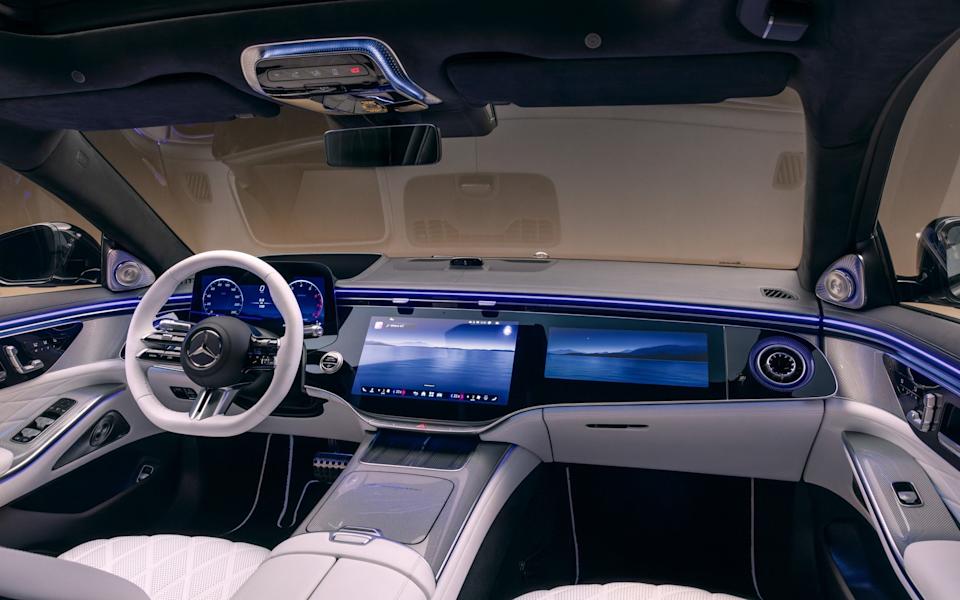
‘AI-enabled in-car experiences are no different from how we use chatbots in our daily lives,’ says Philip Nothard, insight director at Cox Automotive International – Mercedes-Benz Group AG
What next for AI in cars?
The road ahead will involve AI in one way or another, yet it’s far too early to know whether that will lead to tangible benefits or greater driver distraction. Spencer Penn runs an AI logistics company called Lightsource, but before that he held leadership roles at Tesla and helped launch the Model S. He also worked at Google on the launch of its Waymo self-driving car subsidiary, running autonomous driving simulations.
Penn says ChatGPT is a step in the right direction because it’s another example of automotive firms outsourcing technology to a third party, with resounding success. He says Apple CarPlay and Android Auto have been major wins for car producers – and for drivers.
“Consumers gravitated toward them because the software simply worked better,” he explains. “I expect OpenAI or other bots like Anthropic Claude in vehicles such as the 2027 Mercedes S-Class to follow a similar path. When you combine automotive hardware excellence with best-in-class AI software, the user experience improves materially.”
Penn made another interesting point about AI in cars. He says companies such as Volkswagen, Hyundai and Ferrari have “reversed course” when it comes to physical buttons in the vehicle. If the driver has fewer controls and can focus on driving, AI becomes more valuable.
Reducing distraction
“Buttons provide tactile confirmation. You can feel that something worked without looking,” he says. “Voice falls into the same category. If I can say, ‘Turn on the seat heater’ or ‘Find the fastest route home avoiding traffic’ I don’t need to visually navigate menus.” That could lead to less distraction for the driver, not more.
“When implemented well, voice reduces visual-manual distraction [defined as the driver watching the road while also needing to operate the car], which is the most dangerous category of in-vehicle distraction,” he says. Indeed, the more we can focus on that quickly-accelerating BMW 5-Series on the motorway the better, especially in dense but fast-moving traffic.
Yet, there remains a nagging sense that all of this new technology is overwhelming the driver. How do you adjust the head-up display? Which button deactivates lane-keeping? In some electric vehicles, there is no start button, you just start driving. A voicebot like ChatGPT will either make the Mercedes-Benz S-Class easier to drive or increase the complexity.
In the end, there’s one option that will (hopefully) always be available: driving with the technology disabled.