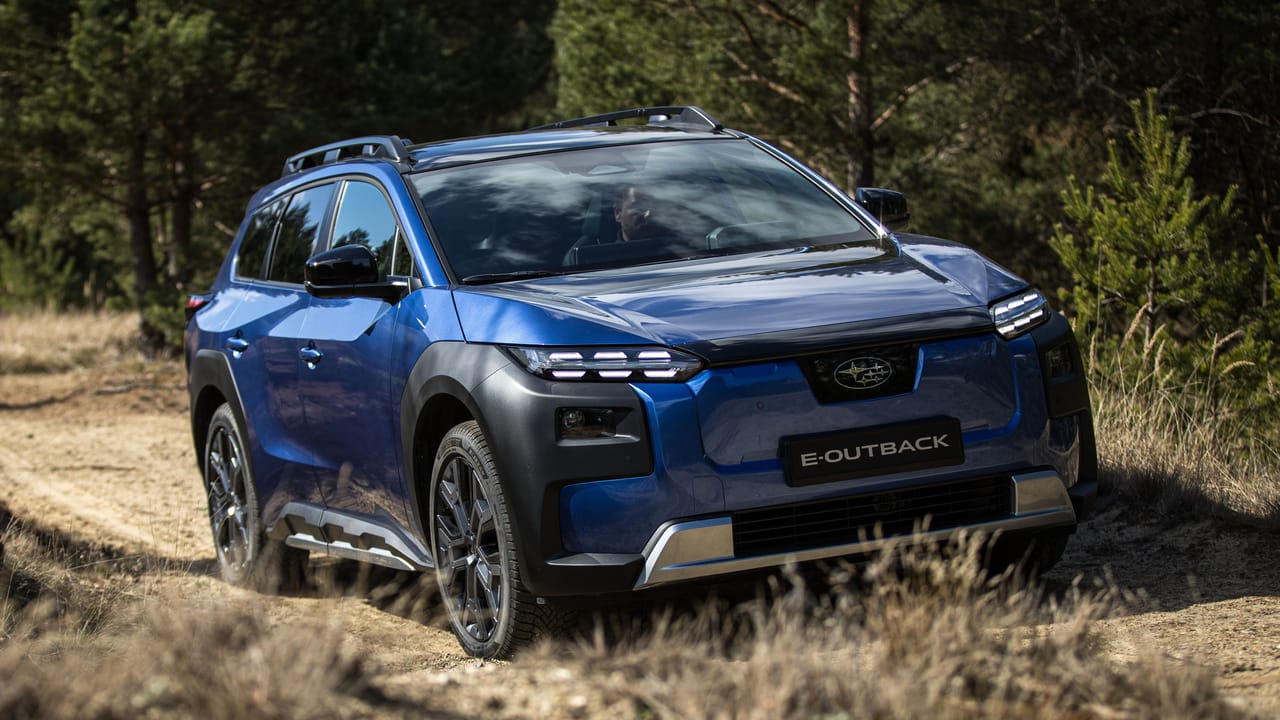
It’s the electric version of Subaru’s Outback estate. Also called the Trailseeker in the US, which is infinitely cooler. But after that, it gets a bit complicated and probably needs a small explainer of provenance to get everyone up to speed. So. The E-Outback is a sort-of wagon version of the Subaru Solterra, except with lots of things changed, most obviously the estate rear which ups the practicality and – to sensible eyes – the style.
But where the Solterra is a sister-vehicle to the Toyota bZ4X and made by Toyota (called the BZ in the US), the E-Outback (and sister bZ4X Touring) are made by Subaru at the company’s Gunma Yajima Plant in Japan. So the E-Outback is more Subaru than the Solterra. It’s also more Subaru than the Toyota; the E Outback will only ever get two motors and all-wheel drive, while the bZ4X Touring offers a front-wheel drive version and fewer modes. Though they both get X-Mode rough road driving modes in the dual-motor versions.
So… the most Subaru electric Subaru you can buy is the E-Outback, even when it’s a Toyota. Glad that’s settled.
So what does the Subaru part make this?
Er… very much in the vein of the ICE Outback, to be honest. It’s an all-wheel drive estate – too low to realistically be an SUV, though not low-low – with a huge boot, tonnes of practicality and an added dose of rugged. It’s faster than – and this makes TG wistfully sad – several of the Impreza WRXs from back in the day at 0-62mph in around 4.5 seconds, has 370bhp, manages an as-yet-unconfirmed 327-miles of official range and dons roof rails you can actually put things on without them bowing like paper straws.
It’s got useful advanced driver assistance (Subaru Safety Sense), genuine off-road ability and comfortable on-road manners. Although a slight caveat comes in that the E-Outback has only been driven lightly on a short road course in normal conditions at this point – though quite hard on a track – where it acquitted itself very well. It might well go up a point once TG has had a chance to assess on-road thoroughly.
What’s it for?
Everything, really. As an antidote to those SUVs that offer ground clearance and yet the off-road capability of a Laboutin six-inch heel. It’s the hiking boot of electric cars. There’s 633-litres of space in the boot (big), more rear headroom than the Solterra/bZ4X, chunky plastic wheelarches (which make more visual sense here), a set of roofrails that you can actually put a rooftent on, and a drivetrain that will manage more than 90 per cent of owners will have the guts to attempt.
It’s supremely comfortable, the interior is practical if not standout and there’s a feeling that for a so-called ‘niche’ vehicle, it’ll fill lots of different niches for lots of different people. Plus, it’s just not got that aggressive swagger of some, or the conscious blandness of others. It’s a grower.
How practical is it?
Very. As mentioned, there’s 633-litres of space in the boot, but more than that it’s a big, wide opening with a moveable floor and no lip if you don’t want it. There’s a kick-sensor opening for the hatch and about 400 cargo hooks (possibly more like eight). Seats down you get 1,718-litres – enough to sleep in – and a tailgate light (with optional tailgate-mounted work lights if you want).
One slight miss is the fact there’s no ski-hatch/pass-through for the 60:40 split rear seats, but that’s a fairly specific problem. It’ll tow 1,500kg (there’s hitch preparation built-in), and you can plop 80kg of moving load on the roof rails, or 317kg static – more than enough for a pretty decent rooftent or whatever. Then there’s vehicle-to-load for running electricals from the traction battery, two 15-watt wireless phone charging pads, USB-C charging ports in the back and plenty of storage.
It’s slightly faster than it needs to be, which is good, and features lots of safety systems that tidy up the excesses of the driver without obvious intervention. The E-Outback is basically nicely butler-ish if you’re on slippery surfaces on tarmac, and if you need to access a campsite/beach/viewpoint down an unknown road, you can just use the X-Mode dials to do a passable impression of a low-slung Defender. It’s genuinely impressive.
What’s the experience like?
This isn’t the kind of car you look at and immediately desire. But it’s the kind of car that becomes useful by doing all the jobs in a confident fashion. The interior might not make you want to do backflips in terms of design, but it’s functional and clear. There are sensible drive modes (Eco, Normal, Power), excellent ride comfort, a quiet cabin. The steering isn’t super-direct, but it telegraphs what you need to know.
Ok, so the charging looks a little mediocre at 150kW peak and 28-minutes-ish for 10-80 per cent state-of-charge, and if you’re chuntering around off-road (and then camping using the vehicle-to-load), ideally you’d want a slightly bigger battery and more range, but you can see why Subaru landed on the compromise. As mentioned, this feels like a grower.
Plus, it’s surprisingly quick; stick it in Power mode and leather the throttle and that sub-five second 0-62 time feels entirely believable. And it does an amusing nose-up/soft rear suspension launch, too.
It’s amazing how sticking an estate rear-end onto a very average SUV-thing (the Solterra) can change the vibe. Okay, so the Solterra/bZ4X has had some upgrades to battery, range and interiors, but the E-Outback feels completely different – not just a bit of BBL. Suddenly it has a much broader range (in the capability sense, not WLTP), and comes with the kind of usability that makes you actually want to use it for mini-adventures.
What’s most pleasing is that in the mire of shared bits, this actually comes across as a Subaru – just one powered by electricity. All it needs is a fake boxer burble piped into the cabin and we’re set. It could probably do with slightly more actual range and faster average charging to satisfy the ever-improving world of EV, but it’s the kind of car that will settle debates. Not super sexy, but a cracking do-it-all.