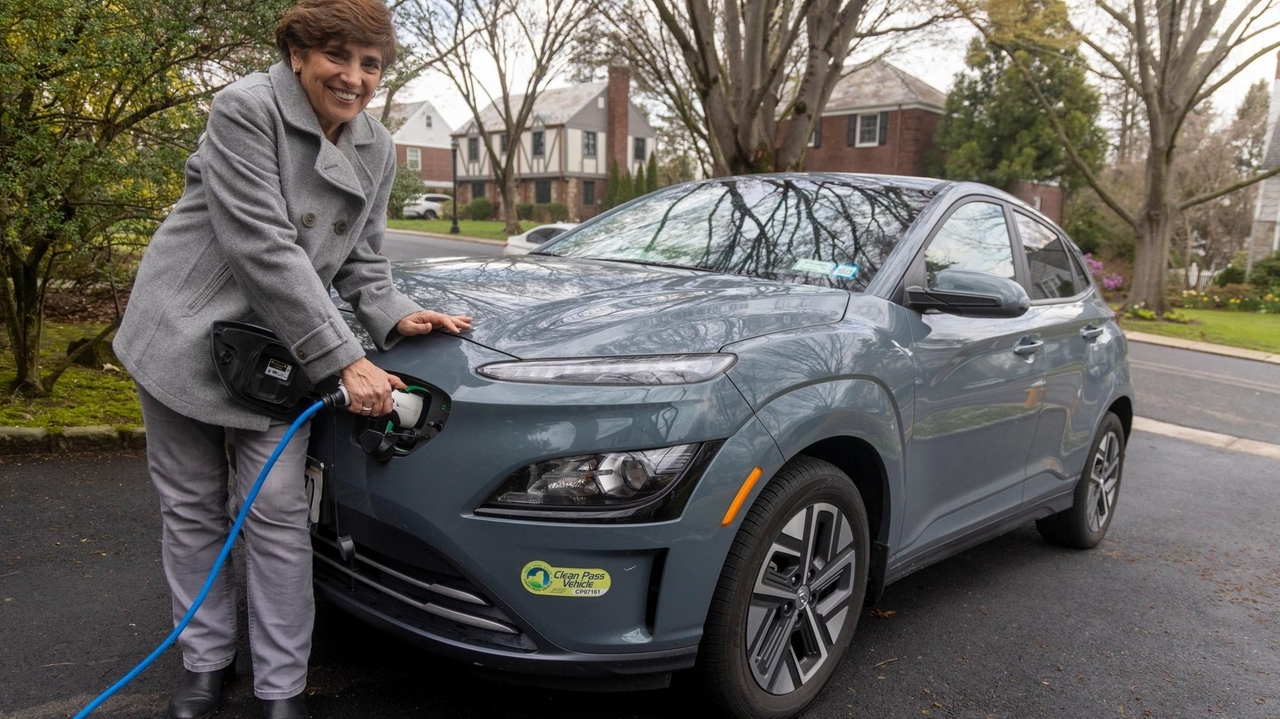
Lauren Krueger, of Merrick, switched to leasing a Kia Niro EV four years ago because it aligned better with her values as an environmentalist, and because the electric vehicle was more cost effective.
As the mother of two watches prices at the pump spike in recent weeks, she said she’s more likely to use the ATM at a gas station than purchase gas.
“How are people going to deal with this? It’s so expensive,” said Krueger, 46. She charges her car at home, where it has a negligible impact on her electric bill, and even at public stations that aren’t free, it costs between $20 and $25 to power her car for more than 200 miles.
“If we had to” pay for gas right now, she added, “it would probably limit our mobility.”
WHAT NEWSDAY FOUND
Experts say more shoppers are considering electric vehicles as gas prices continue to rise, spurred by the U.S.-Israel war with Iran.
The average cost of gas on Long Island hit $3.70 per gallon on Thursday, marking an 85-cent increase from the month before.
Long Island is already an EV hot spot, with nearly a third of electric vehicles in the state registered to owners in the region.
Experts say they’ve seen an uptick in interest in electric vehicles as Brent crude oil surges past $100 per barrel in the wake of the U.S.-Israel war with Iran. On Long Island, the average cost for a gallon of gas hit $3.70 on Thursday, according to AAA Northeast fuel price tracker, about 85 cents higher than a month earlier. Price per gallon in the region remains under the going rate for the nation.
Last week, nearly 24% of all vehicle research activity on the online car-shopping resource Edmunds focused on hybrids and EVs. That’s the highest weekly level of research activity focused on electrified vehicles the platform has seen so far in 2026.
While Edmunds analysts say it’s too soon to confirm a significant change in consumer behavior, site activity is an early sign that spiking gas prices are pushing car shoppers to consider going electric.
“One of the things that happens every time there’s a gas crisis, at least in recent history, is that people always look toward more efficient options,” said Joseph Yoon, consumer insights analyst at Edmunds. “The data isn’t significant but it does represent a sudden increase in interest from shoppers.”
“If you’re already in the market,” Yoon said, especially for consumers in suburban and urban metro areas where there’s strong infrastructure for electric vehicles, “then, I think, it’s worth considering.”
On Long Island, there were more than 1,500 public charging ports at the end of 2025 — an increase of more than 50% from around 1,000 in 2024, according to Drive Electric Long Island.
But, Yoon added, for the average consumer who wasn’t already shopping for a car, the cost of switching may be too high for the savings to be worth it.
Electric vehicles are already popular on Long Island, where adoption is ahead of the rest of the state. More than 87,000 electric vehicles are registered with Long Islanders, according to Drive Electric Long Island, representing nearly a third of all EVs in New York.
And, despite the expiration of federal tax credits in September, the number of electric vehicles on Long Island roads grew 23% between 2024 and 2025, from 71,171 to 87,304, state statistics show.
Local experts say while federal policies moving away from promoting electric vehicle adoption led to a drop in the fourth quarter of 2025, there’s been signs of renewed interest from consumers since the outbreak of the conflict with Iran started causing higher prices at the pump.
“A lot of it will depend on if this drags on,” said Rosemary Mascali, chairwoman of Drive Electric Long Island’s education and outreach program. “But as part of our presentations, we always speak to the volatility of gas prices with a gas car compared to the stability of electricity prices with an EV. So it doesn’t surprise us that this is happening, because … that’s what gas prices do — they go up and down.”
It’s a good time to switch, too, she added. Most EVs over the past three years were leased rather than purchased, so now models only a few years old are hitting the used car market at much lower prices.
The average price for a used EV in February was $34,821, dropping 8.5% from the year before and 1.9% from January, according to Cox Automotive. For a new EV, the average cost in February hit $55,300, a 1.4% decline from last February and 0.6% drop from the month before.
More interest in EVs from Long Islanders
Kim Manitt, president of Tesla Owners Club New York State — a nonprofit that welcomes all electric vehicle brands — said the club has seen a steady influx of EV members since around January, even before the United States first bombed Iran on Feb. 28.
“It’s getting a little bit heavier now, but people are asking more questions about EVs,” said Manitt, who is also the club’s Long Island regional organizer.
At King O’Rourke Auto Group in Smithtown, executive manager Jim Pflumm similarly said more customers are asking about electric vehicles.
“Now you have gas going so high that people” who normally wouldn’t consider buying an EV “are certainly taking another look at them,” Pflumm said.
Besides gas, electric vehicle owners also save “substantially” on maintenance and repairs, he said.
“And for the new EVs, what we’re seeing is the manufacturers are really dropping their prices and having incentives to make up for the loss” of federal tax credits last year, he said.
Pflumm has not seen an increase in sales since the outbreak of the conflict with Iran, though, he said. “When the economy is like this, where people are just unsure,” sales tend to go down.
EVs have become more affordable in recent years
The cost of EVs overall has been trending downward in recent years as well, said Samrat Pathania, clean energy coach with New Yorkers for Clean Power, highlighting Chevrolet’s line of electric vehicles starting at nearly $30,000 as an example.
He hasn’t seen an increase in people seeking advice about purchasing EVs, he said, “but sometimes that takes a little bit of time for that to come, because it’s like, how many people do you know are actually looking to buy a car?”
Carl Muhlbaer, 68, has owned electric vehicles since 2013. He switched because he was concerned about climate change, but now, as gas prices go up, the Melville resident says he’s grateful he drives a vehicle that relies on a different energy source.
“I’ve had to hold myself back from gloating to my friends that drive gas,” said Muhlbaer, whose household drives a Tesla Model Y and Chevy Bolt.

Brianne Ledda covers personal finance and affordability for Newsday. She previously covered Southold and Greenport for The Suffolk Times and is a graduate of Stony Brook University.