Introduction
The average family car has changed in shape dramatically over the course of the 21st century. Once dominated by hatchbacks and estates like the Ford Focus and Mondeo, families began gravitating towards MPVs like the Renault Scenic. Now you’re more likely to see child seats in the back of a Hyundai Tucson or similar SUV.
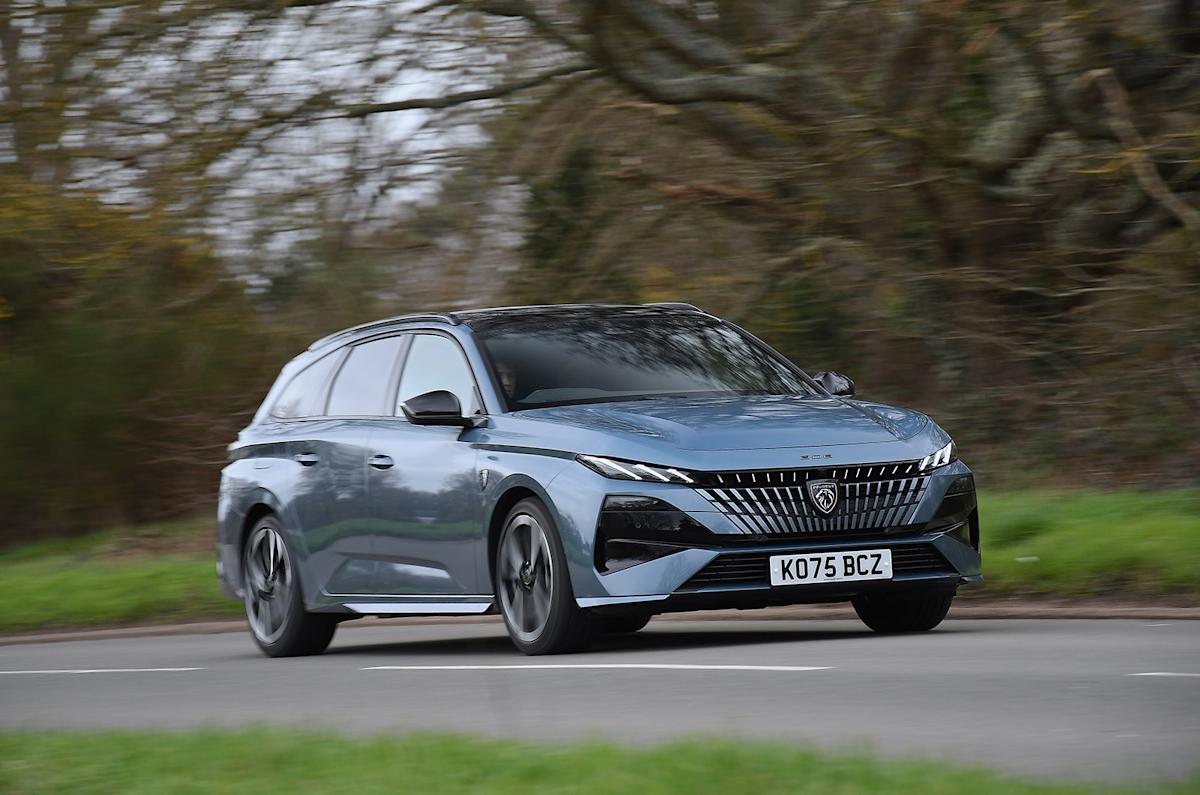
While Peugeot’s range is stacked full of crossovers and SUVs, it still makes room for more traditionally shaped family cars, such as the recently revised 308 hatchback and 308 SW estate reviewed here.
The biggest visual change is a new nose, which to our eyes looks fantastic. It wasn’t half bad before, but it now wears one of the most striking faces in the segment.
That said, it only has the Seat Leon, Cupra Leon, Skoda Octavia, Toyota Corolla, Vauxhall Astra and BYD Seal 6 estates to count as direct rivals.
Despite it not being a big seller in the UK, Peugeot has endowed its C-segment estate with a broad range to suit almost any buyer. Prices start at just under £28,000 (roughly £1200 more than the hatch), for which you get well-specified Allure trim and a mild-hybrid petrol powertrain. A diesel costs about £1000 more. An electric version with 275 miles of range starts at £31,500 (see our separate Peugeot e-308 review), while a plug-in hybrid tops the range at £35,500.
Design & styling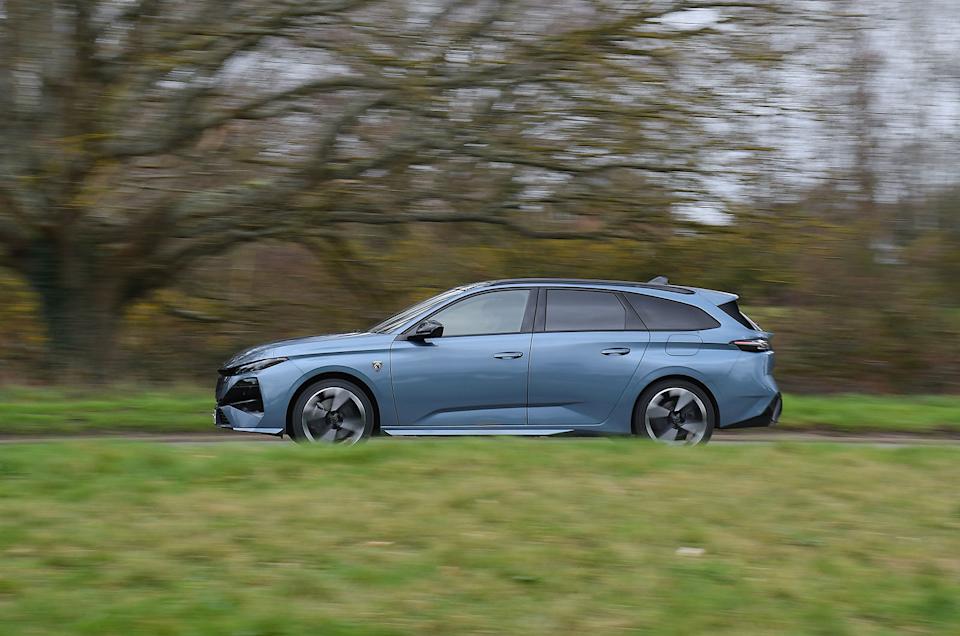
To turn the 308 into an SW, Peugeot has stretched the car by 269mm to 4.6 metres (with a 57mm-longer wheelbase), allowing the boot to increase to more than a metre in length with the seats up. Capacity is 608 litres in the mild-hybrid and diesel, while the EV and PHEV versions are restricted to 548 litres.
That’s competitive with the estate versions of the Octavia (640 litres), Seal 6 (500 litres) and Corolla (598 litres).
With the rear seats folded down, maximum capacity is 1634 litres.
Even with the added length, the 308 SW is a tad shorter than its rivals, so the sharply styled rear end is unfashionably square to allow for the competitively sized boot. That said, the design is still very elegant and well-proportioned; it doesn’t look like your dad’s old brick-shaped Volvo.
For 2026, the 308 has been treated to a mid-cycle update. As well as a shuffling of the powertrain line-up, this is mainly a styling exercise.
Peugeot has leapt enthusiastically on the bandwagon of bold front lighting signatures, with a light bar and a light-up lion emblem. What used to be the main headlight clusters are now only used for the daytime running lights, with the brand-typical ‘three-claw’ pattern, while the main beams are contained in simpler units beneath. It’s a successful update to the exterior design, while inside little has changed.
Mechanically, the 308 is a very similar package to a lot of the other Stellantis offerings, such as the Astra and DS N°4, the EMP2 v3 platform allowing it to offer the wide range of powertrains that it does.
The entry-level 308 uses a 1.2-litre turbocharged three-cylinder petrol engine. Pre-facelift, this came paired with an eight-speed automatic gearbox. Later it was joined by a mild hybrid option, which replaces the eight-speed torque-converter transmission with a six-speed dual-clutcher that encompasses a small electric motor. As part of the update, the pure-petrol version has been dropped and the mild hybrid has become the default.
The PHEVs have gone through a similar evolution. Originally there were two variations (177bhp and 222bhp) of the same system, featuring a 1.6-litre four-cylinder petrol engine and a 90bhp electric motor within an eight-speed torque-converter. After the update, the gearbox is a seven-speed dual-clutcher with a more powerful 123bhp electric motor for a total of 192bhp. The battery capacity has increased from 9.9kWh to 14.6kWh, too, boosting the electric-only range from 40 miles to 52 miles – more competitive than before, if still down on the Seat Leon Estate e-Hybrid’s 82 miles.
The 1.5-litre diesel sticks with its eight-speed torque converter and no electrification.
Suspension is via class-typical MacPherson struts with a torsion-beam axle at the rear, irrespective of which engine you opt for.
Interior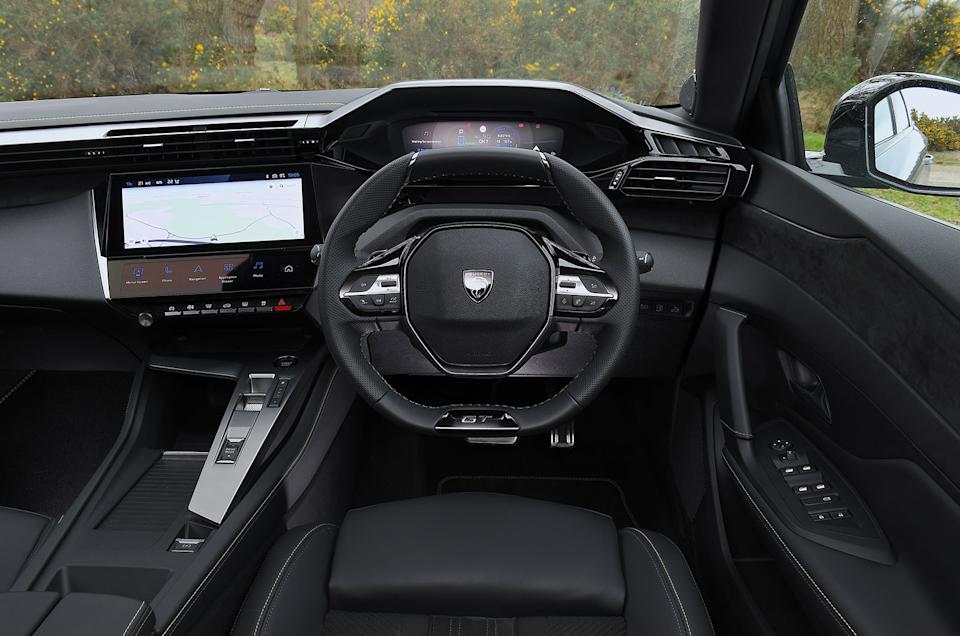
To summarise what we’ve already said, the 308 SW has a very useful boot. It’s large and long and comes with a useful number of nets, hooks and catches.
The Octavia and Leon estates’ boots are a touch bigger, but if you go for a PHEV, the 308 SW comes out on top (the Leon e-Hybrid estate’s is 470 litres, while the Octavia no longer offers PHEV power).
Interior quality remains very good, with nice materials throughout and comfortable, supportive seats. Compared with rivals, it’s a much more special-looking and -feeling place to be.
As before, Allure trim offers a decent smattering of buttons for the climate controls, while stepping up to GT or GT Premium rewards you with customisable touchscreen icons. These i-Toggles are actually a downgrade, because they move the temperature controls onto the main touchscreen.
For the most part, the infotainment is easy to get on with, being clear and quick to respond (except on start-up), but a few more physical buttons, especially for the climate controls, would really enhance usability.
Turning off the lane keeping assistance, overspeed warning and driver attention monitor is supremely easy: just hold the physical button with the car icon. With that said, they’re actually quite well-tuned and unintrusive.
Peugeot’s i-Cockpit layout remains divisive. I don’t mind it for the most part, but the driver’s display is quite cluttered and the steering wheel doesn’t come out far enough for me – although you can sit pleasingly low, if you like.
The longer wheelbase of the estate allows for slightly more rear leg room than in the hatch, although it’s still not fantastic. Anyone over 6ft tall will have their knees close to the chair in front and their head brushing the roof.
Visibility is strong. To aid you when manoeuvring, a reversing camera and parking sensors front and rear come as standard, while a 360deg camera is standard on top-spec GT Premium trim.
Engines & performance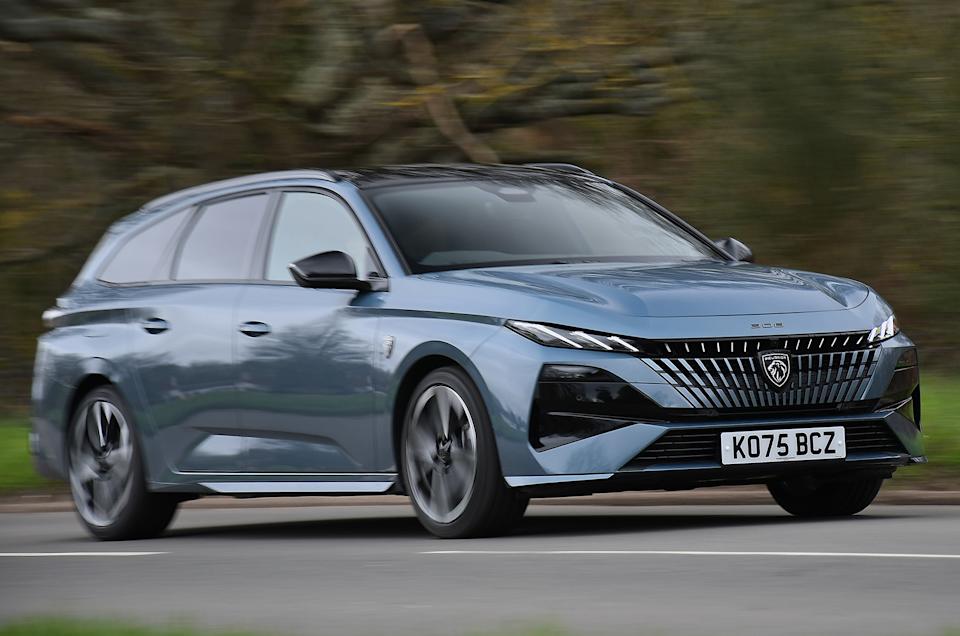
We found the entry-level petrol engine in the pre-facelift 308 generally smooth and quiet, only becoming a little whiny if you really attacked the throttle pedal. The eight-speed automatic gearbox did a good job of picking the right gear, but there were occasions when we wanted a little more torque and acceleration.
The mild-hybrid powertrain in the facelifted car is better but still not perfect. With 143bhp, 170lb ft of torque and a 9.3sec 0-62mph time, it’s quick enough, but it can still feel slightly strained accelerating when loaded up – something that you might do quite often in an estate.
That said, it’s a similar story with engines in entry-level versions of the Octavia, Leon and Corolla. It’s worth noting that the 308 comes standard with an automatic gearbox, like the Corolla. It’s a mostly agreeable six-speed dual-clutcher instead of a noisy CVT.
The diesel offers 128bhp and 221lb ft for a 10.9sec 0-62mph, but in our experience it feels faster than the mild-hybrid more of the time, while the eight-speed automatic keeps the engine very hushed on the motorway, if not so much when accelerating.
The PHEV has been most comprehensively changed as part of the facelift, the previous 1.6-litre petrol engine being mated to a beefier 14.6kWh battery and electric motor for a combined 192bhp and 52 miles of electric-only running.
The extra power from the electric motor is very welcome because it now means engine-off running still feel spritely enough.
With 266lb ft and a 8.0sec 0-62mph time, the PHEV is plenty fast enough, even when loaded up. The engine does a very good job of not being noticed from the inside, with the transition from EV running at low speeds (which it does for an impressive amount of time, even with a flat battery) to engine-on movement being pretty seamless (unless your right foot is heavy enough to trigger kickdown).
Ride & handling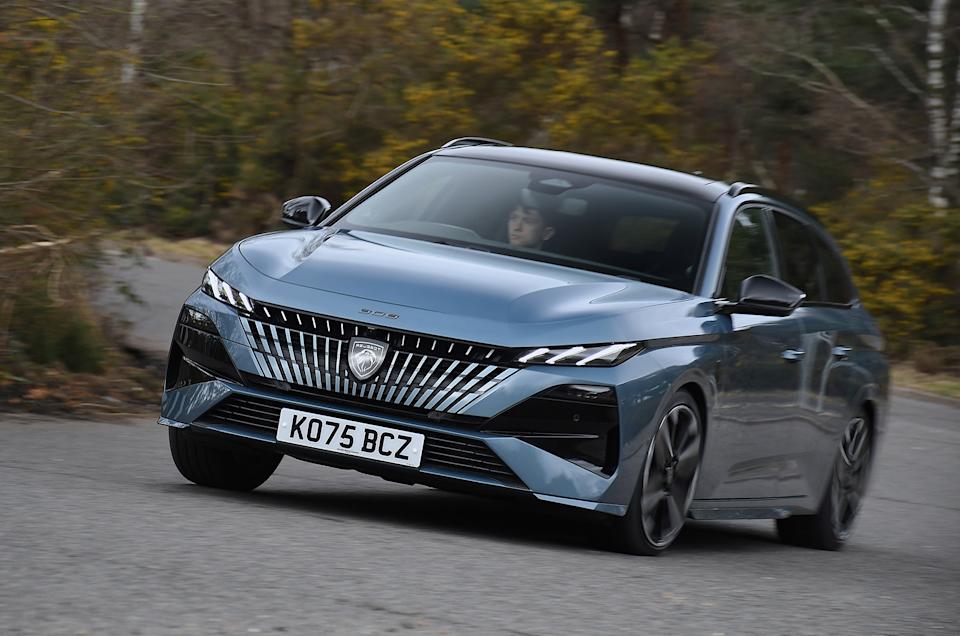
The extended wheelbase and extra size of the 308 SW don’t much dampen the enjoyable handling offered by the hatchback.
There’s a little reduction in dynamism, but in turn the ride is perhaps a little more comfortable, which seems like a fair trade-off.
It’s certainly competitive in the C-segment estate market and ideally balanced for a family car.
Its biggest strengths lie in it not being an SUV: the dynamics, driving position and fuel efficiency are all better than those of the Peugeot 3008 or an equivalent.
Generally the ride and handling are very impressive, especially considering our time has mostly been spent in the 250kg-heavier PHEV on the largest wheels (18in; standard on GT trim).
It’s firmly sprung but not uncomfortably so. You feel imperfections in the road, but they’re not translated into the cabin with any violence or shock, and the dampers do a good job of keeping the ride composed over longer sections of undulations.
Body roll is minimal and the transfer of weight is predictable when you’re pushing on, making for a satisfying car to drive – even if the steering is light and lacking much feel and the paddles behind the wheel seemingly give the gearbox mere suggestions, not instructions.
It’s also impressively hushed at a cruise, although the large 18in alloys do kick up some road noise on rougher surfaces.
MPG & running costs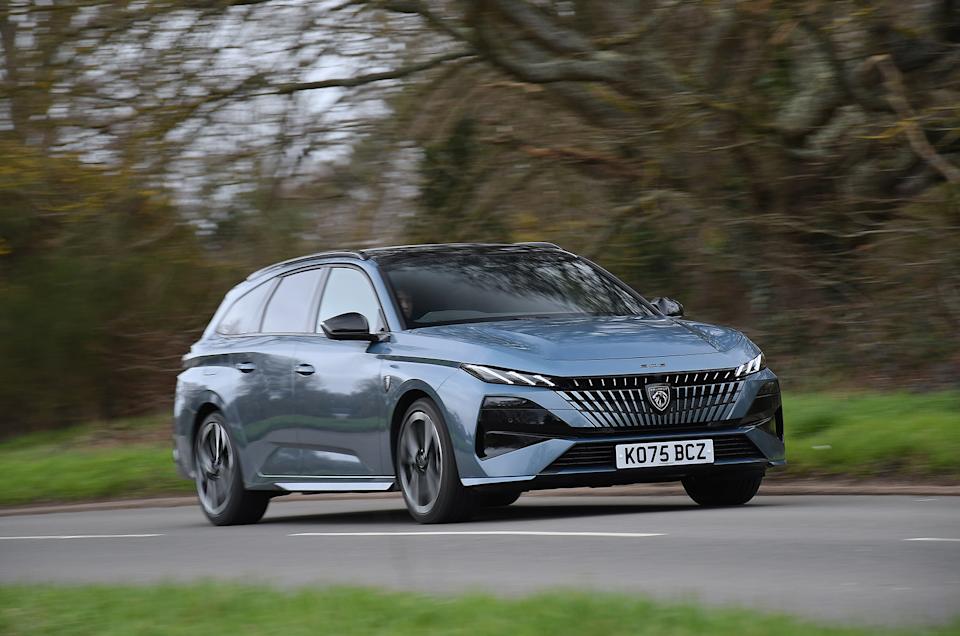
The mild-hybrid claims 56.5mpg on the WTLP cycle. That’s quite impressive: a little more than an equivalent Leon or Octavia estate, a little less than the pricier Corolla hybrid.
In reality, it’s a figure that will be difficult to reach at higher speeds but close to achievable in town (because the engine spends an impressive amount of time turned off, considering it’s only a mild hybrid).
The diesel claims as much as 60mpg, similar to the Octavia and Leon diesels and Corolla hybrid. On the motorway it’s a figure that’s likely achievable, but at lower speeds the mild-hybrid could be the more efficient option. If you’re a high-mileage driver or expecting to keep the car for a significant period, it could be the pick of the range.
The PHEV will be the most economical powertrain, but only if you charge it regularly. Expect 40 miles of electric-only range in real-world use. I achieved 45mpg over 100 miles of motorway running with a flat battery.
If you’re a private buyer, you will struggle to recoup the extra cost, however much you charge: its list price is over £7000 more than the mild-hybrid, at £35,500, or £450 per month instead of £350.
Still, the 308 SW PHEV is cheaper than its rivals: the Seal 6 Touring starts at a similar price but offers only 31 miles of electric range unless you upgrade to the £38,000 Comfort model with 62 miles of range. The Leon PHEV starts at £38,500 (as a Seat; £42,000 in Cupra form) but offers a superior 82-mile range.
For company car buyers, the PHEV’s 16% BIK tax band is significantly lower than the mild-hybrid’s 28% band but notably higher than the 6% of the Leon PHEVs.
Trim levels start with well-equipped Allure at £28,000 (with the mild-hybrid engine). That’s cheaper than all of its rivals (including its less refined Astra sibling) apart from the Seat Leon estate. Allure offers more standard kit than many rivals, too, including a reversing camera, climate control, pixel LED headlights with high-beam assistance and cruise control.
At £30,000, GT trim adds matrix LED lights, an illuminated grille, front parking sensors, 18in wheels, Alcantara interior trim and i-Connect Navigation and configurable i-Toggles for the infotainment.
At £31,500, GT Premium adds a panoramic sunroof, a Focal sound system, heated seats, a heated steering wheel and the Drive Assist Plus Pack.
The top-spec GT Premium PHEV avoids the UK’s ‘luxury car tax’ by only a whisker, so opting for premium paint or a towbar will costs you an extra £425 a year in VED (road tax) for five years.
Verdict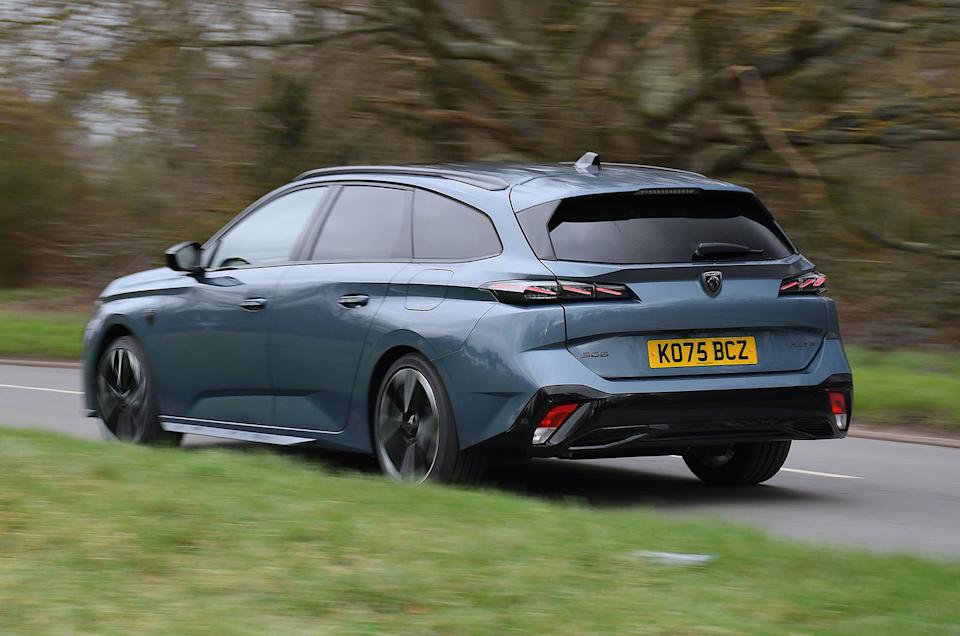
The 308 SW is practical, comfortable and nice to drive and feels more expensive than it actually is. It’s not all perfect, though.
The interior is both a highlight and a lowlight: it’s brimmed with lovely materials and comfortable seats but the infotainment system is too reliant on touch and the driving position won’t be comfortable for some.
The PHEV version won’t go as far on electricity as the equivalent Leon or Seal 6, but it’s cheaper, more luxurious and generally nicer to live with.
Overall the 308 SW is an unfairly forgotten family estate, and it could well be the one to choose, especially if you’re a private buyer looking for a petrol or diesel.
]]>