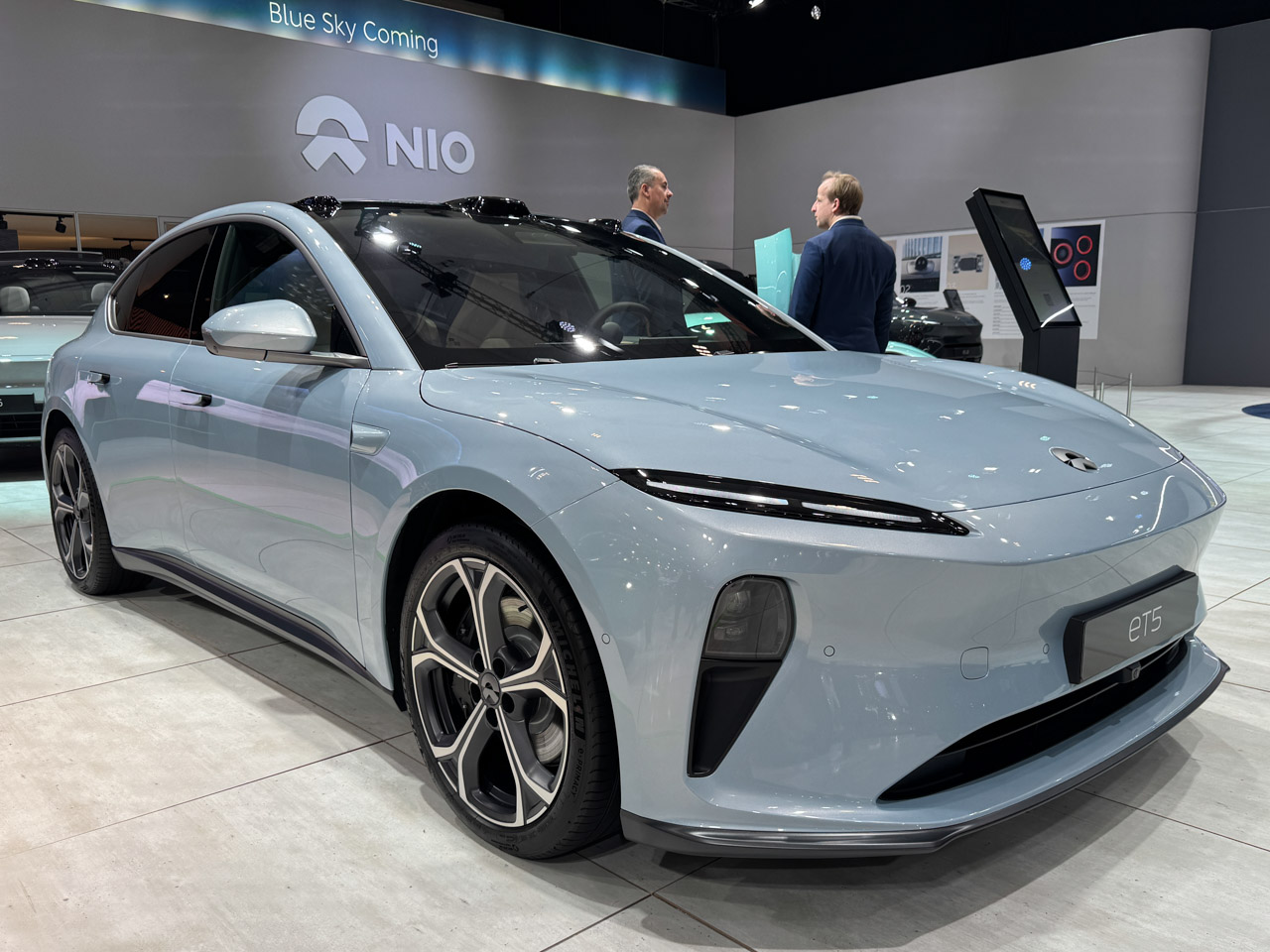
Introduced in late 2021 by the Chinese EV maker listed in the New York Stock Exchange, the Nio ET5 is a midsize electric sedan positioned against the Tesla Model 3 in the Chinese and European markets.
We had a chance to experience the Euro-spec version in person recently, and here are the key observations we made:
Design
The Nio ET5 features a futuristic exterior defined by a sleek roofline, high-tech light design, and prominently positioned LiDAR and dual cameras on the roof. The car has a few sporty design bits as well.
The front bumper features a closed-off design with a concave surface and smooth contours. The raised outer sections of the hood and the progressive spoiler are also among the noteworthy elements at the front.


The ET5 has a largely minimalist exterior, but its dynamic proportions, sharp lighting elements, and sporty design bits offer a nice contrast.
On the sides, the streamlined roofline seamlessly merges into the tail, the beltline sharply kicks up below the rear quarter glass, and the door handles sit flush with the body. 20-inch ‘Gladiator’ five double-spoke alloy wheels and Airglow Orange-colored brake calipers bring contrast with a sporty look.
At the rear, the ‘illumiBlade’ tail light stretches across the width, while the bumper integrates a diffuser-style insert. The Nio logo sits high on the trunk lid, which we found rather unusual.
Interior
The interior follows a minimalist layout with reduced physical controls and clean surface treatment. The dashboard visually forms a seamless connection with the front door panels.


Nomi Mate stands out as the centerpiece of the ET5’s cabin, but I wish Nio offered physical controls for the everyday functions, complementing the voice interactions.
There are two floating displays, including a 10.2-inch HDR driver information display and a 12.8-inch AMOLED portrait central touchscreen. The car also features Nomi Mate, a dash-mounted anthropomorphic AI assistant with a 2.18-inch circular AMOLED display and a dual-motor system enabling 3D head-like movement.
A 256-color ambient lighting system creates a curtain-style, wraparound illumination effect across the cabin. The speaker grilles integrate lighting elements that pulse in sync with audio playback. The front seats offer 14-way power adjustment and include massage, heating, and ventilation functions. The rear seat also comes with a heating function.


The Euro-spec ET5 offers 386 liters (13.6 cu. ft.) of cargo space. Materials and colors throughout the cabin lend it a premium feel.
Experience in the Nio ET5
Entry into the Nio ET5 sedan requires some care because of the low roofline. The touch-sensitive door handles and soft-close doors add a premium feel.
The cabin relies heavily on touchscreen and voice operation, with most seat and vehicle adjustments routed through the display. Temperature and steering-wheel adjustments can also be handled through Nomi, the in-car voice assistant, rather than dedicated physical controls.
Front headroom is not an issue for a six-footer despite the glass roof. The front seats include extendable cushions that provide excellent under-thigh support. Back support is adequate, and side bolstering is decent, but shoulder support could be better and the seats could feel wider for taller occupants.


The pedal box is generously sized and works well even with size 12 footwear. Material quality feels premium throughout. Storage includes a charging mat, cupholders, a center-console bin, and an additional lower compartment for a small bag.
Outward visibility is acceptable for a low-slung sedan, though the low roof and lack of rear quarter glass reduce openness compared with taller vehicles. Rear entry also requires attention to head clearance, as is the case with any electric sedan in this size class.
With the front seat set for a six-footer, the second row offers usable knee room, but the raised floor creates a knee-up seating posture for someone my height. Rear headroom is adequate for a six-footer but would be tighter for taller passengers. The large glass roof helps the cabin feel airy.

Rear passengers get rear air vents, a USB port, and a fold-down center armrest with deployable cupholders. The rear seatbacks do not recline. The flat floor technically allows three across, but comfort and width favor two adults, with three shorter passengers more realistic for shorter trips.
Specifications
The Nio ET5 measures 4,790 mm (188.6 in.) in length, 1,960 mm (77.2 in.) in width, and 1,499 mm (59.0 in.) in height and has a 2,888 mm (113.7 in.) wheelbase. It sports two motors, a 150 kW (201 hp) on the front axle and a 210 kW (282 hp) unit on the rear axle.
Packing 360 kW (483 hp) of total power and 700 Nm (516 lb.-ft.) of torque, the electric midsize sedan hits 0 to 100 km/h (0 to 62 mph) in 4 seconds and achieves a top speed of 200 km/h (124 mph).
Nio provides customers with a choice of 73.5 kWh (net) and 90 kWh (net) battery packs, which support charging at up to 170 kW and 180 kW, respectively. These battery packs deliver a WLTP range of 456 kilometers (283 miles) and 590 kilometers (366 miles), respectively.


The Euro-spec Nio ET5 can travel up to 366 miles on a single charge, and feels like solid value for money.
Price
In Austria, the Nio ET5 retails at EUR 59,500 (USD 68,673) for the standard-range variant and EUR 68,790 (USD 79,395) for the extended-range variant. There’s a Touring (wagon) version as well, priced at EUR 60,990 (USD 70,393) in the standard-range variant and EUR 69,790 (USD 80,549) in the extended-range variant.

An automobile engineer by training, I’ve analyzed the global car market since 2005, with a keen focus on EVs since 2008. My journey in online automotive publishing spans 17 years, during which I have reviewed cutting-edge automotive technologies and interviewed leading global CEOs and vehicle developers.