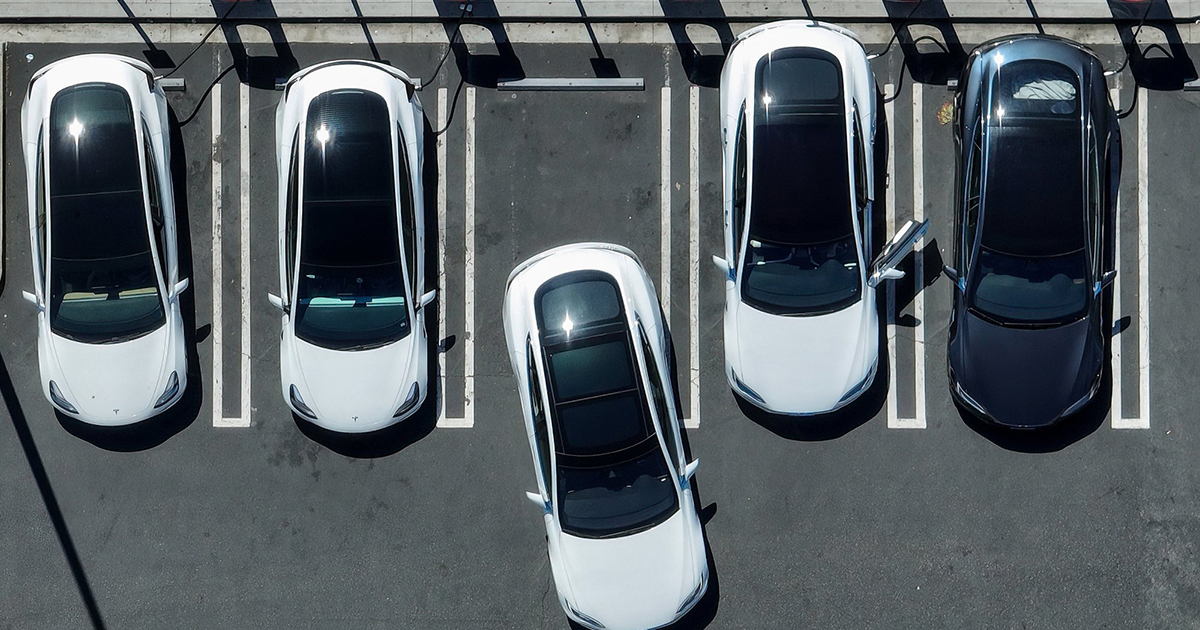
Electric car drivers charge up their vehicles at a Tesla Supercharger in Fountain Valley, Calif. (Jeff Gritchen/Orange County Register/TNS)
March 18, 2026 12:44 PM, EDT
Growing global adoption of electric vehicles helped avoid the consumption of 2.3 million barrels of oil per day last year, according to a modeled scenario from BloombergNEF.
Those fossil fuel savings are expected to increase every year for the rest of the decade as more drivers turn to battery-powered vehicles, said Claudio Lubis, BNEF’s oil analyst. The research group projects that by 2030, avoided daily consumption could more than double to 5.25 million barrels under the economic transition scenario, where governments deploy technologies that are economical rather than implement policies primarily driven by climate goals.
Two- and three-wheeler vehicles now make up the bulk of avoided road fuel use due to the fast rise of electric motorbikes, especially in developing nations. As electric cars become more common, they are forecast to cut more oil demand later this decade.
A separate report released on March 18 by Ember, a London-based think tank, found electric vehicles avoided consumption of 1.7 million barrels of oil a day last year. Daan Walter, analyst at Ember, said the lower figure is based on conservative estimates of how often plug-in hybrid cars run on fossil fuels and heavy EV sales.
Ember calculates that, at current consumption levels and with oil at $80 per barrel, China would save over $28 billion a year in reduced oil imports through its giant fleet of EVs, while Europe would save $8 billion and India $600 million per year.
Growth in global EV sales were expected to slow this year, with China winding down some subsidies, Europe abandoning plans to phase out combustion engines by 2035 and the U.S. making a U-turn on clean tech policies. But surging fuel prices driven by the conflict in the Middle East has reignited interest in EVs.
“Electric vehicles are increasingly cost-competitive with gasoline cars,” said Walter. “Oil volatility means EVs are a common-sense choice for countries wishing to insulate themselves from future shocks.”
NEW | Electric vehicles avoided oil demand equivalent to 70% of #Iran’s exports in 2025 🚗⚡
Oil remains the Achilles’ heel of the global economy. But Ember’s latest analysis shows EVs are the most powerful tool to reduce that vulnerability.
🧵1/4 pic.twitter.com/zoPQfenoxw
— Ember (@ember_energy) March 18, 2026
Electric car sales as a share of the total are above 10% in 39 countries, compared to just four countries in 2019. Asian nations are among the most rapid adopters, a trend that is already slowing growth in oil demand, the Ember analysis shows. In 2025, China reached over 50% of EV sales for the first time, while that share was 38% in Vietnam and 21% in Thailand.