Germany Electric Vehicle Market 2026
Germany Electric Vehicle Market Summary:
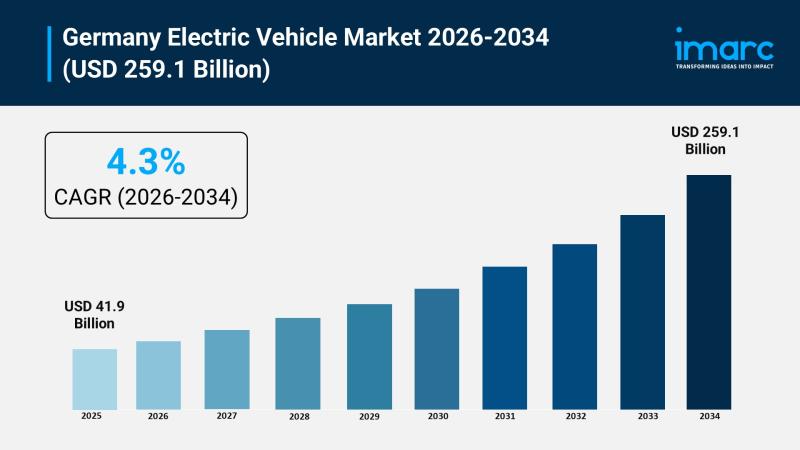
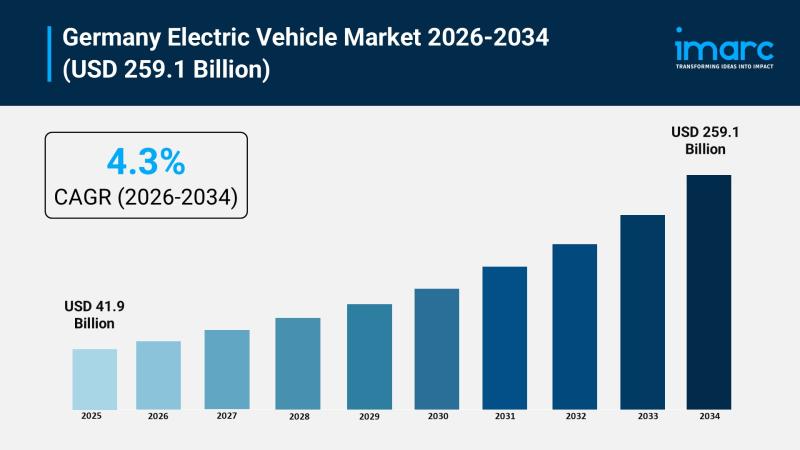
• The Germany electric vehicle market size reached USD 41.9 Billion in 2025.
• The market is projected to reach USD 259.1 Billion by 2034.
• Southern and Western Germany dominate with a significant market share due to the presence of major automotive manufacturing hubs.
• Growth driven by rising fuel costs and supportive government policies, increasing consumer adoption of electric cars, and the accelerating electrification of company fleets.
Request to Get the Sample Report: https://www.imarcgroup.com/germany-electric-vehicle-market/requestsample
Market Overview and Growth Trajectory
According to the latest analysis by IMARC Group, the Germany electric vehicle market size was valued at USD 41.9 Billion in 2025. Looking forward, the market is expected to demonstrate robust growth, reaching a value of USD 259.1 Billion by 2034, exhibiting a growth rate (CAGR) of 22.44% during the forecast period of 2026-2034.
The automotive industry sector is currently witnessing a transformative phase driven by the urgent need to decarbonize transportation. Traditional internal combustion engine vehicles are increasingly being replaced by advanced battery-electric and hybrid solutions. Experts at IMARC Group note that the market is evolving beyond simple vehicle electrification into a complex network of smart charging infrastructure, vehicle-to-grid (V2G) systems, and integrated mobility services designed to optimize efficiency and sustainability.
What Are the Key Drivers of the Germany Electric Vehicle Market?
Rising Fuel Costs and Supportive Government Policy:
The escalating expense of traditional fossil fuels is pushing consumers toward electric alternatives. With unleaded gasoline and diesel prices remaining high, electric vehicles (EVs) offer a compelling economic advantage. Furthermore, the German government has implemented ambitious strategies and incentives to stabilize domestic demand and promote EV adoption, directly spurring innovation and investment in electric mobility solutions.
Increasing Electric Car Adoption:
The rapid uptake of EVs in Germany reflects a broader global shift toward environmentally friendly transportation. According to the Federal Motor Transport Authority (KBA), battery-electric vehicles (BEVs) now account for a significant portion of new registrations, with the country surpassing two million BEVs on the road in early 2026 – a nearly sixtyfold increase since 2017. This surge is supported by tax incentives, subsidies, and growing environmental consciousness among consumers.
Company Fleet Electrification:
Fleet electrification is becoming a decisive factor in the market as German corporates and logistics providers transition to sustainable mobility to meet emission reduction targets and cut operating costs. Leasing models, government fleet incentives, and lower total cost of ownership are accelerating adoption among delivery companies, municipal services, and ride-sharing operators. Commercial adoption creates a ripple effect, normalizing electric transport across industries and boosting demand for both passenger and light commercial EVs.
Emerging Trends: Chinese OEM Expansion and BEV Milestones
The report highlights that the industry is not just growing in size but also changing in nature. A key market trend is the increasing focus on the aggressive expansion of Chinese automotive brands into the German market. Companies are rapidly adopting competitive pricing and advanced technology to gain a foothold, with brands like BYD, Leapmotor, and XPeng experiencing triple-digit growth rates in early 2026, challenging established European and American players.
Furthermore, the integration of high-voltage architecture and ultra-fast charging capabilities is bolstering market growth by offering significantly reduced charging times and enhanced driving range. Advanced driver-assistance systems (ADAS) are also being developed to cater to the need for enhanced safety and autonomous driving features, further enhancing the market outlook.
Germany Electric Vehicle Market Segmentation Analysis
IMARC Group provides a comprehensive analysis of the key trends in each segment of the market. The report has categorized the market based on Component, Propulsion Type, and Vehicle Type.
Breakup by Component:
• Battery Cells and Packs
• Fuel Stack
• On-Board Charger
• Electric Motor
• Brake, Wheel and Suspension
• Body and Chassis
• Others
Breakup by Propulsion Type:
• The market is dissected into Battery Electric Vehicle (BEV), Fuel Cell Electric Vehicle (FCEV), and Plug-In Hybrid Electric Vehicle (PHEV). The shift towards BEVs reflects the growing desire among businesses and consumers to adopt fully electric mobility solutions with zero tailpipe emissions, supported by an expanding charging network and longer driving ranges.
Breakup by Vehicle Type:
• The market is dissected into Passenger Vehicles, Commercial Vehicles, and Others. The shift towards electric passenger vehicles is the primary driver of market volume, fueled by consumer incentives, a growing model variety from compact cars to SUVs, and the need to reduce personal transportation carbon footprints.
Regional Insights:
• Western Germany
• Southern Germany
• Eastern Germany
• Northern Germany
IMARC Group analysts analyse the region’s growth factors:
• Automotive Heartland: This region hosts the headquarters and major production facilities of global giants like Volkswagen, BMW, Mercedes-Benz, and Audi, along with a dense network of specialized suppliers like Bosch and ZF Friedrichshafen.
• High Consumer Affordability & Infrastructure: States like Bavaria, Baden-Württemberg, and North Rhine-Westphalia have the highest rates of disposable income and the most developed charging infrastructure, driving massive demand for premium and mid-priced EVs.
• Government and Corporate Investment: Governments and corporations in the region are heavily investing in R&D centers, battery cell production (e.g., Volkswagen’s PowerCo in Salzgitter), and future mobility technologies to maintain Germany’s leadership in the automotive sector.
Other regions, including Eastern and Northern Germany, are also showing significant growth, fueled by increasing industrial activity and the need for modern mobility solutions in major urban centers like Berlin and Hamburg.
Speak to an Analyst: https://www.imarcgroup.com/request?type=report&id=23241&flag=C
Competitive Landscape
The Germany electric vehicle market is characterized by the presence of several key players focusing on expanding their geographical reach and technological prowess. These industry leaders are investing in R&D for solid-state batteries and software-defined vehicles to offer enhanced performance and user experiences to customers, and are engaging in strategic partnerships and vertical integration to secure battery supply chains and strengthen their global footprints.
• Volkswagen AG
• BMW Group
• Mercedes-Benz Group AG
• Stellantis N.V.
• Tesla Inc.
• Hyundai Motor Company
• BYD Company Ltd.
• Robert Bosch GmbH
• ZF Friedrichshafen AG
• Continental AG
Media & Sales Contact
IMARC Group,
134 N 4th St. Brooklyn, NY 11249, USA
Email: sales@imarcgroup.com
Tel No: (D) +91 120 433 0800
United States: +1-201971-6302
About IMARC Group
IMARC Group is a global management consulting firm that helps the world’s most ambitious changemakers to create a lasting impact. The company provides a comprehensive suite of market entry and expansion services. IMARC offerings include thorough market assessment, feasibility studies, company incorporation assistance, factory setup support, regulatory approvals and licensing navigation, branding, marketing and sales strategies, competitive landscape and benchmarking analyses, pricing and cost research, and procurement research.
This release was published on openPR.