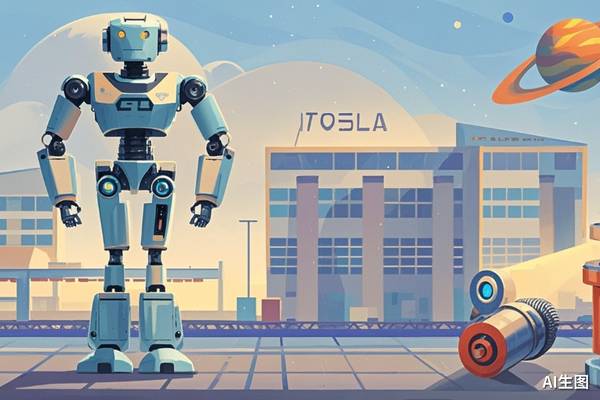
With the debut of Tesla’s third-generation Optimus at AWE2026, Elon Musk’s promise of mass-producing one million units seems to be just around the corner.
Who is manufacturing the “joints” for Optimus? In the past, there were various speculations from the outside world, but there was no official response. Until recently, the news that five Chinese suppliers collectively went to Thailand to build factories for the first time brought Tesla’s “O-chain” (Optimus supply chain) to the surface.
In February this year, Thai media reported that the Thailand Board of Investment had approved Xinjian Transmission, Bete Technology, Sanhua Intelligent Control, Tuopu Group, and Xusheng Group to invest in building factories in Thailand to produce structural frames, joints, arm and finger control systems for humanoid robots. The main target market for the factory construction is to supply components for “Tesla robots” and other major technology companies (including Apple, Samsung, and Huawei).
Taking a closer look at this “O-chain” list, the division of labor is clear at a glance: Sanhua Intelligent Control produces actuators, providing “muscle” power for the robot; Tuopu Group is responsible for joint modules and actuators, connecting the “skeleton” of the robot; Xusheng Group produces components such as joints; Xinjian Transmission and Bete Technology produce planetary roller screws, controlling the delicate movements of the robot.
Most of these enterprises have cooperated with Tesla in the new energy vehicle field for many years. When the humanoid robot trend came, they extended their business to the humanoid robot field by leveraging their technological accumulation in precision manufacturing, and entered the supply chain of key components such as actuators, ball screws, joints, and arms of robots.
Today, let’s take stock of the familiar faces in Musk’s “O-chain.”
1
The most attention is on Sanhua Intelligent Control. As an established supplier of Tesla, in media reports, it is about to produce actuators for Optimus, which are the core components of the joint movement of humanoid robots, equivalent to the “muscles” of the robot.
Sanhua Intelligent Control started with agricultural machinery and air-conditioning accessories, and later entered the new energy vehicle industry. In 2017, it became a first-tier supplier of Tesla, providing thermal management components. The market has long regarded it as a “Tesla concept stock.”
In 2023, Sanhua Intelligent Control began to layout the robot electromechanical actuator business, including rotary and linear actuators, and invested in building a factory for this purpose. In January 2024, Sanhua Intelligent Control planned to invest 3.8 billion yuan in Hangzhou to build a R & D and production base for robot electromechanical actuators and domain controllers.
In the robot business, Sanhua Intelligent Control is still in the initial stage, but it has already started to cooperate with customers. In the first half of 2025, Sanhua Intelligent Control has cooperated with customers in the R & D, trial production, iteration, and sample delivery of a full range of products, and has achieved a series of innovative results around existing products.
Although Sanhua Intelligent Control has never admitted to being a supplier of Tesla’s Optimus robot, market news can always stir up the stock price.
In October last year, there was market news that Tesla had placed an order for linear actuators worth more than 5 billion yuan with Sanhua Intelligent Control, and planned to start delivery in the first quarter of 2026. The market estimated that this would produce at least 180,000 Tesla Optimus humanoid robots.
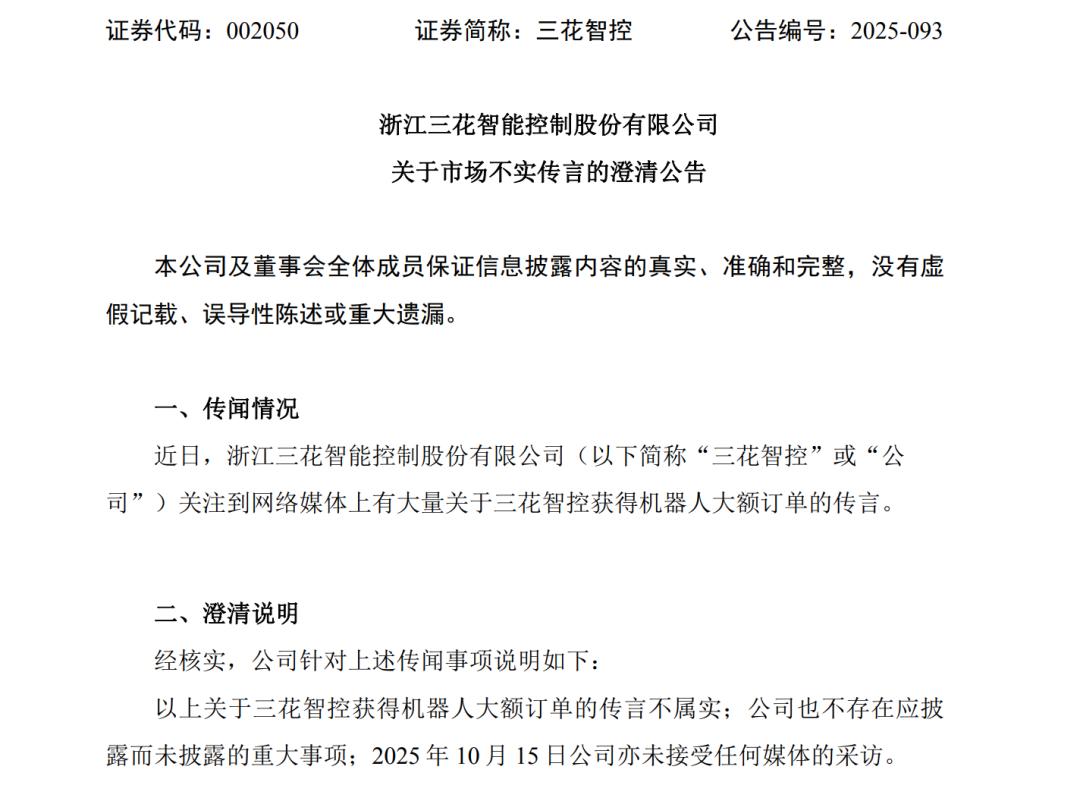
This news caused Sanhua Intelligent Control to rise simultaneously in the A-share and Hong Kong stock markets, with a 10% increase in the A-share market on that day. As a result, Sanhua Intelligent Control urgently issued a clarification announcement saying that “the rumor is untrue” and there were no major matters that should have been disclosed but were not.
Also an established supplier of Tesla, Tuopu Group was already a chassis supplier of Tesla as early as 2016, and later entered the robot business.
In 2023, Tuopu Group established an electric drive division and entered the field of embodied intelligent robots. Later, Tuopu Group planned to invest 5 billion yuan to build a production base for robot electric drive systems.
In addition to electric drive actuators, Tuopu Group has also laid out robot body structural parts, sensors, foot shock absorbers, electronic flexible skins, etc.
Its 2024 annual report shows that Tuopu Group started cooperation with customers on linear actuators, then launched the R & D of rotary actuators, and then began to develop products such as dexterous hand motors, and has sent samples to customers many times.
Although it is not clear who the customer is, in media reports, Tuopu Group is about to produce joint modules and actuators for Tesla robots.
Another long-term core supplier of Tesla, Xusheng Group, is about to produce joints and skeletal components for Optimus.
Xusheng Group was established in 2003 and has outstanding advantages in aluminum alloy forming technology. It has long been engaged in the R & D, production, and sales of precision aluminum alloy parts, and its products are mainly supplied to the electric drive, battery, chassis, and suspension systems of new energy vehicles.
As early as 2013, Xusheng Group reached a cooperation with Tesla and became its first-tier supplier, providing lightweight solutions for Tesla’s Model S/X, Model 3/Y and other models.
With the advent of the robot era, Xusheng Group has also started to get involved in the robot business.
In May last year, when answering investors’ questions, it said that the company had reached cooperation on products such as joint shells and torso structural parts with many domestic and foreign humanoid robot customers. Its semi-annual report in 2025 also shows that Xusheng Group has established cooperation with many domestic and foreign leading robot enterprises and obtained project approvals from multiple customers.
Xinjian Transmission is manufacturing “planetary roller screws” for Optimus. Screws are the core components of the robot’s arms, legs, waist, and dexterous hands. Each Optimus is expected to use 14 – 16 planetary roller screws.
Different from the above three, Xinjian Transmission is not a core supplier of Tesla cars. However, it has already entered the Optimus supply chain. According to China Securities Journal, Xinjian Transmission’s products were applied to Optimus in 2022.
Xinjian Transmission was established in 1999 and develops and produces products such as rolled worm gears, seat horizontal drives, planetary roller screws, and linear electric drive joints. Relying on its advantages in the screw field, Xinjian Transmission has entered the humanoid robot field.
In March 2025, Shan Xinping, the chairman of Xinjian Transmission, revealed in an interview with Zhejiang Daily that “planetary roller screws are the key components of robot equipment… This year, Xinjian Transmission has welcomed a new industrialization project for producing one million planetary roller screws for humanoid robots annually, seizing the new trend.”
According to the website of the Hangzhou Municipal People’s Government, in the first quarter of 2025, the headquarters of Xinjian Transmission and the industrialization project base for producing one million “planetary roller screws” for humanoid robots annually started construction. The total construction area of this project is about 71,000 square meters, with a planned total investment of 2.6 billion yuan and a first-phase investment of 1 billion yuan.
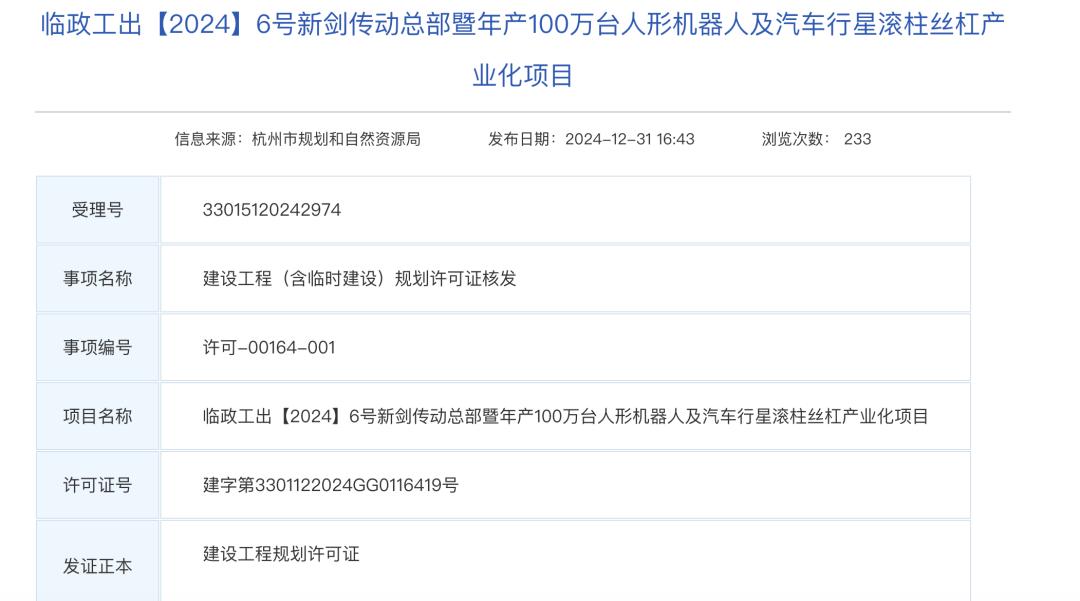
The production capacity plan of one million units exactly matches Tesla’s long-term goal. Musk has clearly stated that the third generation of Optimus will start mass production before the end of 2026, with a target annual output of one million units.
In the second half of last year, there was market news that Tesla had placed an order for the mass production of dexterous hand assemblies with Xinjian Transmission, with an order quantity of more than 1,000 units.
Although this news is a market rumor, in August last year, Xinjian Transmission cooperated with Zhejiang Honghui Motor Co., Ltd., a subsidiary of Xinzhi Group, in the field of transmission actuators such as humanoid robot dexterous hands and joint modules.
Riding on the wave of humanoid robots, in January this year, Xinjian Transmission launched the listing counseling work.
Bete Technology also produces “planetary roller screws” for Tesla. This company was established in 2003 and focuses on the R & D of power electronic protection components and related accessories. Its products are used in fields such as automotive electronics and consumer electronics. In 2024, its annual revenue was about 500 million yuan.
In September last year, Bete Technology was acquired by Yangjie Technology, which also produces electronic protection components, for 2.218 billion yuan in cash to acquire 100% of its equity, and signed a performance gambling agreement with a total of 555 million yuan for the next three years.
2
In addition to the aforementioned five enterprises, public information shows that two other Tesla suppliers, Changying Precision and Lens Technology, are also regarded by the market as potential suppliers of Tesla robots. Their common points are: on the one hand, they are both long-term suppliers of Tesla; on the other hand, both companies have entered the robot-related business field and delivered samples to customers.
Changying Precision is a long-term supplier of Tesla, and its business has also involved robots in recent years. In 2025, Changying Precision delivered a total of about 690,000 precision components for humanoid robots, of which about 80% of the products were sent to overseas customers. These 690,000 products cover precision components of multiple core parts such as the dexterous hands, limb joints, and transmission systems of humanoid robots.
Lens Technology is also a core supplier of Tesla, and its business has long extended to fields such as humanoid robot structural parts, functional modules, and complete machine assembly. Its semi-annual report in 2025 shows that Lens Technology has made substantial progress in cooperation with domestic and foreign leading embodied intelligent enterprises, and achieved mass delivery of core components such as joint modules, dexterous hands, and exoskeleton equipment, as well as complete machine assembly.
For example, Lens Technology has long reached a cooperation with Zhiyuan Robotics. In January 2025, Lens Technology delivered a batch of humanoid robot Lingxi X1 to Zhiyuan, and participated in the production, assembly, testing, and control of core components such as the joint modules, DCU controllers, and OmniPicker (grippers) of the Lingxi X1 robot.
In September last year, an investor asked if Lens Technology was involved in supplying Tesla’s Optimas humanoid robots?
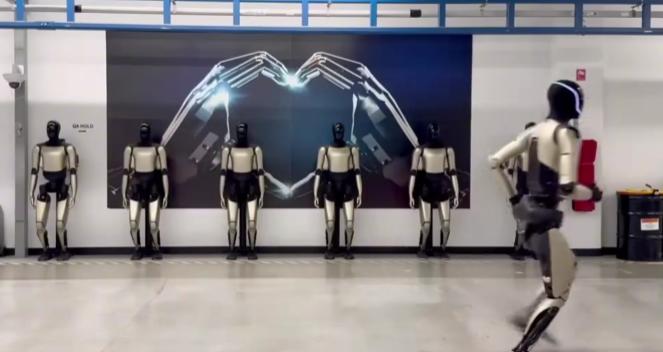
Lens Technology replied that the company has delivered a batch of head modules, joint modules, dexterous hands, torso shell structural parts, and complete machine assembly to multiple humanoid robot customers, and is also cooperating with a major North American customer to develop humanoid robot-related modules.
Wolong Electric Drive is also one of the speculated objects. However, in September last year, Wolong Electric Drive denied the news that “the axial flux motors and frameless torque motors it produced had entered the testing stage of Tesla’s Optimus, and it had locked in an order for 200,000 motors.”
Hengli Hydraulics was also rumored to be one of the suppliers of Tesla robots, and its business involves screw production. According to 21st Century Business Herald, screws are the largest cost source of Tesla’s humanoid robot hardware, accounting for about 30% of the total cost of the whole machine. However, Hengli Hydraulics quickly refuted the rumor, saying that the company was mainly cooperating with customers in early R & D and sample design work, and was actively contacting many domestic and foreign customers, and the cooperation progress covered multiple links such as R & D and sample delivery.
These speculations all point to one thing: the Chinese supply chain is an indispensable part of Tesla’s Optimus.
Although Musk stopped producing the Model S and X and transformed the Fremont factory in California into a factory for producing “Optimus,” it is obvious that the production of Optimus depends on the Chinese supply chain.
Musk has been in contact with Chinese manufacturers for many years.
Observer.com cited a report from the South China Morning Post, saying that people familiar with the matter revealed that Tesla had started contacting hundreds of Chinese parts suppliers for procurement three years ago, and had also carried out in-depth cooperation with some manufacturers in R & D and hardware design work. Some suppliers had delivered small batches of parts samples based on Tesla’s feedback. In recent months, some suppliers have sent new prototype accessories for the curved glass head of the “Optimus” robot to Tesla.
The aforementioned people familiar with the matter said that this supply chain will follow the example of Apple and Tesla’s electric vehicles and establish a strong parts supplier network in China – from the manufacturers of actuators, motors, reducers, bearings, vision systems, sensors, screws to batteries.
3
After sorting it out, we can see that the core members of this looming “O-chain” almost all have a common label: they are more or less related to the automotive industry, and most of them are suppliers of Tesla cars. In the past decade or so, they have participated in the manufacturing of Tesla cars. Now, when Musk places his next bet on humanoid robots, they also need to make plans for themselves.
“No one will remember that Tesla used to make cars in the end,” Musk’s transformation not only concerns his own development prospects but also has a certain impact on the automotive industry chain.
Technically, the migration from the automotive supply chain to the robot supply chain is almost a natural thing. The core components of humanoid robots, such as actuators, joints, and screws, have a high degree of technical homology with the electric drive systems of new energy vehicles.
The deeper reason is that after the explosive growth of the new energy vehicle industry, it has gradually entered a stable period, and enterprises need a new growth engine. And the blueprint of “mass-producing one million units” and “the future market value exceeding that of cars” depicted by Musk, as well as the market valuation of 25 trillion US dollars, just provide an imaginative growth space.
Of course, this migration is not a one-sided affair. Musk also has reasons to rely on the Chinese supply chain.
On the one hand, most of the current production of humanoid robot parts comes from Chinese enterprises.
Cheng Xin, a partner at Bain & Company, said: “About 50% to 70% of the manufacturing capabilities and core parts production technologies in the humanoid robot field are in the hands of Chinese enterprises… In some core parts fields, the products of Chinese enterprises account for at least 55% of the global humanoid robot bill of materials.”
IDC data also showed that there were about 18,000 humanoid robots globally in 2025, and most of them were from Chinese robot enterprises.
Second is the cost issue. According to Morgan Stanley’s estimate, if the Chinese supply chain does not participate, the total cost of the second-generation Optimus will rise from about $46,000 to $131,000. This is obviously an unbearable burden for Tesla, which wants to control the cost at $20,000.
Chinese suppliers are eager to seize the wave of the times, and Tesla needs to find a supply chain system in China to replicate the miracle of the “Apple supply chain.” To some extent, this is a two-way pursuit.
However, although suppliers are eager for orders, the reality is much calmer.
In November last year, Goldman Sachs released a field research report on nine Chinese humanoid robot supply chains