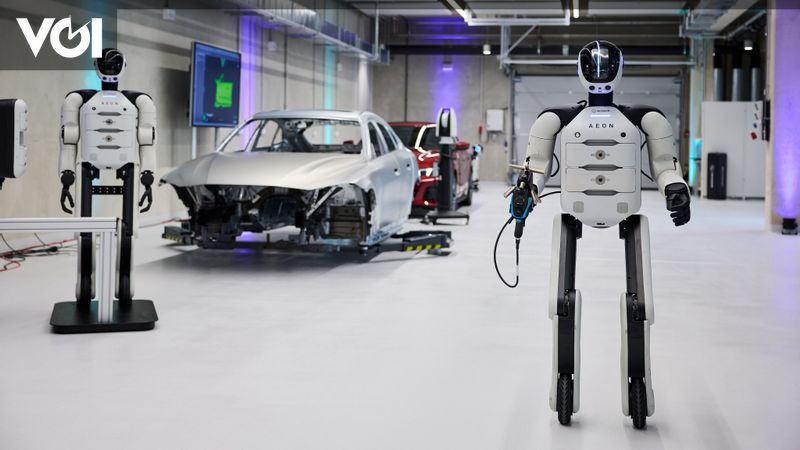
BMW – German automotive manufacturer BMW has begun testing the use of humanoid robots in the production process of electric cars at its iFACTORY manufacturing facility in Leipzig, a move that marks the acceleration of the integration of artificial intelligence in the automotive industry.
The robot used in the trial is called AEON, a humanoid machine developed by Zurich-based technology company Hexagon Robotics. This device is designed to help with various jobs on production lines that are repetitive or require high physical strength.
The AEON robot is about 1.65 meters tall and weighs about 60 kilograms. Unlike conventional humanoid robots that use legs, AEON moves using wheels so that it can move faster and more efficiently on the factory floor.
At the production facility, robots are used to assist in the assembly process of electric vehicle batteries, tightening bolts, and handling components used in high-voltage battery systems. These tasks have been known to take time and are repetitive, so they are considered suitable for automation.
The robot is equipped with 22 sensors, including cameras and microphones, which allow the machine to analyze the surrounding environment and avoid obstacles while working in production areas. The robot’s computing system uses the NVIDIA Jetson Orin AI computing platform that processes sensor data and drives the artificial intelligence system for navigation and motion control.
BMW calls this approach the concept of “Physical AI”, which is the integration of digital intelligence with physical machines that can interact directly with the real world environment.
This project is actually a continuation of a previous trial at the BMW factory in Spartanburg, USA. In the pilot program for about 10 months, the robot helped handle more than 90,000 components and contributed to the production of about 30,000 vehicles.
BMW plans to continue testing this technology with a number of additional trials, before running a larger pilot program this summer.
BMW’s move reflects a growing trend in the automotive industry, where a number of companies are beginning to experiment with humanoid robots to increase production efficiency. Companies such as Tesla, Mercedes-Benz, and Hyundai are also developing or testing human-shaped robots to work on assembly lines.
One of the most highlighted projects is Tesla’s Optimus robot developed by Tesla. The robot is designed to perform repetitive factory work, and in the long run it is estimated that it can be produced at a lower cost than a car.
If this technology matures, humanoid robots have the potential to become a common part of the modern manufacturing ecosystem, changing the way factories operate while accelerating the production of electric vehicles around the world.
The English, Chinese, Japanese, Arabic, and French versions are automatically generated by the AI. So there may still be inaccuracies in translating, please always see Indonesian as our main language.
(system supported by DigitalSiber.id)