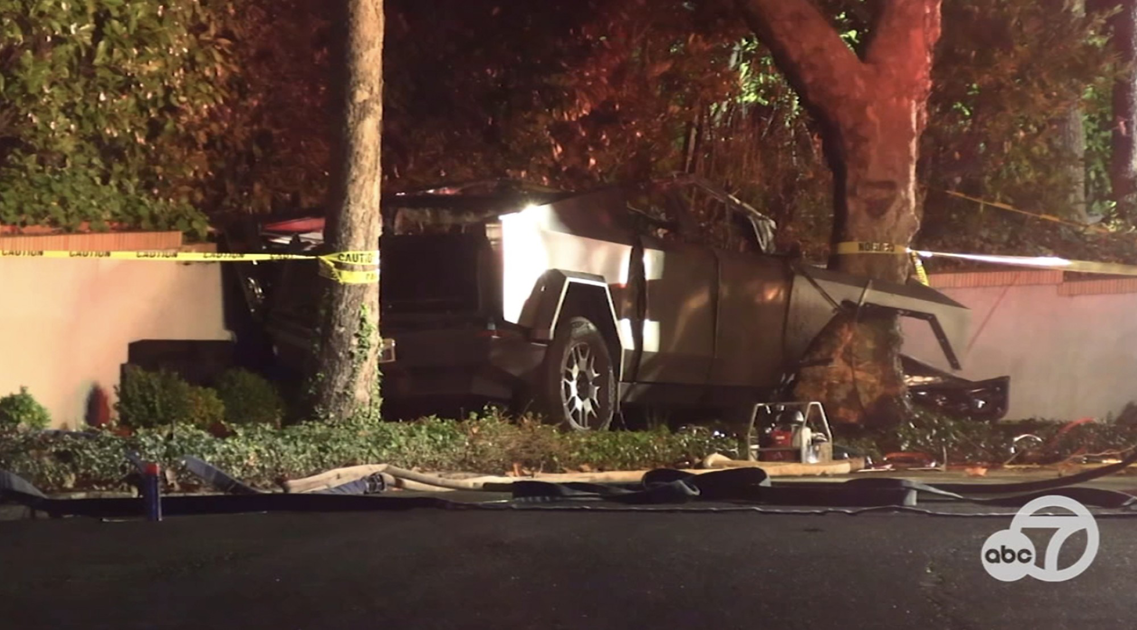
The sole survivor of a 2024 Tesla Cybertruck crash that killed three young adults sued the automaker Monday in Alameda County Superior Court, alleging that a design flaw turned the burning vehicle into a trap that prevented passengers from escaping.
Jordan Miller, 20, was in the front passenger seat on Nov. 27, 2024, in Piedmont. Soren Dixon, 19, was driving; Jack Nelson, 20, and Krysta Tsukahara, 19, were in the back seat. The four, who graduated from Piedmont High School in 2023, were socializing while home from college for Thanksgiving.
According to the complaint, the crash occurred around 3:07 a.m., when the 2024 Cybertruck struck a tree on Hampton Road near King Avenue. The truck caught fire almost instantly; witnesses reported flames climbing an estimated 10 feet near the front of the vehicle.
A friend who’d been driving a vehicle behind the Cybertruck reached the scene within seconds but could not get the truck’s doors open, the complaint says.
The friend grabbed a tree branch and struck the front window repeatedly until the reinforced glass broke, according to the suit. He reached in and pulled Miller to safety but could not reach the other three.
Miller claims Tesla is responsible because the Cybertruck’s doors — which rely on electronic buttons and have no exterior mechanical handles — failed immediately following the crash, making rescue impossible. “He couldn’t open the doors. No handles. The buttons weren’t working,” Annie Wu, one of Miller’s attorneys, said in a statement. “Jordan was trapped in a burning vehicle when he didn’t have to be. That is a design problem.”
Dixon was driving drunk, with a blood alcohol level of 0.195%, and had cocaine in his system, according to toxicology tests.
Miller suffered severe injuries. He was placed in a five-day induced coma with ventilator-assisted breathing and suffered burns to his airways and lungs. Approximately half his colon was removed, four fractured vertebrae required fusion with permanent implants, and he had third-degree burns to his left leg and left hand, requiring extensive skin grafts.
In addition to Tesla, the complaint names as defendants the estates of Dixon and Charles Patterson, the vehicle’s owner.
The complaint brings six causes of action against Tesla: strict product liability for negligence, design defect, failure to warn, and negligent failure to recall or retrofit, as well as negligence and negligent entrustment claims against the Dixon and Patterson estates.
Anthony Label, another of Miller’s attorneys, said the vehicle’s fundamental design flaw is the absence of exterior door handles.
“When you design a vehicle with no mechanical way to open the doors from the outside, you are betting the electronics will work in every scenario, including a high-speed crash followed by a fire,” Label said. “Someone was there to help immediately. He couldn’t get in. This lawsuit is about what Tesla knew and what Tesla designed.”
Label said his client faces a lifetime of consequences from injuries sustained in the crash. “It’s been a tough road,” he said. “Jordan has had a lot of surgeries and will be dealing with the effects for the rest of his life.”
The parents of Nelson and Tsukahara sued Tesla in October, making similar arguments about the Cybertruck’s doors.
Most automakers, Label said, do not design vehicles that prevent occupants from escaping or block rescuers from getting in. “This design feature is pretty unique,” he said. “It was either done without thinking, or they thought about it and didn’t care — they chose design and style over safety.”
The complaint alleges that Tesla has known for more than a decade that its electronic door systems risked trapping occupants after crashes. It cites a statement from Tesla CEO Elon Musk, made during a May 2013 earnings call, acknowledging that door-handle sensors sometimes malfunctioned.
The suit also cites a series of fatal or near-fatal entrapment incidents involving Tesla vehicles going back to 2016, and safety recalls of the Cybertruck issued by the National Highway Traffic Safety Administration since the vehicle’s November 2023 launch.
In a crash in August 2024 in Baytown, Texas, a Cybertruck driver became trapped after a single-vehicle collision and died in a fire that reached 5,000 degrees Fahrenheit, according to the complaint.
Miller’s lawsuit claims the Cybertruck’s reinforced windows compounded the entrapment hazard, noting that first responders have found the glass capable of withstanding multiple strikes from an ax and other standard rescue tools.
Tesla representatives did not respond to a request for comment.