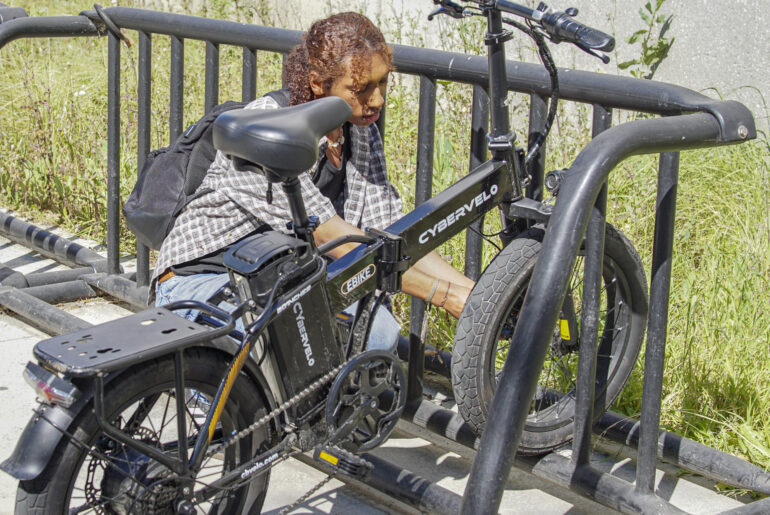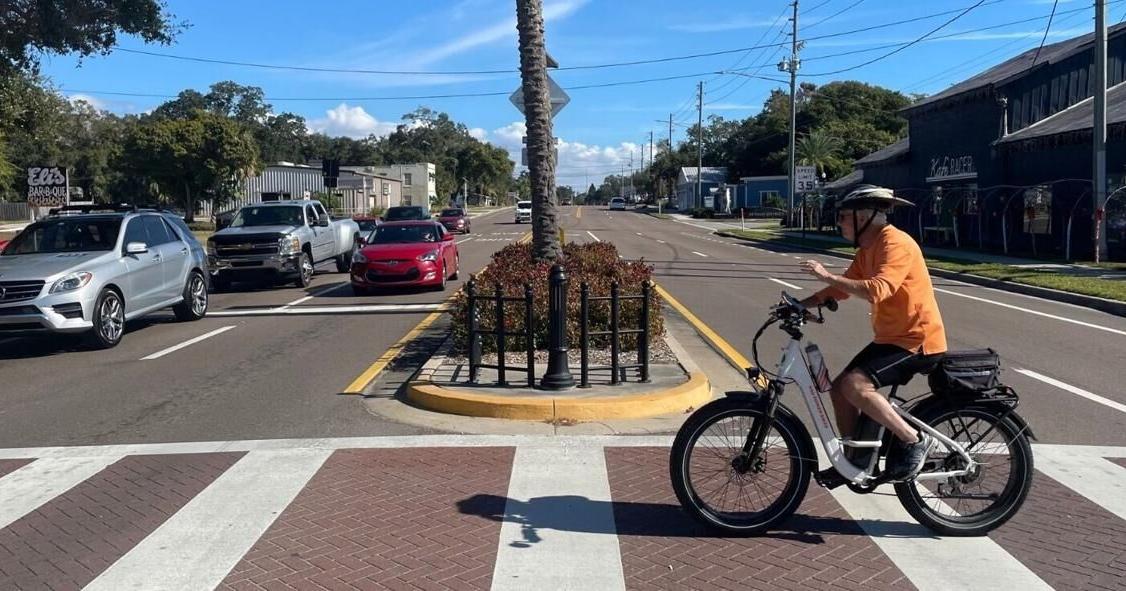
Victor Strong used to ride his e-bike six to 10 miles each way to work in St. Petersburg. He planned every route like a math problem, calculating which roads had less traffic, which turns were safest, which hours to avoid.
He took 32nd Avenue home instead of 30th because the neighborhood streets were quieter, even though 30th has a bike lane. He skipped rush hours and weekend nights when he could.
“I almost got hit all the time it felt like,” Strong said. “People in this area drive way too fast.”
Strong, 25, is exactly the kind of rider Florida’s new e-bike legislation is supposed to protect. But the bill that passed the Legislature is far thinner than the one that was filed. And Strong, whose bike was stolen, said he’d love tougher laws on theft before the state starts regulating how people ride.
Three people died in e-bike and bicycle crashes in Pinellas County over 12 days in October. Within weeks, two Florida lawmakers filed bills that would have required a driver’s license to operate the fastest e-bikes, created a new “electric motorcycle” classification and imposed fines for tampering with e-bike motors.
Five months later, the Legislature passed something else entirely.
The bill now on Gov. Ron DeSantis’ desk, SB 382, was approved unanimously by the Senate on Feb. 25 and the House on March 9. It sets a 10 mph speed limit for e-bike riders on sidewalks and shared pathways when a pedestrian is within 50 feet. Riders must give an audible warning before passing. Violators face a nonmoving traffic infraction, which carries a $30 penalty under existing state law.
There is no age requirement. No driver’s license mandate. No registration. No helmet provision.
Strong said he thinks kids are the real problem, and he draws a sharp line between young riders and adults.
“Eighty to 90% of issues arise from children on these bikes,” he said, “and most of the time they are models that don’t have pedals, so they’re really just electric dirt bikes.”
Putting regulations on minors makes sense, Strong said. Extending those rules to adult commuters does not.
“They want you to register it. They want you to insure it. They want you to be paying for it like it’s a car,” he said, “despite the whole point being that it’s a cheaper alternative to having a car in a state where insurance prices are so high.”
What was cut
Sen. Keith Truenow, R-Tavares, filed SB 382 in November. The original bill required anyone riding a Class 3 e-bike, models that provide pedal assistance up to 28 mph, to carry a valid driver’s license or learner’s permit. It also would have reclassified e-bikes capable of exceeding 28 mph as electric motorcycles, subjecting them to the same rules as motorized vehicles.
Rep. Yvette Benarroch, R-Naples, filed an identical companion bill, HB 243, in the House.
By late January, both provisions were gone. Committee amendments in both chambers stripped out the licensing and reclassification language. The bills that emerged focused on the sidewalk speed limit, crash data collection and a nine-member Micromobility Device Safety Task Force housed within the Department of Highway Safety and Motor Vehicles. The task force is charged with delivering recommendations by Oct. 1.
The bill also requires the Florida Highway Patrol and every local law enforcement agency in the state to begin tracking e-bike crash data, information that until now has not been collected in any systematic way.
Local officials who traveled to Tallahassee to testify in favor of stronger regulations were overruled.
Mixed reviews
Whit Blanton, executive director of Forward Pinellas, the county’s transportation planning agency, said the bill has some value but not enough.
He said he likes that SB 382 reinforces courteous behavior riders should already be practicing, such as giving an audible alert near pedestrians and slowing down when passing. But he noted the rules apply only to e-bikes, not all cyclists, and raised doubts about enforceability. He compared the 50-foot rule to the state’s existing 3-foot passing law for motorists, a provision that has proven difficult to enforce in practice.
“I’m not sure people are good judges of distance to determine when they are 50 feet away from someone walking,” Blanton said. “But it does give law enforcement recourse when there’s a collision or a complaint, and it probably strengthens local government’s ability to regulate behavior on trails and sidewalks.”
Blanton was more pointed about the task force. He said an existing statewide pedestrian and bicyclist safety coalition, one that already includes the Florida Highway Patrol, FLHSMV, police, sheriffs, EMS, trauma professionals, and transportation planners and engineers, could have handled the job.
“It seems redundant to an established body that perhaps just needed a direct charge,” he said.
He said he supports licensing and age requirements for electric motorcycles that operate at higher speeds but not broader regulation of e-bikes. And he was blunt about the bill’s limitations.
“Nothing in the legislation will have a dramatic effect on those crashes,” Blanton said. “That will take a combination of enforcement, communication, engineering and education.”
Separately, the Florida Department of Transportation has contracted with the University of South Florida’s Center for Urban Transportation Research for an e-bike safety study. As of February, the project was awaiting final signatures, with a kickoff expected within weeks.
The crash numbers
Pinellas County recorded 823 bicycle crashes and 15 cycling deaths in 2025, according to the Florida Department of Transportation. Across Tampa Bay, encompassing Hernando, Hillsborough, Pasco and Pinellas counties, there were 1,896 crashes and 43 deaths. Statewide, the toll was 9,920 crashes and 203 deaths.
But those figures include all bicycles. The state does not separately track e-bike crashes, making it impossible to quantify how much of the problem involves electric bikes. That gap is one of the issues SB 382 is designed to address.
Nationally, the Consumer Product Safety Commission estimated e-bike injuries led to roughly 53,200 emergency room visits between 2017 and 2022. Nearly half, about 24,400, occurred in 2022 alone. The agency counted 104 e-bike fatalities in that period.
The trend has not slowed. In Palm Beach County, trauma center admissions for e-bike injuries more than doubled from 29 in 2023 to 66 in 2024.
For Strong, the biggest threat was never other riders. It was the drivers.
“Drunk drivers, texting while driving, that’s the biggest threat for a rider,” he said, pointing to the death of a Pinellas County woman killed in a hit-and-run while riding her e-bike in Gulfport in September. “I actively work to eliminate risk with each ride.”
Cities aren’t waiting
While Tallahassee produced a sidewalk speed limit and a task force, some Florida cities have gone further on their own.
Palm Coast adopted a local ordinance in October that restricts e-bike use on public paths to riders 11 and older, caps speeds between 20 and 28 mph depending on the bike class, and requires riders to carry government-issued identification. Violations carry fines of up to $100, more than three times the penalty in the state bill.
In Pinellas County, North Redington Beach voted unanimously March 12 to ban e-bikes from sidewalks entirely. Commissioner John Messmore said a near-accident involving an e-bike last month, captured on video, prompted the town to act.
“Our objective is only to save a life,” Messmore said.
The ordinance needs a second reading to take effect, but the vote came just three days after the House passed SB 382, a signal that some local governments see the state bill as insufficient.
In Dunedin, city commissioners approved an updated multimodal transportation master plan in December that was shaped in part by public alarm over e-bike safety. Consultant Kimley-Horn found crash concentrations at key intersections and along the Pinellas Trail, and community feedback singled out e-bikes as a top concern.
“E-bike safety on the Pinellas Trail, that was definitely one of the most prevalent comments we received,” said Hanna Shaffer, an urban planner with the firm.
Commissioner Tom Dugard called e-bikes a “revolution” that has brought challenges.
“The trail is a community asset that many of our citizens don’t feel is safe anymore,” Dugard said, citing deaths and reckless behavior involving e-bikes.
The incidents that prompted the state legislation have not stopped. On Feb. 21, two teenagers on an e-bike struck a 5-year-old boy on Daytona Beach and fled the scene. The child was hospitalized with minor injuries. Volusia County Sheriff Mike Chitwood offered a $1,000 reward to identify the riders.
What happens next
DeSantis has not indicated whether he will sign the bill. If he does, most provisions take effect immediately, with the crash-data reporting requirement beginning 30 days later and some sections starting July 1.
The task force would have until Oct. 1 to deliver its recommendations. DHSMV would have until Oct. 31 to compile the first statewide crash report.
Whether those recommendations lead to licensing, age limits or other regulations remains to be seen. The conversation in Tallahassee may not be over. Rep. Susan Valdes, R-Tampa, filed House Bill 667 in December, which would have required all e-bike drivers and riders under 18 to wear helmets. The bill was written with a group of Freedom High School students who lost a classmate in an e-bike accident.
Maggie Takamatsu, a senior, said after her classmate died she heard about similar incidents involving teenagers without helmets.
“This is an incident that just keeps happening and it’s not stopping,” she said in the Tampa Bay Times. “And so I felt that what better could we do than to attack something that is such a major issue in our community?”
The students developed the bill through the Hillsborough County School District’s “Ought To Be A Law” program, which since 2004 has allowed high school students to pitch ideas to state legislators.
The bill never got a committee hearing and died when the session ended. Takamatsu told WFSU News that lawmakers can revisit it in the future.
Strong, for his part, said the experience of commuting by e-bike changed the way he thought about transportation. He would like to see more public transit options so fewer people have to rely on cars.
“I would have called the idea crazy myself until I got an e-bike,” he said. “It’s a great experience, and I enjoy it a lot more 95% of the time.”
For now, the state’s answer to a growing safety problem is a nonmoving violation and a study.