Gasgoo Munich- Even as the global auto industry accelerates its shift to electrification, the pace varies widely by country. Data from research firm EV sales shows that by 2025, global new energy vehicle (NEV) sales—spanning both battery electric and plug-in hybrid models—continue to climb, yet the path to electrification looks starkly different across regions.
China holds a commanding lead in NEV sales volume, but it doesn’t top the global list for penetration rate—a key metric of market maturity.
Only Eight Markets Top 50%
Global electric vehicle sales reached roughly 23 million units in 2025, marking a 20% year-on-year increase and extending the recent growth trend. China accounted for about 16 million of that total, securing the top spot globally. Europe followed with sales of around 4.3 million units, up 33% from the previous year. Other regions—including Southeast Asia, South America, and South Korea—also posted rapid growth.
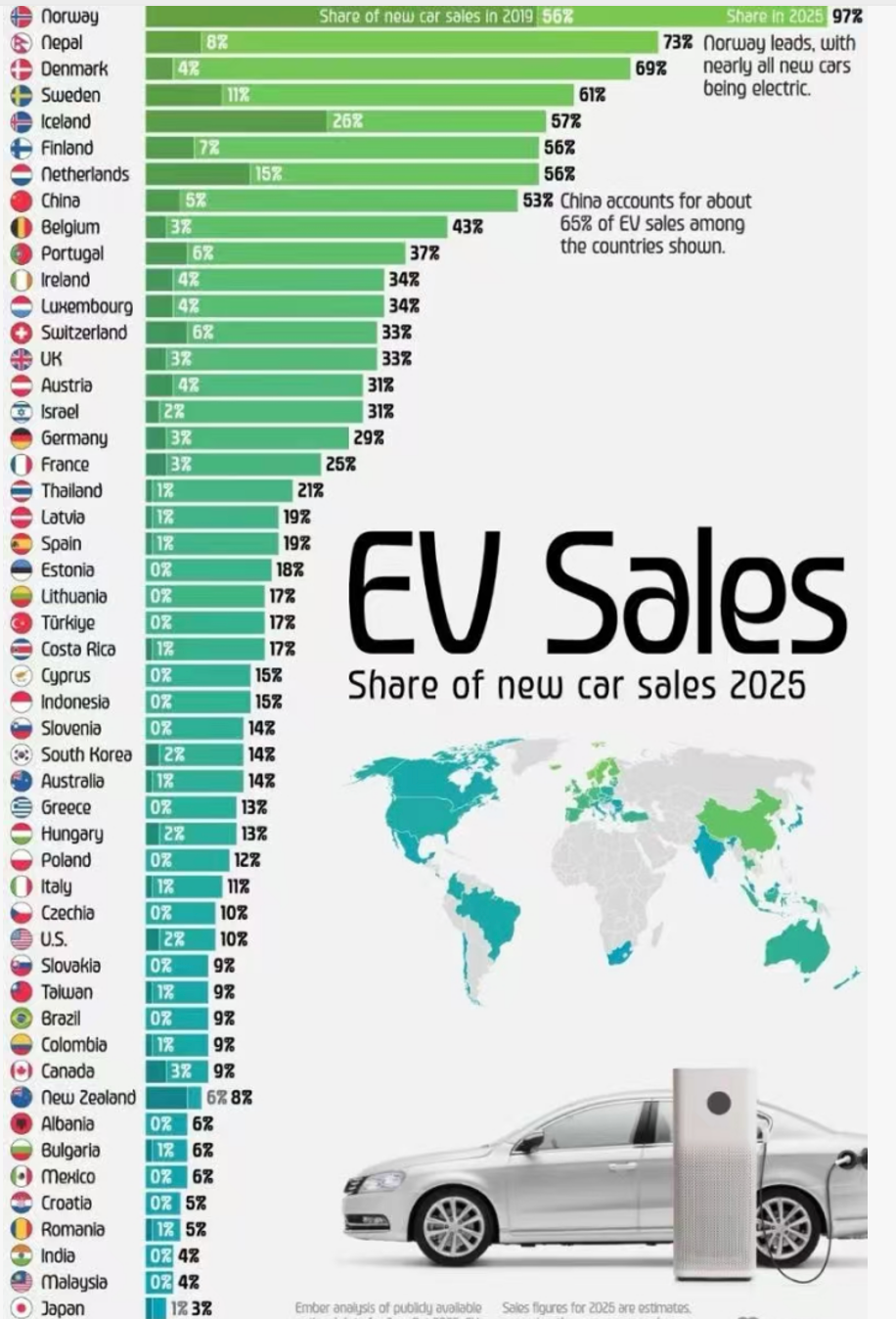
Image Credit: EV sales
Behind the headline growth lies a sharply uneven distribution. To date, only eight countries have breached the 50% penetration threshold. Nordic nations dominate this group, with Norway leading the pack—pure electric vehicles have become the mainstream choice for over 90% of its consumers.
Traditional automotive powerhouses like Germany, the UK, and France saw steady gains in penetration, hovering around 30% as restored subsidies and stricter emissions regulations drove demand.
Image Credit: Volkswagen
The US, by contrast, is lagging. With the federal tax credit expiring, growth in 2025 effectively stalled, leaving overall penetration at just 10%—well below major auto markets like China and Germany.
In Asia, Japan’s electrification is also moving at a crawl. Long dominated by hybrids, the market’s battery electric penetration has lingered around 3% in recent years.
As the world’s largest NEV market, China’s annual volume has hit the 10-million mark, accounting for roughly 70% of global sales. Yet, constrained by the sheer size of its existing internal combustion fleet, its overall penetration stands at about 53%.
Penetration in many emerging markets remains low. Only a handful, like Thailand, have pushed past the 20% mark thanks to aggressive policy support. In most countries, NEV penetration remains below 10%—often far lower.
This has created a global landscape defined by “concentrated scale, divergent penetration.” A handful of nations have reached electrification maturity, while most are still navigating the transition. This divide reflects structural and demand differences, underscoring the imbalance in the global shift.
Why the Gap Is So Wide
In some countries, EVs are already mainstream; in others, adoption is just beginning. As Lang Xuehong, deputy secretary-general of the China Automobile Dealers Association, puts it: “Every country is different.” Behind the disparities lie a mix of factors: policy intensity, infrastructure, consumer habits, and even geography.
In the early stages, consistent policy and strong support were decisive. Studies show purchase subsidies, tax breaks, and perks like free parking or toll exemptions effectively drive sales.
Norway’s sustained lead comes from decades of generous tax incentives and charging subsidies, embedding electrification into daily life. Europe saw a swift rebound once subsidies were restored or maintained. Germany’s sales jumped 48% in 2025, while the UK rose 27%.
North America’s stagnation in 2025 was directly triggered by policy shifts. The US federal EV tax credit expired in late September, causing fourth-quarter sales to halve compared to the previous quarter. Canada also saw sales plunge 49% for the year as incentives were pulled early.
The state of charging infrastructure is equally critical. Without adequate chargers, “range anxiety” dampens buying intent. In some markets, expanding the public network has directly fueled sales growth.
Europe’s public charging network has expanded steadily. By 2025, the total number of public charging stations surpassed 1 million. The Netherlands, Germany, and France have built robust systems, with the Netherlands leading the EU with over 210,000 public chargers.
Conversely, some emerging markets are constrained by weak power grids and insufficient investment in charging, limiting convenience and slowing adoption.
Cost disparities also widen the gap. In parts of Europe, high electricity prices and production costs significantly higher than China’s make it hard for EVs to compete with internal combustion cars without heavy subsidies.
Furthermore, major automotive nations face resistance from legacy industries and competing interests. Lang notes that traditional manufacturing hubs like Europe and the US are balancing “marginal utility.”
With deeply entrenched internal combustion engine industries, shifting to EVs means abandoning decades of technical expertise, cutting jobs, and overhauling supply chains. This kind of radical restructuring faces fierce internal opposition.
Countries like Germany and the US, home to global automakers, often waver between protecting local champions and pushing green goals. Nordic nations, lacking a massive domestic auto industry, face far less resistance, allowing them to lead easily in penetration.
In Japan, a mature hybrid supply chain has created strong market inertia. Consumer habits are fixed, and slow rollout of charging infrastructure keeps battery electric penetration at low levels.
Geography and energy structure also play a role. Lang points to Southern Europe, where narrow streets dampen demand for large EVs, driving preference for agile small cars—A-segment or B-segment models.
Backed by Chinese Brands
As global electrification accelerates, the progress in some countries is increasingly tied to the presence of Chinese enterprises, beyond just domestic policy and market forces.
Chinese automakers have built competitive edges in technology, cost, and supply chains, enabling a massive push into overseas markets. This expansion not only broadens their own reach but also drives growth in certain NEV markets abroad.
Europe, a pioneer in the shift, saw 2025 sales surge 33%, fueled significantly by Chinese brands. Their market share doubled to 6% in 2025. By January 2026, overall sales for Chinese brands jumped 80% year-on-year, capturing a 7.4% share.
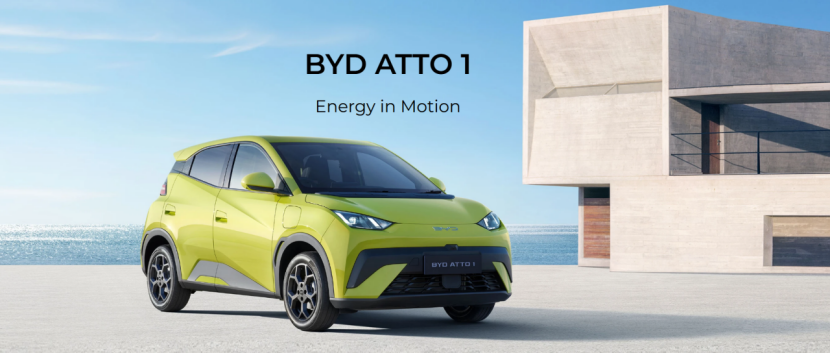
Image Credit: BYD
MG became the first Chinese brand to sell 1 million units in Europe, including 320,000 battery electric vehicles. BYD followed with a 276% surge, its Seal U plug-in hybrid becoming the year’s best-seller in its category. Chery’s Omoda and Jaecoo brands combined for over 100,000 sales, growing at a breakneck pace.
Models like the BYD Dolphin and Omoda 5 hit the mark with moderate sizing and smart features, satisfying European demand for high-value, compact electric cars.
Spain offers a clear example. Data from Dataforce shows the country’s EV penetration rose from about 9% to 12% in 2025, aided by Chinese brands. BYD exported 20,000 pure electric and 22,000 plug-in hybrid passenger cars to Spain, becoming one of the fastest-growing NEV brands locally.
For nations transitioning without a complete local supply chain, Chinese entrants help fill the product void. China’s NEV industry boasts a complete ecosystem in batteries, motors, and control systems, giving its automakers a cost edge and the agility to launch models tailored to specific markets.
Take Thailand. A major auto production hub, the government is pushing electrification with strong policies. Lang notes that while support is high and the auto industry mature, Japanese brands—long dominant there—have been slow to pivot to electric.
Chinese firms seized the chance, building plants and networks in Thailand. In 2025, Chinese brands accounted for about 80% of pure electric sales there. BYD made inroads with the Dolphin and Seal, while Neta and Great Wall Motor also rushed in.
In Latin America, sales in South and Central America grew 49% in 2025. Brazil saw a significant surge, driven by BYD and Great Wall Motor. BYD captured over 40% of the local EV market with models like the Dolphin mini and invested 5.5 billion reais in a production base. Great Wall acquired Mercedes-Benz’s Brazil plant to localize models like the Haval H6.
Lang argues that nations like Thailand and Brazil welcome Chinese NEV projects to maintain their status in the global auto industry.
Image Credit: Mexican Automotive Industry Association
In Mexico, part of the North American market, sales rose 29% in 2025, driven by affordable Chinese EVs.
BYD commands a 70% share of Mexico’s NEV market, far outpacing Tesla. Facing shifting tariff barriers, BYD and Geely are bidding for local factories, shifting from trade to manufacturing to survive within the USMCA framework.
Chinese brands contribute more than just sales figures; they are integrating deeply into supply chains. Lang highlights their resourcefulness and flexibility. Faced with high EU tariffs, MG and BYD pivoted to hybrids, breaking into markets like Poland with shares jumping from zero to 8%.
What’s Next for Exports?
As the global NEV market expands, China’s role in the supply chain deepens. Trade is growing too, with imports now accounting for nearly one-fifth of global EV sales. China stands as one of the world’s largest exporters.
But new challenges loom. “There is no unified answer,” Lang says. “It depends on development and geopolitics—not one size fits all.” Chinese automakers must move beyond crude product exports to refined, market-specific strategies. High-penetration markets have barriers; low-penetration ones offer opportunity—but the playbooks differ completely.
Image Credit: Magna
In mature markets like Norway and Germany, where penetration is high and habits set, price competition alone won’t suffice. Chinese brands must seize the window to export not just products, but brand value and a complete industrial ecosystem.
Operations here should focus on local production and smart ecosystems. BYD and Chery are already doing this, building plants in Hungary and Spain to bypass trade barriers and integrate into local supply chains.
On the product side, leverage China’s lead in intelligence and software. For Europe’s preference for compact cars (A- and B-segment), offer premium, high-tech models rather than just cheap alternatives. Robust after-sales service and residual value management will be key to long-term competitiveness.
In blue-ocean markets like Southeast Asia, Latin America, and Africa—where penetration is low but growth is fast—the task is to fill the void left by internal combustion engines. Lang notes that while these regions have mature auto industries, incumbents like Japanese brands are slow to electrify. This gives Chinese brands an opening to grab share with cost and supply chain advantages.
The logic here: infrastructure first, then perfect product fit. In Thailand and Brazil, Chinese brands aren’t just shipping cars; they’re investing in charging networks and KD assembly plants to build local confidence.
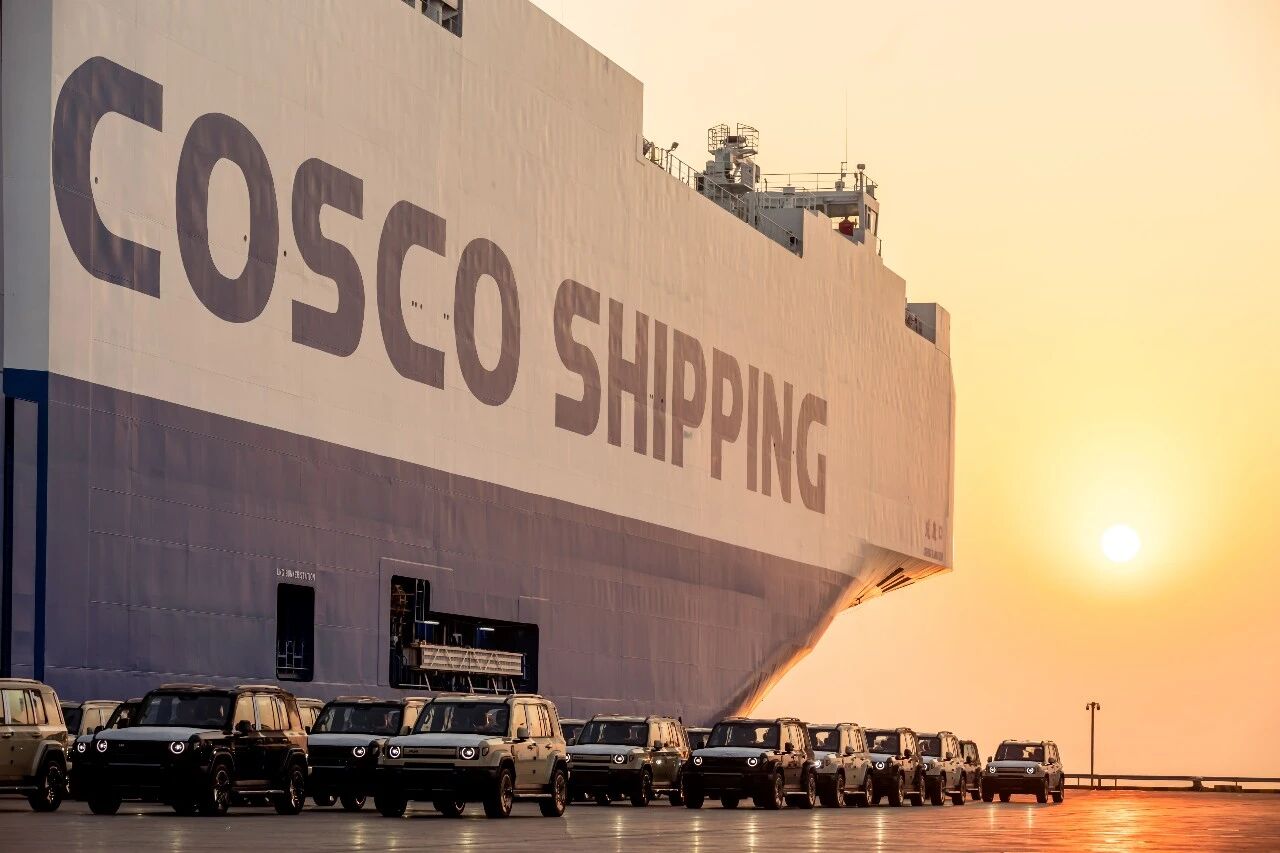
Image Credit: Chery Automobile
Adapting to tropical climates for battery thermal management and tuning chassis for rough roads builds trust. By offering affordable models that are easy to own and use, Chinese brands are effectively driving electrification in these nations.
Lang emphasizes that development stages vary widely, so strategies must be tailored to local industrial environments, policies, and market size. As global trade policies shift, Chinese firms need to stay alert to regulatory changes and keep honing their technology, brand, and supply chain competitiveness.
Of course, with protectionism rising, the road ahead is far from smooth. Facing complex trade maneuvers—like Canada’s shift from punitive tariffs to quotas, and US/EU scrutiny of Chinese supply chains—some argue Chinese automakers must learn to “dance in shackles.”