Shares of electric-vehicle and energy specialist Tesla(NASDAQ: TSLA) boast a staggering market capitalization of about $1.5 trillion as of this writing. The growth stock‘s extraordinarily high valuation is fascinating — especially considering the company’s core automotive business is currently shrinking.
So, what gives? Why are investors paying a price tag of about 360 times earnings as of this writing? And, more importantly, is the stock a buy, sell, or hold?
Will AI create the world’s first trillionaire? Our team just released a report on the one little-known company, called an “Indispensable Monopoly” providing the critical technology Nvidia and Intel both need. Continue »
With the company’s 2025 results in the rearview mirror, let’s look at the underlying business and the stock’s valuation to help investors think through how they want to approach the stock.
Image source: The Motley Fool.
A business in transition
Tesla’s recent financial results highlighted a company leaning heavily on its secondary businesses to offset weakness in its primary one.
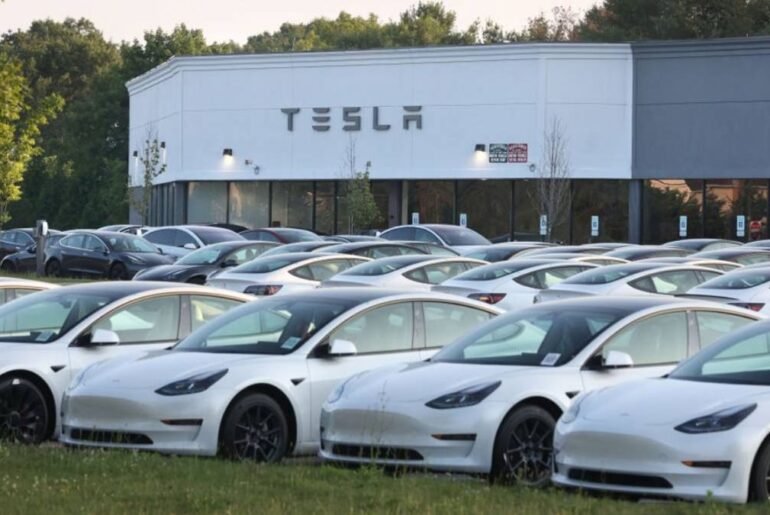
Vehicle deliveries fell 16% year over year in Q4 to about 418,000 units. But looking at just the back half of the year can be slightly misleading. Tesla experienced some unusual factors impacting its third and fourth quarters due to the timing of the expiration of an electric vehicle credit, which pulled some demand forward into Q3, leaving Q4 unusually weak. Because of this noise, a look at full-year trends for vehicle deliveries does a better job of telling investors what’s actually going on.
Unfortunately, that full-year picture still shows a business under pressure. Total vehicle deliveries in 2025 totaled roughly 1.64 million, a decline of about 9% from 2024. This broader volume decline weighed heavily on the company’s top line, with total automotive revenue for the year dropping 10% to roughly $69.5 billion.
Fortunately, the company’s fast-growing energy generation and storage business helped offset some of this pain. Energy revenue climbed 27% year over year to nearly $12.8 billion for the full year. This surging segment helped keep total company revenue at $94.8 billion — down just 3% from the prior year.
But profits are still moving in the wrong direction. Tesla’s full-year non-GAAP (adjusted) net income fell 26% year over year to roughly $5.9 billion.
A massive bet on autonomy
With the core automotive business struggling to grow, the bull case for Tesla increasingly hinges on its transition to a physical artificial intelligence (AI) and robotics company.
And to the company’s credit, it is making measurable progress.
Tesla’s active Full Self-Driving (FSD) subscriptions reached 1.1 million by the end of the year, up an impressive 38% year over year. Further, the company recently began removing safety monitors from its Robotaxis in Austin, Texas. And reports also suggest Tesla is preparing its production lines to begin manufacturing hundreds of its upcoming steering-wheel-free Cybercabs per week starting in April.
But a successful transition to autonomy requires heavy spending.
Management noted that it expects capital expenditures to exceed $20 billion in 2026. This is a massive figure, especially when anchored against the company’s current scale, highlighting the highly capital-intensive nature of building out AI compute infrastructure and scaling a robotaxi fleet.
Priced for perfection
The problem for investors isn’t the company’s ambitious vision, but rather the price required to buy into it.
At near $400 per share as of this writing, Tesla trades at a price-to-earnings ratio of about 360.
Despite a core automotive business that saw revenue decline 10% over the past year, investors are essentially already paying for a successful, highly profitable rollout of Tesla’s autonomous ride-sharing network and its Cybercab — produced at scale. A valuation multiple this high prices in exceptional growth for years to come, leaving almost no room for error.
If the timeline for autonomy slips or the economics of operating a fleet-based service prove less lucrative than investors hope, the stock could take a massive hit.
So, is Tesla stock a buy, sell, or hold today?
I don’t think it looks compelling at this valuation.
However, I also wouldn’t call it an outright sell for investors who already own it and firmly believe that Tesla will dominate the self-driving era. For these investors, the stock may be worth holding.
But investors who choose to hold should be prepared for significant volatility. Given the enormous expectations baked into its roughly $1.5 trillion market capitalization and the unproven economics of its upcoming ventures, they should be well aware that this is a highly speculative stock today.
Don’t miss this second chance at a potentially lucrative opportunity
Ever feel like you missed the boat in buying the most successful stocks? Then you’ll want to hear this.
On rare occasions, our expert team of analysts issues a “Double Down” stock recommendation for companies that they think are about to pop. If you’re worried you’ve already missed your chance to invest, now is the best time to buy before it’s too late. And the numbers speak for themselves:
Nvidia:if you invested $1,000 when we doubled down in 2009,you’d have $467,544!*Apple: if you invested $1,000 when we doubled down in 2008, you’d have $47,627!*Netflix: if you invested $1,000 when we doubled down in 2004, you’d have $514,000!*
Right now, we’re issuing “Double Down” alerts for three incredible companies, available when you joinStock Advisor, and there may not be another chance like this anytime soon.
*Stock Advisor returns as of March 17, 2026.
Daniel Sparks and his clients have positions in Tesla. The Motley Fool has positions in and recommends Tesla. The Motley Fool has a disclosure policy.