Tesla STEM High School students shine in ExploraVision program
Published 3:30 pm Monday, March 16, 2026
Each time a quartet of Tesla STEM High School students turned in its project, teacher and coach Rebecca Townsend witnessed an improved and more scientific version of the Redmond students’ dream.
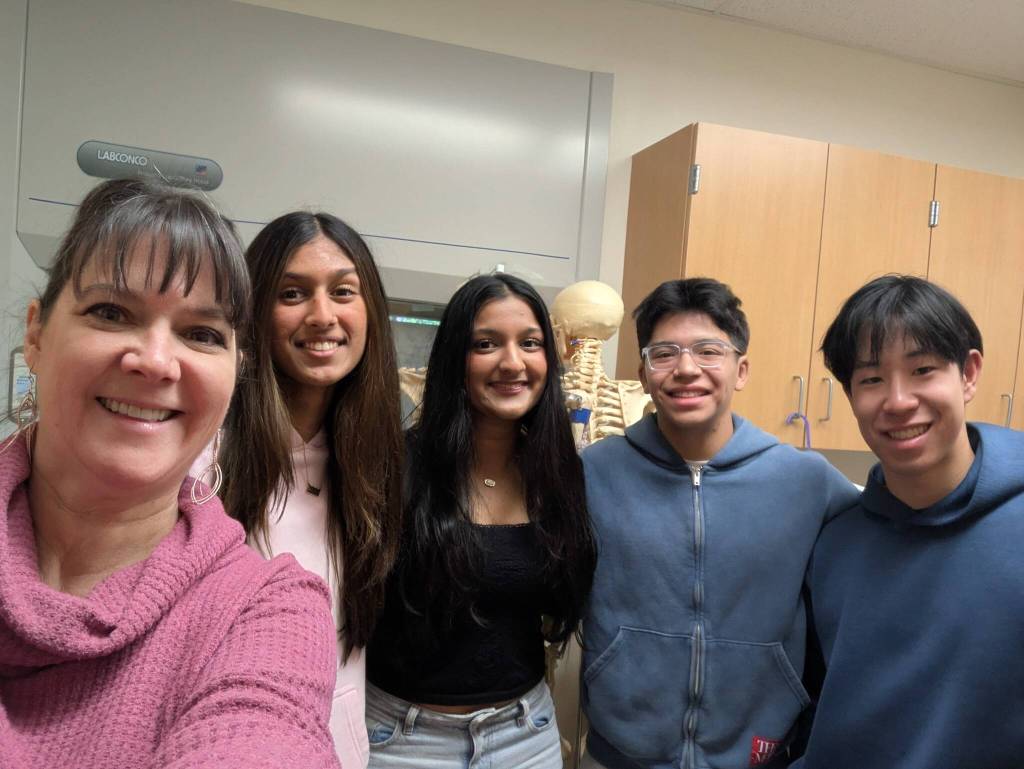
Seniors Shriya Krishnan, Shailja Tyagi, Rafael Reyes and Koji Hamanaka recently learned that their “Dermaplex: Adaptive Smart Patch for Burn Healing” project was one of 24 regional winning prototype designs in the Toshiba and National Science Teaching Association’s 34th annual ExploraVision program.
The locals’ project in the six-region K-12 science competition is a microneedling patch — with the microneedles made from hyaluronic acid and polyvinylpyrrolidone — that is used to target drug delivery to burn wounds and burn scars, according to Krishnan.
“It basically releases anti-scarring medication for around 12 to 14 hours, which targets the response of the burn scar,” said Krishnan, adding that a hydrogel backing keeps the microneedles moist and the patch also features embedded biosensors.
Additionally, Krishnan said they implemented their AI system to train on multiple skin tones and they plan to create fun patterns or characters for kids.
“I think they have a really fascinating, almost invention that they’ve come up with here,” said Townsend, adding that competitors take a current technology and expand on where they think it will be in 10 years. “It’s really nice to have the opportunity for them to maybe be able to make it all the way to the national competition. That’s what they’re working on.”
Tom Kumagai, chairman and CEO of Toshiba America, Inc., noted about what all students gain from participating in the competition: “The creativity, communication and collaboration skills learned while participating in ExploraVision empowers students to move beyond textbooks to tackle the real-world challenges of today.”
Tyagi and Reyes hatched the idea because they both know people who are burn survivors who have undergone cosmetic awareness with burns.
“Collectively, we spent a lot of time thinking of different things, things that existed, things that didn’t exist,” said Tyagi, adding that they kept diversity and ethics in mind during the two-month project. “Since AI has been such a really prevalent part of modern technology, we knew that we really wanted to incorporate that into our design.”
Teamwork was crucial in bringing the project to fruition, said Reyes, whose mom is a burn survivor.
“This was sort of our way of finding a solution to giving people (while going through the situation) a lot of help and be able to build on what we already have and make it even better,” said Reyes, noting that his parents have driven him to achieve success in life.
Added Hamanaka about the importance of the team’s project: “What we kind of envisioned for the future is it would reduce inequality because skin grafting and stuff like that is super expensive. And for a lot of rural hospitals, it can be very inaccessible. But with this technology, it’d be a lot cheaper to use, and it’d be a lot cheaper to implement in those hospitals.”
Next up for the locals and other regional winners is national judging. Four first-place and four second-place national winners will each receive U.S. Series EE Savings Bonds in the amounts of $10,000 (first-placers) and $5,000 (second-placers), at maturity.