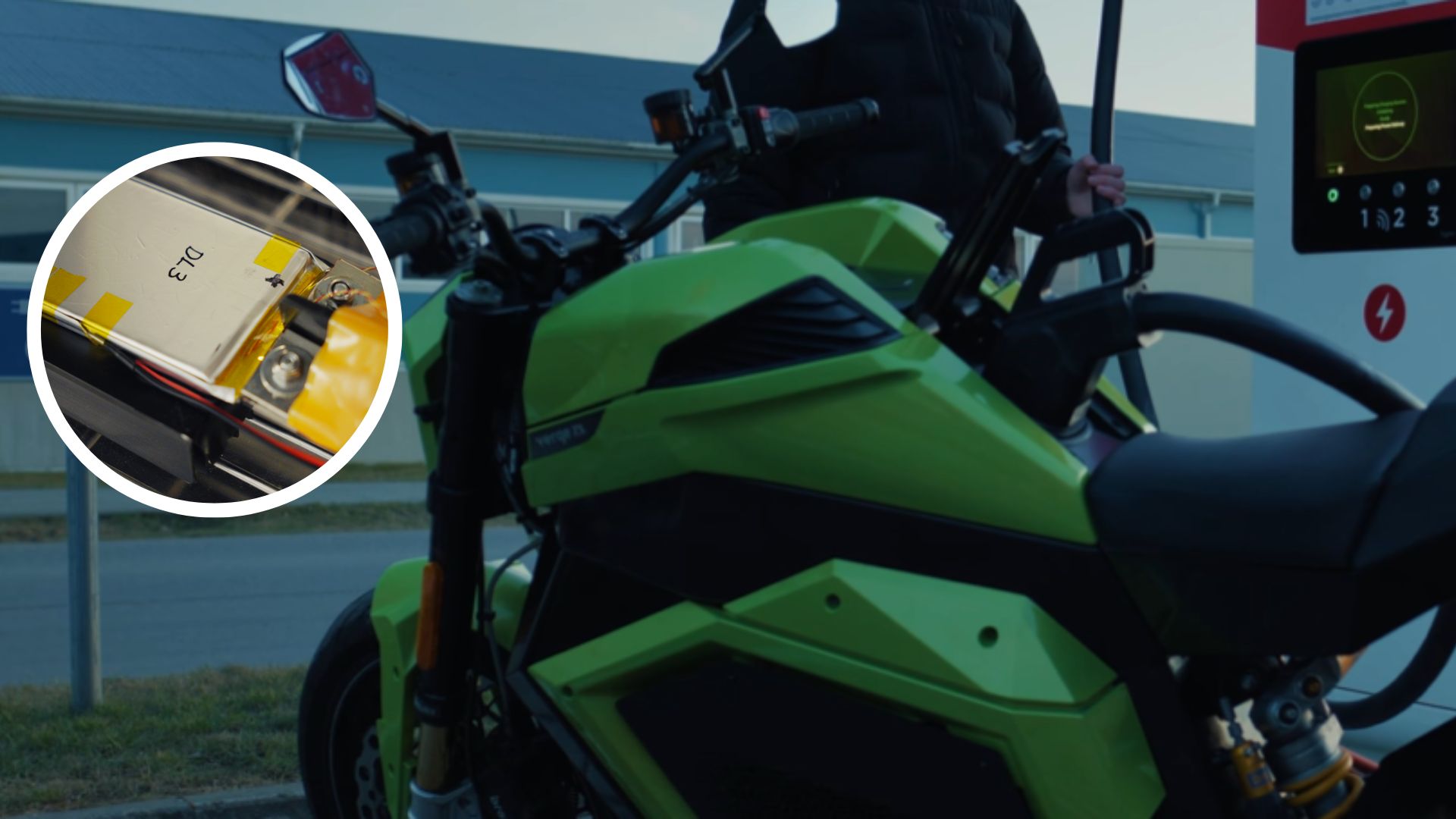
Donut Lab has published results from its fourth battery test with Verge Motorcycles, demonstrating ultra-fast charging performance in an electric motorcycle battery pack.
The experiment evaluates the company’s solid-state battery technology under real vehicle conditions rather than in laboratory cell tests.
The test forms part of an ongoing research project investigating how multiple battery cells behave together in a full battery pack.
Engineers integrated the technology into an air-cooled battery pack designed for the latest-generation Verge TS Pro electric motorcycle.
Unlike earlier demonstrations that focused on individual battery cells, this test evaluates pack-level performance inside a working vehicle.
Pack-level battery testing
Donut Lab conducted the experiment using an earlier-generation Verge motorcycle fitted with a new model-year battery pack.
The pack delivers a nominal capacity of 18 kilowatt-hours and relies on air cooling instead of complex liquid systems.
Researchers say the test marks the first time the company has publicly demonstrated the behavior of its solid-state battery technology in a real vehicle battery pack.
“This is the first test we have published to a wider audience that demonstrates the performance and behaviour of multiple battery cells in a real vehicle environment,” says Ville Piippo, CTO at Donut Lab.
The company says its battery design achieves high energy density, allowing manufacturers to configure different energy capacities while keeping the same physical pack size.
“The high energy density of our battery technology enables flexible battery pack design and superior performance even in more challenging applications, such as motorcycles, where space is limited and system simplicity is key,” Piippo says.
He adds that the technology allows manufacturers to maintain consistent packaging while offering different battery sizes.
“We are able to offer vehicle manufacturers packs with different energy capacities in the same physical size, with even the smallest packs having very high capacities,” Piippo says.
Donut Lab believes demonstrating pack-level functionality represents a key step toward integrating the technology into production vehicles.
Ultra-fast charging results
The fast-charging test used a public high-power charger. Engineers began the test with the battery pack at roughly 20 degrees Celsius.
During the experiment, the system maintained peak charging power above 100 kilowatts. That corresponds to a 5C charging rate.
The motorcycle’s battery rose from 10 percent to 50 percent charge in about five minutes. Overall charging time from 10 percent to 70 percent measured just over nine minutes.
The system reached 80 percent charge in roughly 12 minutes. Engineers say the battery pack charges about three times faster than Verge’s previous battery system.
“Our goal is to provide Verge users with the best possible user experience,” says Tuomo Lehtimäki, CEO of Verge Motorcycles.
He says Donut Lab‘s battery technology supports that goal by enabling faster charging.
“The advantages of Donut Lab’s battery technology, such as ultra-fast charging, complement our goal seamlessly,” Lehtimäki says.
The Verge TS Pro already targets extremely fast charging capability while maintaining a relatively simple thermal design.
“The world’s fastest charging electric motorcycle, the Verge TS Pro, is also air-cooled,” Lehtimäki says.
The battery pack used in the test represents Verge’s standard configuration, though the company also offers a higher-capacity option.
“The battery pack used in this test is our standard model, but an extended range version is also available, with approximately two-thirds more energy capacity,” Lehtimäki says.
Engineers expect further optimization to improve charging performance in future versions of the system.