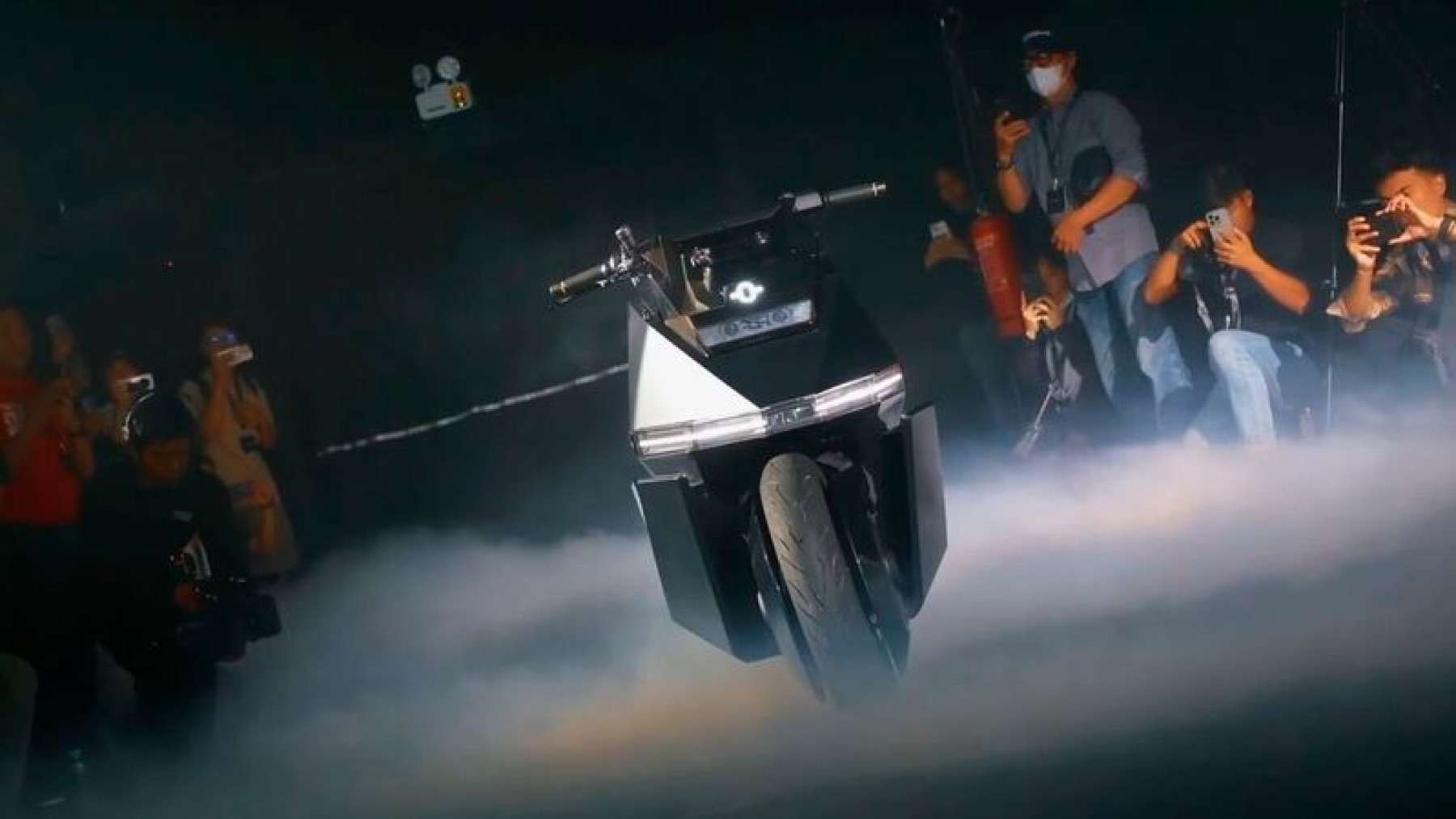
A motorcycle balances itself on a seesaw — no rider, no kickstand, no one holding it up. It just stays there.
Staying upright has been the fundamental challenge of two-wheeled vehicles since their invention. Honda tried to solve it. Yamaha tried too. Both produced impressive concept bikes that could stand on their own — and both stopped there, never moving beyond the demonstration stage. Now a little-known startup says it has done what the industry giants couldn’t: built a self-balancing electric motorcycle ready for mass production.
Spacecraft tech on two wheels
At the heart of the OMO X is a Control Moment Gyroscope — a CMG — the kind of precision stabilization device found aboard satellites and spacecraft. By rapidly adjusting angular momentum, the gyroscope actively counteracts the forces that would otherwise topple the bike, keeping it upright at very low speeds or when fully stopped. The same physics that holds a spacecraft in orientation during orbit, now miniaturized and fitted into a motorcycle frame.
OMOWAY wraps this hardware inside a broader architecture it calls OMO-ROBOT — a system combining vision-based perception, high-speed onboard computing, and physical stabilization into what the company describes as a full-stack platform. The result, in OMOWAY’s own framing, is not really a motorcycle. It’s a two-wheeled robot that happens to carry a rider.
Beyond balance: active safety systems
Staying upright is only part of what the OMO X is designed to do. OMOWAY says the bike includes “full active safety” — features covering wet-surface slip prevention, curve assistance, and emergency obstacle avoidance. These systems draw on the same sensor array and computing infrastructure that handles balance, allowing the bike to read the riding environment and respond in milliseconds.
The OMO X also collected a 2026 iF Design Award before its market launch — a respected prize whose evaluators assess the whole product, not just its headline technology. Winning it ahead of release suggests the bike has attracted serious attention well outside engineering circles.
Why others tried and stopped
Honda and Yamaha both demonstrated self-balancing motorcycle concepts that genuinely worked. Both showed bikes capable of standing without a kickstand or a rider. Neither moved the idea past the technology demonstrator stage.
The obstacle was never purely scientific. Making a self-balancing system compact enough, affordable enough, and reliable enough for mass production has proven far harder than building a proof of concept in a controlled environment. That gap — between demonstration and production line — is where most ambitious motorcycle technology has quietly disappeared. OMOWAY claims to have crossed it. The company says the OMO X has already entered mass production, a step neither Honda nor Yamaha publicly took with their equivalent projects. Whether that claim holds under real manufacturing scrutiny remains to be seen.
Indonesia first, then the world
OMOWAY isn’t launching everywhere at once. Pre-orders open in Indonesia in late April 2026, with the official market debut set for Jakarta in late May. Final pricing and full specifications haven’t been disclosed yet; those details will be released closer to launch.
The distribution groundwork appears to be in place. OMOWAY says it has already signed dozens of distributors and expects its retail network to exceed 100 locations across Jakarta, Bandung, Surabaya, and Bali. Indonesia — one of the world’s largest motorcycle markets — is a logical starting point for a company trying to establish commercial viability before expanding further. Alongside the OMO X, OMOWAY also unveiled Mobility One, a multi-purpose wheeled robot built on the same balancing and autonomy platform, pointing to ambitions that stretch well beyond personal transportation.
Who this motorcycle is really for
The most immediate practical case for self-balancing technology is accessibility. Motorcycles have always carried an inherent learning curve, and much of it lives in slow, awkward moments — pulling out of a parking space, inching through traffic, stopping on uneven ground. That challenge is amplified for smaller or newer riders who may be significantly outweighed by the machine they’re trying to control.
A motorcycle that manages its own stability could meaningfully lower that barrier. It wouldn’t eliminate the skill involved in riding, but it could strip away one of the most intimidating parts of getting started — and one of the most dangerous moments even for experienced riders.
The real measure of the OMO X won’t come from a seesaw demonstration or a design award. It’ll come from what happens when ordinary riders take it into traffic, through rain, across broken pavement, and into all the situations engineers can’t fully anticipate in a lab.
What to watch for
If OMOWAY delivers on its production claims and the OMO X performs reliably in Indonesian conditions, the implications for the broader motorcycle industry could be significant. Larger manufacturers that shelved their own self-balancing research may find themselves reconsidering those decisions.
Near-term milestones are clear enough: pricing at launch, early rider feedback, whether the retail network materializes as promised. The longer question is whether a startup can sustain what it takes to turn genuinely novel technology into a durable, scalable product — and whether the major players will be paying close enough attention to respond.