Gasgoo Munich- It’s that time of year again when automakers lose sleep. March 15—a day that keeps PR teams working through the night and legal departments on edge—always arrives with the expectant gaze of countless car owners.

2026 3.15 Theme Poster; Image Source: State Administration for Market Regulation
Who will land on the “broadcast list” tonight? The answer is still pending. But we can first review the “report card” for the past year. According to statistics compiled by Gasgoo from recall announcements issued by the State Administration for Market Regulation’s Defect Product Management Center, domestic automakers issued 125 recall notices between March 2025 and March 11, 2026, pulling back a total of 3.5545 million defective vehicles. That averages nearly 10,000 cars ordered back to the shop every single day.
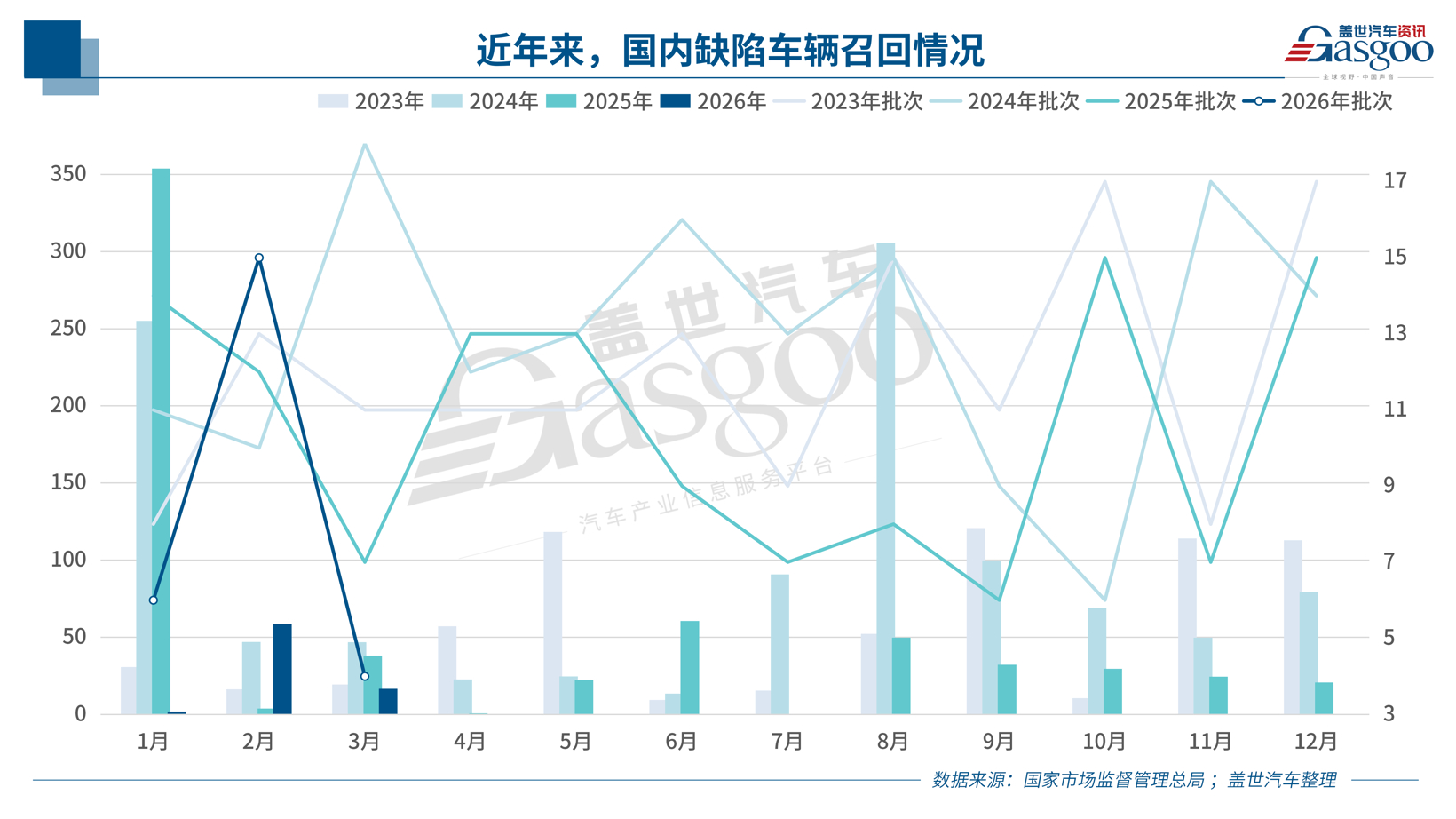
Interestingly, among those 3.55 million vehicles, there are plenty of “familiar faces.” For some brands, a single recall rivals another’s annual sales; others have had to repeatedly patch the same issue, while some landed in the trending topics solely due to software bugs. Today, rather than guessing who will be targeted, let’s discuss these “recall stars” and the stories behind them.
Code Failures Mount as Cars Become “Massive Software Testing Grounds”
After years of touting “software-defined vehicles,” it turns out the first thing truly defined by the concept was the recall.
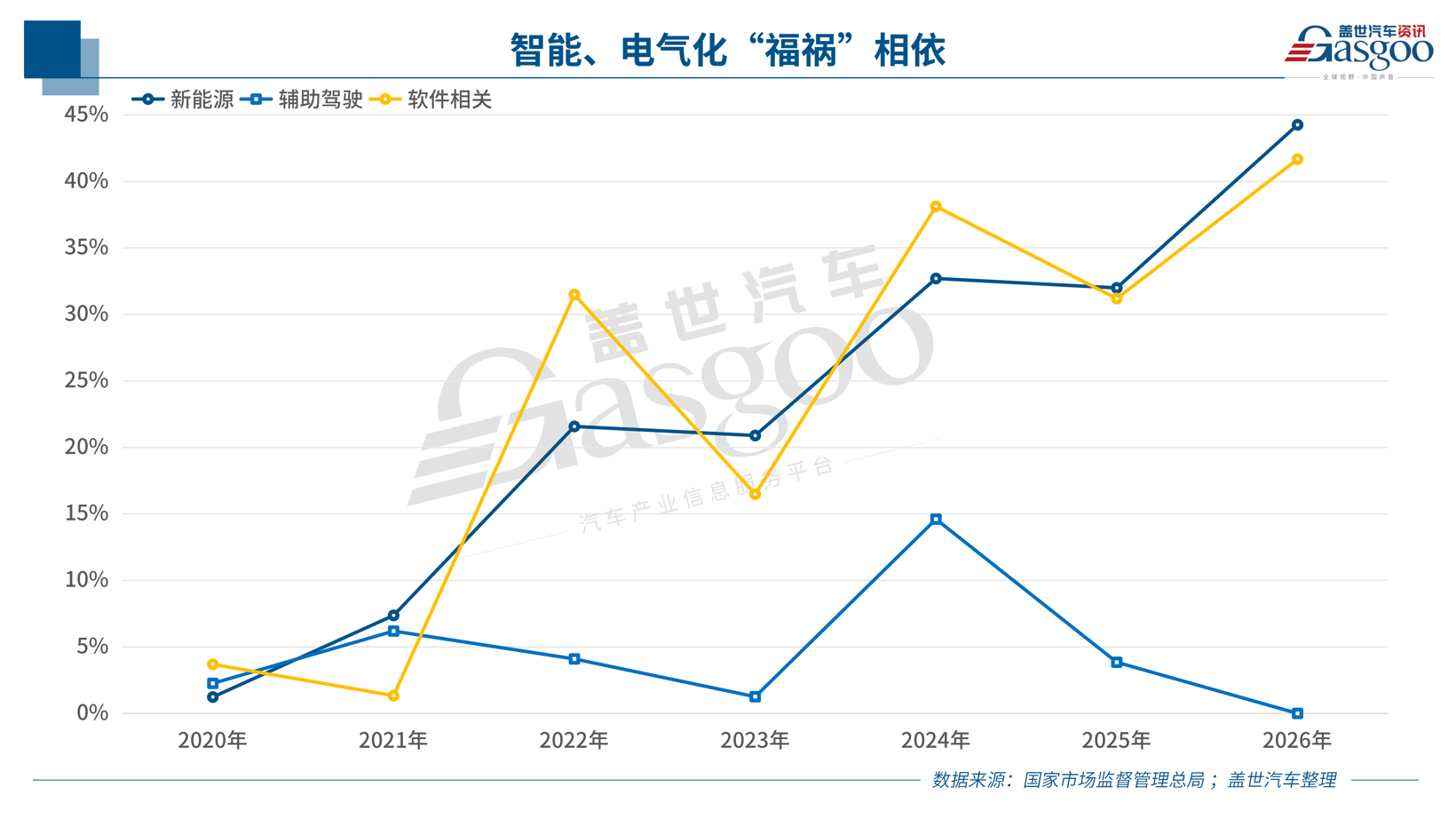
Nearly 70% of defective vehicle recalls over the past year were directly linked to software. From blacked-out instrument clusters to frozen backup cameras, and from driver-assistance systems “going blind” to battery management glitches—one line of bad code can send 100,000 cars back to the shop. This isn’t car manufacturing; it’s effectively issuing “public beta passes” to drivers nationwide.
Japanese automakers found themselves on the front lines of these software failures. Last August, Toyota recalled over 220,000 vehicles due to an improper instrument cluster control program. That was followed in September by a recall of more than 30,000 cars after air conditioning software caused reduced defogging performance. By December, a bug in the panoramic imaging system affected over 94,000 units, including the Lexus LM, Alphard, and Prado. Within a year, software issues triggered recalls exceeding 350,000 vehicles.
Of course, software bugs aren’t exclusive to Japanese brands. In May last year, Audi recalled over 130,000 units—including the domestically produced A6L and imported A7 and Q7 models—due to instrument cluster software defects. Meanwhile, Volkswagen’s Sagitar saw a recall of over 200,000 cars because insufficient moisture protection in wheel speed sensors could cause the ABS and ESP systems to fail without warning. Notably, that action came only after the State Administration for Market Regulation launched an investigation.
In February 2026, NIO initiated a recall of over 240,000 defective vehicles covering the ES8, ES6, and EC6 models due to a software issue. The glitch could cause the instrument cluster and central control screen to go black briefly under specific conditions, leaving drivers without essential vehicle information and functions.
As a result, NIO topped the list of domestic new energy passenger vehicle brands by recall volume over the past year, accounting for 22% of the total.
Such cases were almost unheard of in the past. In the mechanical era, cars didn’t “misjudge.” But in the intelligent era, a code bug can translate directly into a safety risk.
The data suggests the share of software-related recalls will likely climb further. For automakers, “software-defined vehicles” is not just a product strategy—it is a commitment to responsibility. Well-written code matters little if the car doesn’t run safely. For consumers, upgrading promptly upon receiving a software recall notice is the safest course of action. After all, your vehicle might currently be “driving while impaired.”
Batteries Remain a Hot Topic: Power Batteries Take Center Stage in Recalls
If software recalls represent a “new headache,” then power battery recalls are a persistent “old problem.”
Internal combustion engine vehicles still dominate the passenger car market, but new energy vehicles account for a significant share. Specifically, during the period in question, pure electric passenger vehicles reached 27.96% of recalls, while plug-in hybrids approached 6%.
In March 2025, Volvo announced a recall of approximately 14,000 units—including the XC60, S90, S60, and XC90—citing a risk that “battery cells may short-circuit, potentially leading to thermal runaway in extreme cases.”
The language in the announcement was restrained, but the phrase “thermal runaway” is enough to make any owner’s heart skip a beat.
The causes behind power battery recalls are far more complex than imagined.
BYD recalled certain models in November 2025 due to “power battery pack consistency issues and gasket installation problems.” What does consistency mean? Simply put, among the hundreds of cells in a battery pack, performance parameters aren’t identical. During charging and discharging, individual cells may be overcharged or over-discharged, triggering safety hazards.
Mercedes-Benz recalled certain EQA and EQB models in February 2026 due to “fluctuations in high-voltage battery production processes that could lead to internal short circuits.” Notably, this action is an expanded re-recall following a notice issued on March 28, 2025, by Beijing Mercedes-Benz Sales Service Co. for some of its domestic EQA and EQB vehicles.
BMW’s recalls involved high-voltage system insulation faults. Certain models, including the i3, iX3, and iX, faced potential power interruptions due to inadvertent shutdowns of the high-voltage system.
Data shows that between March 2025 and March 11, 2026, China recalled over 950,000 pure electric passenger vehicles. Given that the overall ownership of new energy vehicles is still in a growth phase, this absolute volume is enough to put the industry on high alert.
According to Gasgoo’s analysis, the share of new energy vehicles among all defective passenger cars announced in 2026 surged to 44.26%, up from just 1.23% in 2020. That represents a 36-fold increase over six years—a growth rate far outpacing the rise in sales.
Among recalls triggered by state investigations, “power battery consistency defects” ranked as the second-highest cause. To put it bluntly, the cells within a battery pack have “clashing personalities”—some are too aggressive, others too conservative—and when forced together, they are prone to “fighting,” potentially leading to fires.
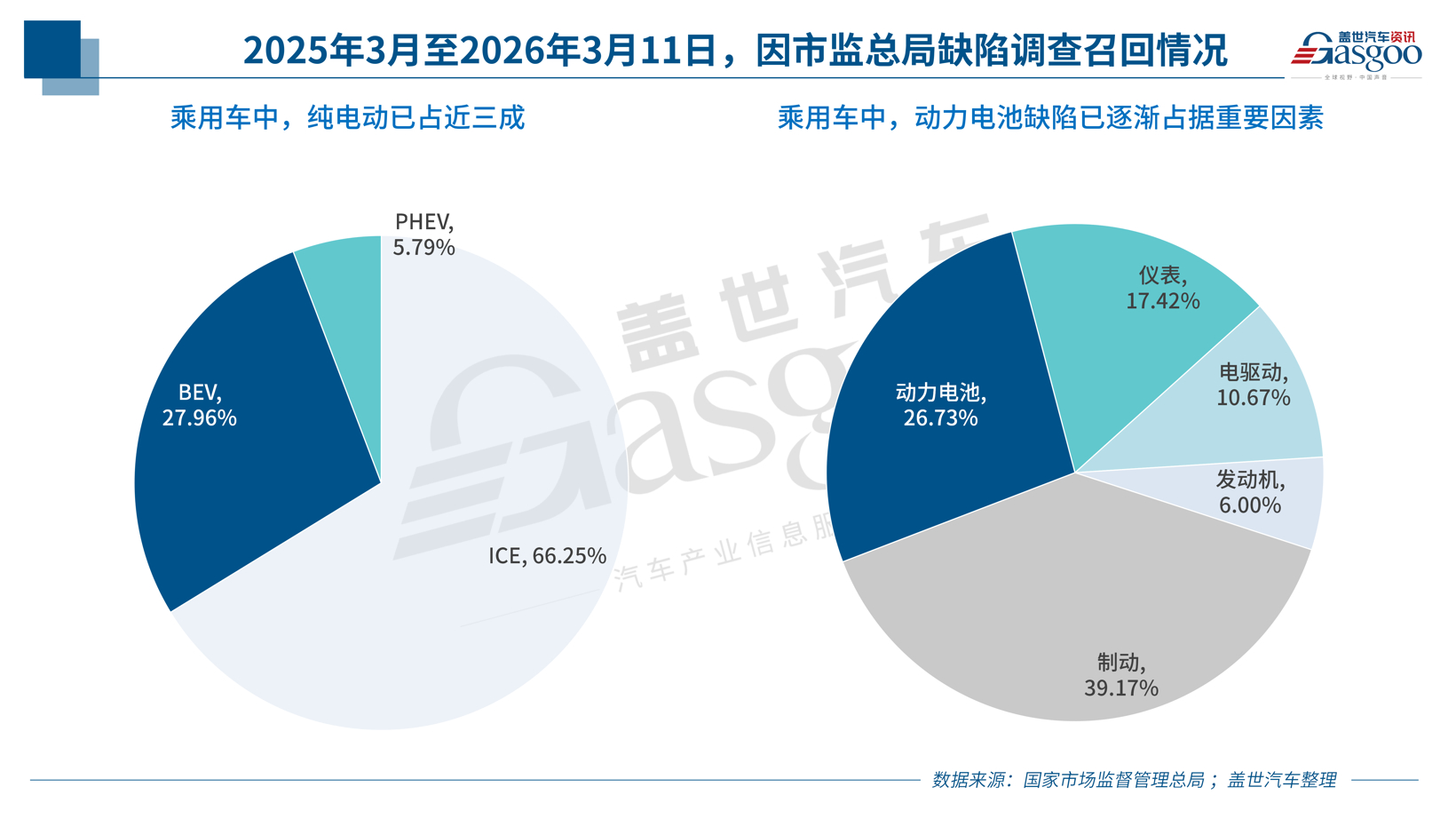
Battery safety is no laughing matter. The higher the energy density, the greater the risk of fire. Automakers are currently racing to roll out 800V platforms and ultra-fast charging, but let’s not forget: batteries are chemical products, not digital games. Consumers buy electric vehicles to save money and help the environment, not to purchase a “mobile energy pack” that requires constant vigilance.
Whack-a-Mole: “Expanded Recalls” and “Re-Recalls” Become the New Normal
A look through recall announcements reveals a frequent phrase: “This recall is a re-call of the previous recall campaign with an expanded scope.” In plain English: the last fix didn’t work, so they’re trying again—and this time, even more cars are involved.
BMW’s electric vehicles have been through this “return engagement.” After recalling cars in August, the company discovered in November that some vehicles still had the incorrect software version, forcing another recall. One can only imagine the owners’ frustration.
The battery issues with the Jeep Wrangler 4xe saw an initial recall in late 2024 expand again by late 2025, covering more model years and increasing the volume of vehicles. Ford Lincoln’s brake master cylinder issues and BMW’s starter relay waterproofing faults also underwent expanded recalls.
Behind this lies the tightening grip of the regulator’s “visible hand.” Since March 15, 2025, 13 batches of recalls have stemmed from defect investigations launched by the State Administration for Market Regulation, involving brands such as BYD, Volkswagen, Audi, Roewe, Geely, Mercedes-Benz, and Land Rover, totaling approximately 769,000 vehicles. Cases like the Volkswagen Sagitar’s wheel speed sensor and the Audi A6L’s instrument cluster software only saw recalls initiated after regulatory intervention.
In other words, if automakers don’t take issues seriously, regulators will “take them seriously” for you. The old dynamic of companies voluntarily confessing for leniency is being replaced by a new reality of being strictly punished after problems are uncovered.
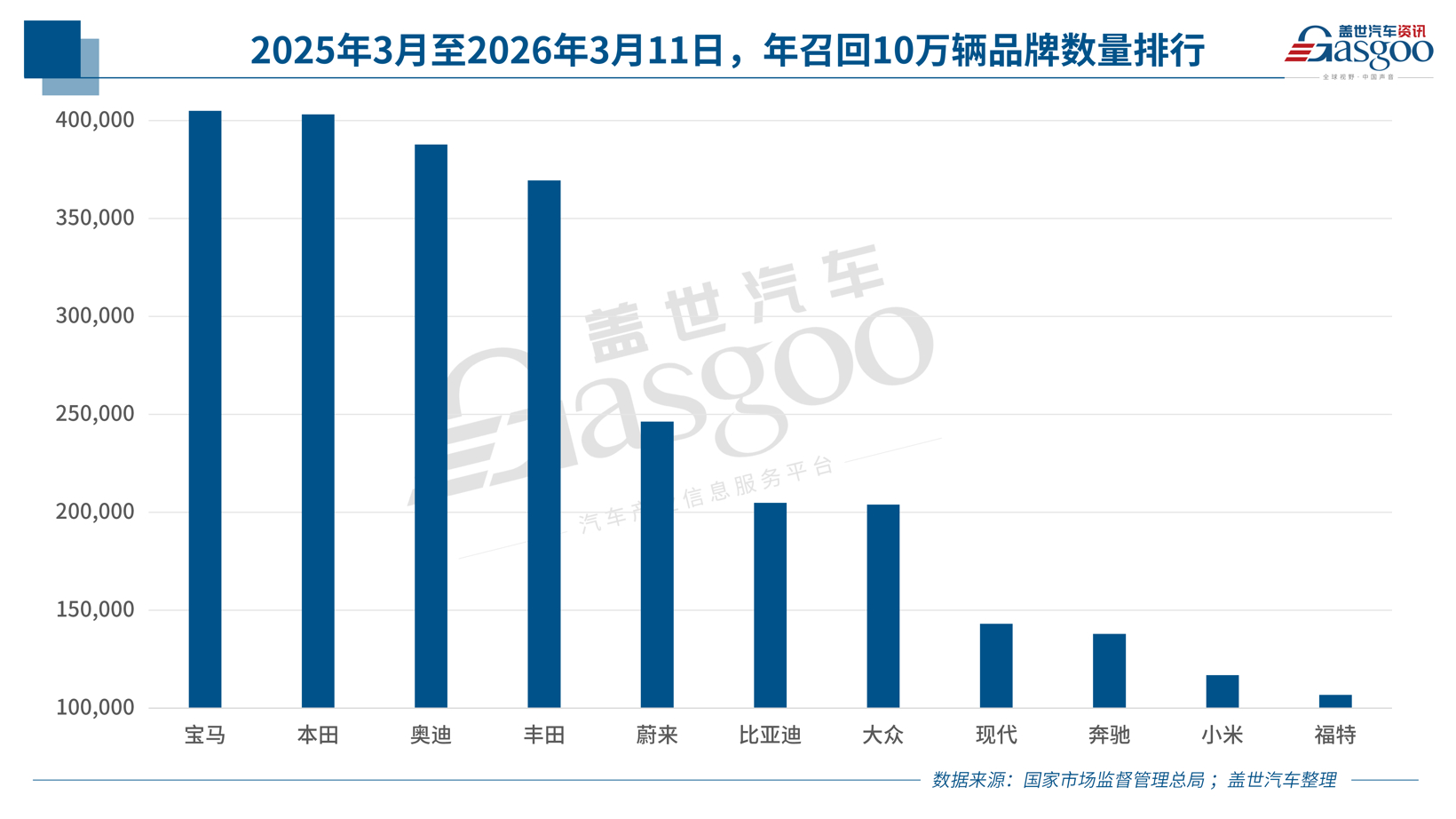
The brand rankings are even more revealing. Over the past year, BMW claimed the top spot with 413,000 recalled vehicles, representing 12.19% of the total. With six separate recalls covering everything from starter relay waterproofing to generator connectors, and from accidental high-voltage system shutdowns to steering dampers, they proved to be an “all-around player.” Honda followed closely with 407,000 vehicles; a single fuel pump recall accounted for over 380,000 of those—63% of its annual China sales of 645,000 units. That means for every 10 cars Honda sold, more than six had to be recalled. Audi and Toyota took third and fourth place respectively. Together, these four brands accounted for 46.5% of all recalls—nearly half the total.
Data doesn’t lie: BMW, Honda, Audi, and Toyota are both sales leaders and recall leaders. But that isn’t necessarily a bad thing. The act of recalling shows a company is willing to pay the price for defects and take responsibility for users. The real concern lies with those “hard cases” that refuse to admit fault until the bitter end.
Conclusion:
The significance of March 15 has never been to expose or shame specific companies, but to remind all participants that consumer trust is the most valuable asset—and the most fragile.
Over the past year, 3.5545 million vehicles were recalled—meaning 3.55 million instances of trust were tested. Whether it’s the “public beta” of software code, the “overheating” of power batteries, or the frequent “return engagements” of expanded recalls, they all remind us of one thing: as automobiles transform from mechanical products into “mobile intelligent terminals,” safety is always the number 1; all other functions are merely the zeros that follow.
Tonight, whoever takes the stage, let’s hope this marks not an end, but a new beginning. After all, for those on the road every day, nothing matters more than arriving safely.