(Bloomberg) — One would be hard-pressed to find a bigger petrol-head than Michael Prichinello, cofounder of Manhattan’s Classic Car Club. And yet, after years of driving the world’s most precious (and thirstiest) sports cars, Prichinello is shopping for an electric pickup truck – “begrudgingly” – because his gas bill has stretched to $50 a day.
“My commute is 220 round-trip and I drive a full-sized Silverado,” he explained. “She’s a gem and I’ll never get rid of her, but it feels irresponsible.”
Most Read from Bloomberg
 Photographer: Michael Nagle/Bloomberg
The war in Iran and the surging gas prices that followed are reinvigorating interest in electric vehicles after months of slowing sales. This week alone, US drivers will pay an additional $1.65 billion at the pump, according to BloombergNEF. Not surprisingly, EV holdouts are starting to go electric for the first time or are crunching the mileage numbers on the growing batch of hybrid vehicles.
Somewhere around $4 a gallon is where car shoppers will start going electric en masse, according to Steven Cegelka, chief operating officer of Ignition Dealer Services, a consultancy for car dealerships. “It’s all going to boil down to the question: Is EV the solution or is it really the hybrid?” he said. “It is what it is, it happens every time.”

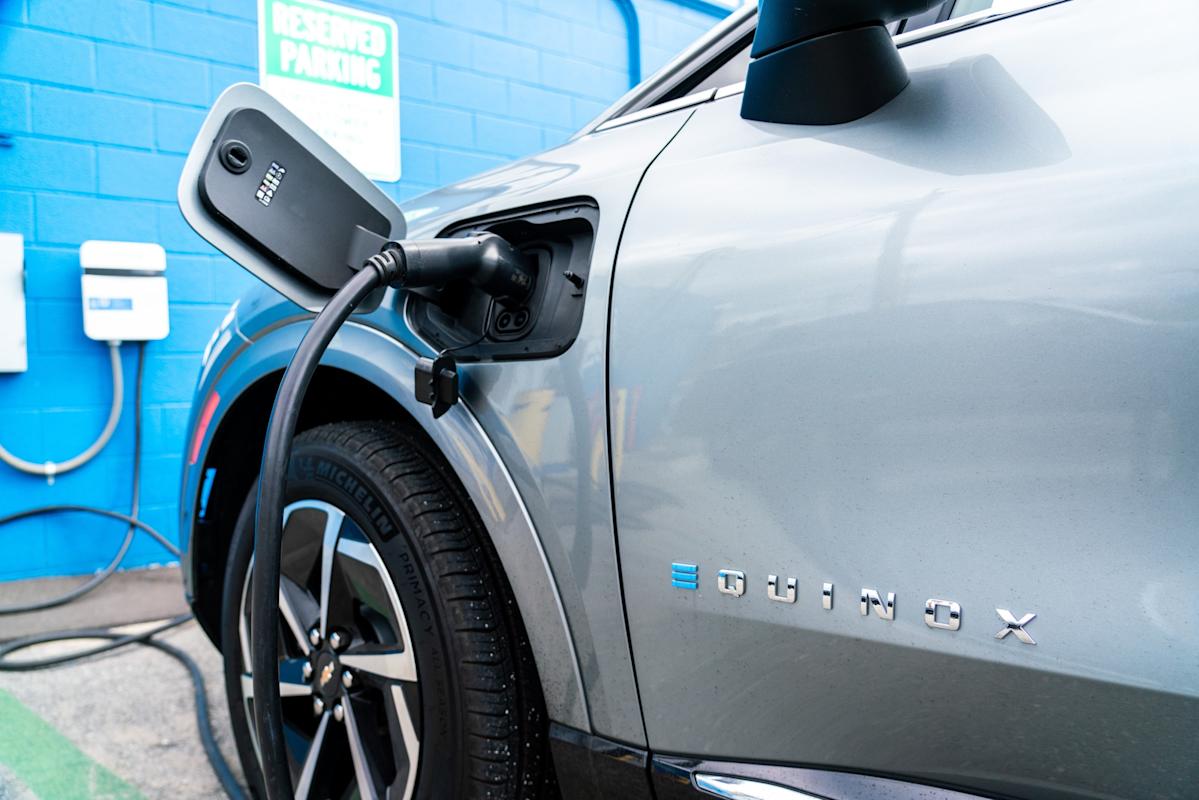
CarEdge, an AI-driven platform that helps car shoppers negotiate with dealerships, said search traffic for electric vehicles was up 20% in the week following the initial attack on Iran, compared with the prior week. For the most popular EVs, such as the Tesla Model Y and Chevrolet Equinox, traffic nearly doubled.
Since the initial barrage Feb. 28, the price of a gallon of regular gas in the US has climbed by 20% to $4.29 a gallon, a level not seen in almost three years. For the average American driver, that equates roughly to an extra $31 a month in fuel costs, though the financial pain will be greater for those driving luxury cars, which require more expensive gas, and those in less efficient vehicles; there are about 50 million Americans like Prichinello who pilot pickup trucks and another 10 million or so households with a large SUV.
The EV-curious will be spoiled for choice, at least for the time being. Once federal purchase incentives of up to $7,500 per vehicle expired at the end of September, sales of electric cars and trucks swooned by 36% in the recent quarter, compared to the year-earlier period. Though carmakers have been trimming EV production and culling future models, inventory levels for electric cars and trucks are nearly double that of internal-combustion vehicles.
Story Continues
Mind you, this is a relatively unprecedented moment. In the five or so years that EVs have been in the mass market, gas prices have largely been both low and stable. However, the one outlier was a spike to $5.36 per gallon in the summer of 2022 after Russia invaded Ukraine. Sales of battery-powered machines surged by 66% that year, a period that predated federal purchase incentives.
Drivers don’t forget that kind of thing, particularly when inflation is running hot. At the end of 2024, long after gas prices had cooled, car shoppers said saving on fuel was their No. 1 incentive to go electric, according to a study by Carvana LLC, a predominantly online used-car vendor.
Harvard Senior Fellow Elaine Buckberg, formerly chief economist for General Motors, said the duration of the inflated fuel prices may prove more telling than the initial spike. At the moment, high gas prices are likely only influencing people who are currently shopping for a car, she explained. But if gas prices stay high for three months or more, even folks who weren’t in the market for a new vehicle may get the EV itch.
“A second incident of major gasoline price volatility in under five years,” she added, “may make consumers more sensitive to this one.”
To be sure, high oil prices also push electricity rates, but not nearly by as much or as directly. Most of a US power bill goes to transmission and customer service; only about one quarter to one-third is tied to fuel costs. And as renewable energy gushed in recent years, oil and natural gas now comprise less than half of that fuel.
A typical electric vehicle uses about 7.5 kWh of electricity to travel 25 miles. At the moment, charging with household electricity, that power costs about $1.30 on average, far less than a gallon of gasoline. In some states, retail electricity can be double that amount or more, but those also tend to be places where fossil fuel prices are also higher than average.
Meanwhile, Itay Michaeli, an analyst at TD Cowen investment bank, says gas price volatility, more than a single spike, could keep driving consumers to electric vehicles. “You can kind of adjust to a higher price to some degree,” he explained. “But if it’s $4 a gallon, do you think it might go to $6? You just don’t know.”
Michaeli believes the country is poised for a surge in EV sales, as households with two or more cars decide at least one of their vehicles should be untethered from the gas station. In a report this week, he posited that the country could see demand for millions of new electric vehicles, virtually overnight.
“What’s been lost in the US narrative is we have this luxury of two vehicles per household,” he explained. “If you have an EV and an [internal combustion car], you haven’t really fully adopted the EV lifestyle; it’s a middle ground no one’s really talking about.”
Meanwhile, Buckberg, the former GM economist, said carmakers are likely weighing plans to add shifts for EV assembly lines and extend sunset dates for battery-powered machines they had planned to stop making. If gas prices stay high enough, they may also walk back plans to shrink EV product pipelines and begin to greenlight new models.
“They are running the math already,” Buckberg said, “but they are also thinking about how long high prices would last.”
Most Read from Bloomberg Businessweek
©2026 Bloomberg L.P.